Nanobiosensorics Laboratory, Institute of Technical Physics and Materials Science, Centre for Energy Research, Hungarian Academy of Sciences, Budapest, Hungary.
Department of Electronics Technology, Budapest University of Technology and Economics, Budapest, Hungary.
Sci Rep. 2019 Jul 16;9(1):10287. doi: 10.1038/s41598-019-46691-x.
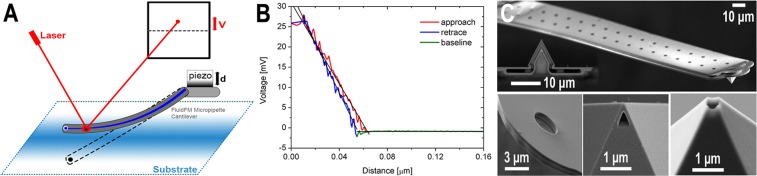
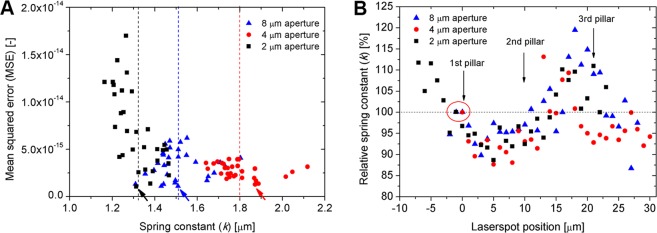
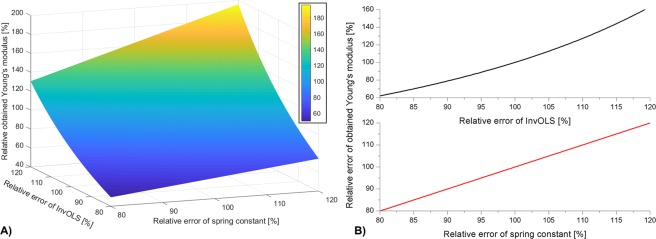
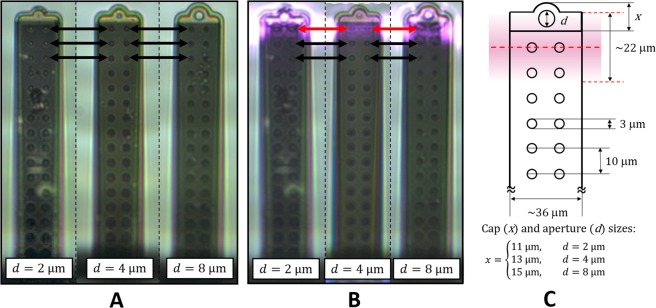
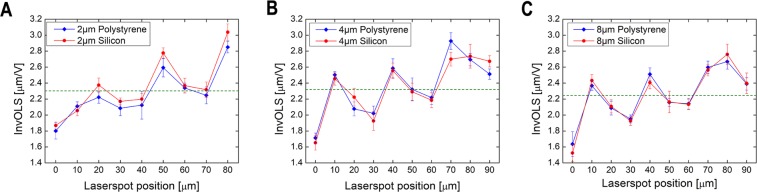
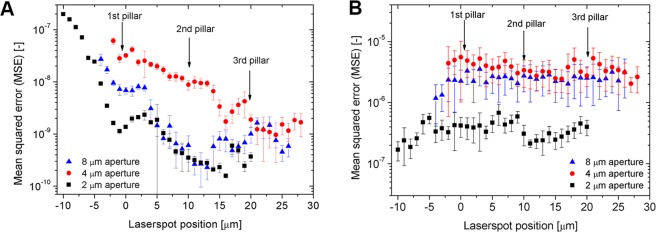
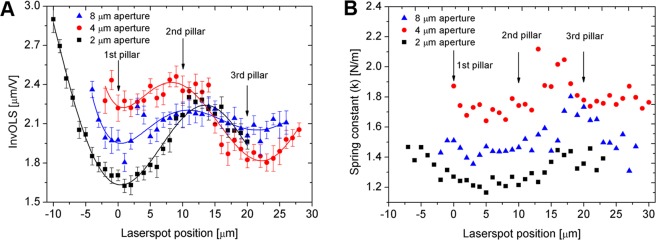
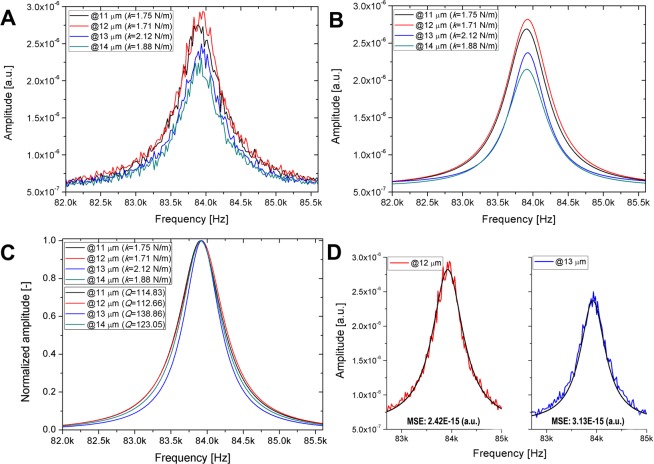
The fluidic force microscope (FluidFM) can be considered as the nanofluidic extension of the atomic force microscope (AFM). This novel instrument facilitates the experimental procedure and data acquisition of force spectroscopy (FS) and is also used for the determination of single-cell adhesion forces (SCFS) and elasticity. FluidFM uses special probes with an integrated nanochannel inside the cantilevers supported by parallel rows of pillars. However, little is known about how the properties of these hollow cantilevers affect the most important parameters which directly scale the obtained spectroscopic data: the inverse optical lever sensitivity (InvOLS) and the spring constant (k). The precise determination of these parameters during calibration is essential in order to gain reliable, comparable and consistent results with SCFS. Demonstrated by our literature survey, the standard error of previously published SCFS results obtained with FluidFM ranges from 11.8% to 50%. The question arises whether this can be accounted for biological diversity or may be the consequence of improper calibration. Thus the aim of our work was to investigate the calibration accuracy of these parameters and their dependence on: (1) the aperture size (2, 4 and 8 µm) of the hollow micropipette type cantilever; (2) the position of the laser spot on the back of the cantilever; (3) the substrate used for calibration (silicon or polystyrene). It was found that both the obtained InvOLS and spring constant values depend significantly on the position of the laser spot. Apart from the theoretically expectable monotonous increase in InvOLS (from the tip to the base of the cantilever, as functions of the laser spot's position), we discerned a well-defined and reproducible fluctuation, which can be as high as ±30%, regardless of the used aperture size or substrate. The calibration of spring constant also showed an error in the range of -13/+20%, measured at the first 40 µm of the cantilever. Based on our results a calibration strategy is proposed and the optimal laser position which yields the most reliable spring constant values was determined and found to be on the first pair of pillars. Our proposed method helps in reducing the error introduced via improper calibration and thus increases the reliability of subsequent cell adhesion force or elasticity measurements with FluidFM.
流体力显微镜(FluidFM)可以被认为是原子力显微镜(AFM)的纳流控延伸。这种新型仪器简化了力谱学(FS)的实验过程和数据采集,也用于测定单细胞粘附力(SCFS)和弹性。FluidFM 使用带有集成纳米通道的特殊探针,探针支撑在平行的柱子行之间的悬臂上。然而,对于这些中空悬臂的特性如何影响直接缩放获得的光谱数据的最重要参数(反向光学杠杆灵敏度(InvOLS)和弹簧常数(k)),人们知之甚少。在进行校准的过程中,精确地确定这些参数是至关重要的,这样才能获得可靠、可比和一致的 SCFS 结果。我们的文献综述表明,之前使用 FluidFM 获得的 SCFS 结果的标准误差范围为 11.8%至 50%。问题是,这是否可以归因于生物多样性,或者可能是由于校准不当的结果。因此,我们工作的目的是研究这些参数的校准精度及其对以下方面的依赖性:(1)中空微管型悬臂的孔径尺寸(2、4 和 8 µm);(2)激光光斑在悬臂背面的位置;(3)用于校准的基底(硅或聚苯乙烯)。结果发现,获得的 InvOLS 和弹簧常数值都显著依赖于激光光斑的位置。除了理论上可以预料的 InvOLS(从悬臂的尖端到根部,随着激光光斑位置的函数单调增加)单调增加之外,我们还发现了一种明确且可重复的波动,其幅度可高达±30%,无论使用的孔径尺寸或基底如何。弹簧常数的校准也显示出误差范围在-13%/+20%,在悬臂的前 40 µm 处进行测量。基于我们的结果,提出了一种校准策略,并确定了产生最可靠弹簧常数值的最佳激光位置,该位置位于第一对柱子上。我们提出的方法有助于减少由于校准不当引入的误差,从而提高后续使用 FluidFM 进行单细胞粘附力或弹性测量的可靠性。