Department of Reproductive Medicine, Division of Gynecology and Reproduction, Karolinska University Hospital, Novumhuset Plan 4, 141 86, Stockholm, Sweden.
Wunschbaby Institut Feichtinger, Vienna, Austria.
J Assist Reprod Genet. 2019 Aug;36(8):1649-1656. doi: 10.1007/s10815-019-01519-5. Epub 2019 Jul 16.
To investigate the impact of symptomatic and surgically confirmed endometriosis on ovarian sensitivity index (OSI) and cumulative live-birth rates (LBR) using predominantly single embryo transfer (SET).
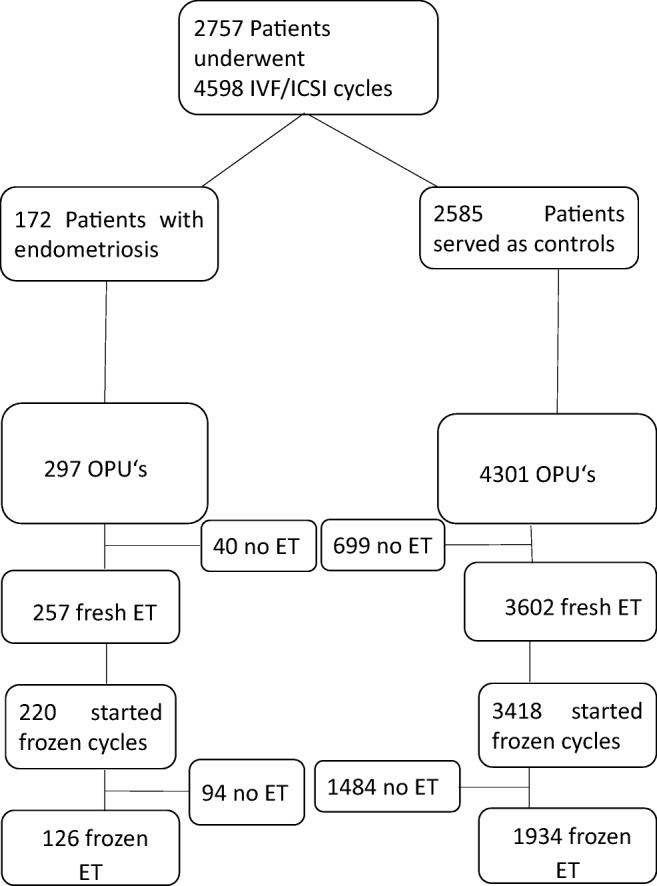
Cross-sectional case-control study in a University-based ART program. Women with symptomatic and surgically confirmed endometriosis (N = 172), who underwent IVF/ICSI at Karolinska University Hospital were compared to controls without clinically suspected endometriosis (N = 2585). Two thousand seven hundred fifty-seven patients underwent 8236 treatment cycles (4598 fresh and 3638 frozen cycles). Primary outcome measures included Ovarian Sensitivity Index (OSI) estimated as collected oocytes/FSH dose and cumulative LBR/oocyte pickup (OPU). Generalized estimated equation (GEE) model accounting for dependencies between consecutive treatments were applied. Secondary outcomes included number of oocytes, pregnancy rate per OPU and per ET, LBR per ET, and miscarriage rate.
Patients diagnosed with endometriosis had significantly fewer oocytes collected (8.47 vs. 9.54, p = 0.015) and lower OSI (p = 0.011) than controls. There were no differences in cycle cancelations (p = 0.59) or miscarriages (p = 0.95) between the two groups. Cumulative LBR/OPU did not differ between women with endometriosis and controls (35.6% vs. 34.7%, respectively, p = 0.83). In both groups, more than 60% of women had consecutive FETs after fresh ETs (p = 0.49) with SET in > 70% of cases. The results were similar whether ovarian endometrioma was present or not.
Our data support that a diagnosis of endometriosis, with or without present endometrioma, does not negatively affect ART cumulative results. The impact of endometriosis was discernible on OSI but not on clinical relevant outcomes including pregnancy and LBR.
使用主要的单胚胎移植(SET)技术,研究有症状和经手术证实的子宫内膜异位症对卵巢敏感指数(OSI)和累积活产率(LBR)的影响。
这是一项在大学辅助生殖技术(ART)项目中进行的横断面病例对照研究。在卡罗林斯卡大学医院接受体外受精/卵胞浆内单精子注射(IVF/ICSI)的有症状和经手术证实的子宫内膜异位症患者(n=172)与无临床疑似子宫内膜异位症的对照组患者(n=2585)进行比较。2757 名患者进行了 8236 个治疗周期(4598 个新鲜周期和 3638 个冷冻周期)。主要结局指标包括作为采集的卵母细胞/FSH 剂量和累积活产率/卵母细胞采集(OPU)估计的卵巢敏感性指数(OSI)。应用了考虑连续治疗之间相关性的广义估计方程(GEE)模型。次要结局指标包括卵母细胞数量、每 OPU 和每 ET 的妊娠率、每 ET 的活产率和流产率。
与对照组相比,诊断为子宫内膜异位症的患者采集的卵母细胞数量明显较少(8.47 个 vs. 9.54 个,p=0.015),OSI 也较低(p=0.011)。两组之间的周期取消率(p=0.59)或流产率(p=0.95)没有差异。子宫内膜异位症患者和对照组的累积活产率/OPU 也没有差异(分别为 35.6%和 34.7%,p=0.83)。在两组中,超过 60%的女性在新鲜 ET 后进行了连续的 FET(p=0.49),其中超过 70%的情况下进行了 SET。无论是否存在卵巢子宫内膜异位囊肿,结果都是相似的。
我们的数据支持有或没有卵巢子宫内膜异位症的子宫内膜异位症诊断不会对 ART 的累积结果产生负面影响。子宫内膜异位症的影响可在 OSI 上体现出来,但对包括妊娠和活产率在内的临床相关结局没有影响。