Morris Animal Foundation, Denver, Colorado, United States of America.
American Kennel Club Canine Health Foundation, INC, Raleigh, North Carolina, United States of America.
PLoS One. 2019 Jul 17;14(7):e0209131. doi: 10.1371/journal.pone.0209131. eCollection 2019.
In the United States, gonadectomy is common and widely promoted as a component of responsible pet ownership. The recent publication of several studies examining the effect of gonadectomy on future health has challenged long-held assumptions and recommendations for gonadectomy in companion animals. The purpose of this study was to characterize the associations between gonadectomy and two outcomes: overweight/obesity and orthopedic injuries, in a large prospective study of Golden Retrievers.
Age at gonadectomy was divided into four categories: intact (reference), ≤ 6 months, > 6 months ‒ ≤ 12 months, and > 12 months. Dogs with a Purina Body Condition Score of 7 or greater were classified as overweight or obese. Orthopedic injuries considered were the first instance of veterinary-reported cranial cruciate ligament injury and clinically evident osteoarthritis. We performed survival analyses on a cohort of Golden Retrievers to estimate the associations of interest using proportional hazards. We adjusted for age at study enrollment, owner-reported activity level, and dog's sex.
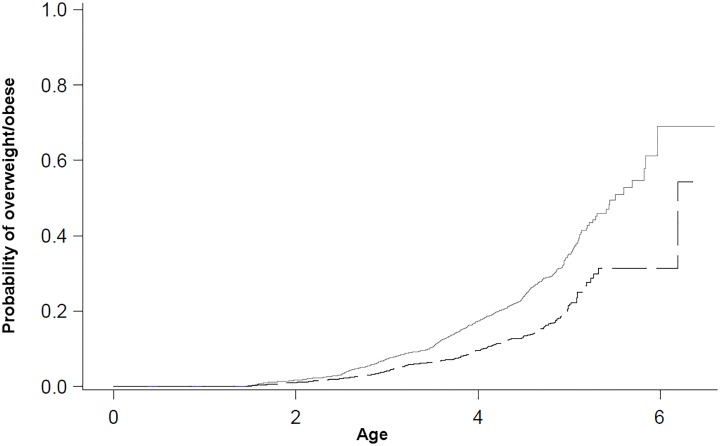
Compared to intact dogs, all gonadectomy age categories showed increased risk for the development of overweight/obesity. (≤ 6 months, HR: 1.81, 95% CI: 1.36-2.40), p-value: <0.0001; 6 months to ≤ 12 months, HR: 2.21, 95% CI: 1.77-2.73, p-value: < 0.0001; > 12 months, HR: 1.56, 95% CI: 1.24-1.96, p-value: 0.0001). Compared to intact dogs, dogs who were ≤ 6 months at gonadectomy had increased risk for orthopedic injury (HR: 4.06, 95% CI: 2.15-7.67, p-value: <0.00001).
This study presents prospectively acquired data demonstrating that gonadectomy is a risk factor for both overweight/obesity and chronic non-traumatic orthopedic injuries in a prospective cohort of Golden Retrievers. Our data suggest that gonadectomy at any age is a risk factor for overweight or obesity, but delaying gonadectomy until dogs are at least 6-12 months of age may help to decrease the risk for orthopedic injury.
在美国,去势是常见的,并且被广泛宣传为负责任的宠物拥有的一个组成部分。最近发表的几项研究检查了去势对未来健康的影响,这挑战了长期以来对伴侣动物去势的假设和建议。本研究的目的是在一项对金毛猎犬的大型前瞻性研究中,描述去势与两个结果之间的关联:超重/肥胖和骨科损伤。
去势年龄分为四个类别:完整(参考)、≤6 个月、>6 个月-≤12 个月和>12 个月。体况评分为 7 或更高的狗被归类为超重或肥胖。考虑的骨科损伤包括兽医报告的前十字韧带损伤和临床明显的骨关节炎的首次发生。我们对金毛猎犬队列进行生存分析,使用比例风险估计感兴趣的关联。我们调整了研究入组时的年龄、主人报告的活动水平和狗的性别。
与完整的狗相比,所有去势年龄组都显示出超重/肥胖发展的风险增加。(≤6 个月,HR:1.81,95%CI:1.36-2.40),p 值:<0.0001;6 个月至≤12 个月,HR:2.21,95%CI:1.77-2.73,p 值:<0.0001;>12 个月,HR:1.56,95%CI:1.24-1.96,p 值:0.0001)。与完整的狗相比,6 个月以内去势的狗有更高的骨科损伤风险(HR:4.06,95%CI:2.15-7.67,p 值:<0.00001)。
本研究前瞻性地获得了数据,证明去势是金毛猎犬前瞻性队列中超重/肥胖和慢性非创伤性骨科损伤的一个危险因素。我们的数据表明,任何年龄的去势都是超重或肥胖的一个危险因素,但将去势推迟到狗至少 6-12 个月大可能有助于降低骨科损伤的风险。