Wen Fang, Wu Zhang-Ying, Nie Lei, Zhang Qi-Zhu, Qin Yuan-Kun, Zhou Zun-Lun, Wu Jin-Jian, Zhao Xing, Tan Jun, Sawmiller Darrell, Zi Dan
Department of Obstetrics and Gynecology, Affiliated Hospital of Guizhou Medical University, Guiyang 550004, Guizhou, China.
National and Guizhou Joint Engineering Laboratory for Cell Engineering and Biomedicine Technique, Center for Tissue Engineering and Stem Cell Research, Guizhou Province Key Laboratory of Regenerative Medicine, Guizhou Medical University, Guiyang 550004, Guizhou, China.
Biosci Rep. 2019 Aug 5;39(8). doi: 10.1042/BSR20191124. Print 2019 Aug 30.
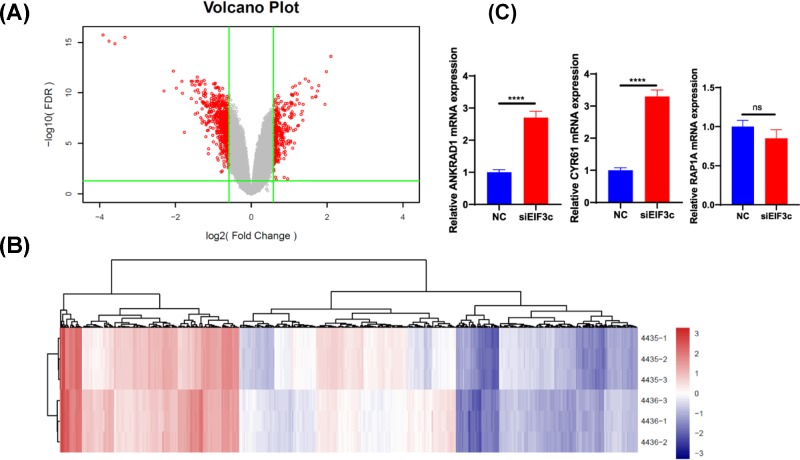
Ovarian cancer remains the leading cause of death among all gynaecological cancers, illustrating the urgent need to understand the molecular mechanisms involved in this disease. Eukaryotic initiation factor 3c (EIF3c) plays an important role in protein translation and cancer cell growth and proliferation, but its role in human ovarian cancer is unclear. Our results showed that EIF3c silencing significantly up-regulated 217 and down-regulated 340 genes. Ingenuity Pathway Analysis (IPA) indicated that the top differentially expressed genes are involved in 'Classical Pathways', 'Diseases and Functions' and 'Networks', especially those involved in signalling and cellular growth and proliferation. In addition, eIF3c silencing inhibited cellular proliferation, enhanced apoptosis and regulated the expression of apoptosis-associated proteins. In conclusion, these results indicate that by dysregulating translational initiation, eIF3c plays an important role in the proliferation and survival of human ovarian cancer cells. These results should provide experimental directions for further in-depth studies on important human ovarian cancer cell pathways.
卵巢癌仍是所有妇科癌症中导致死亡的主要原因,这表明迫切需要了解该疾病所涉及的分子机制。真核生物起始因子3c(EIF3c)在蛋白质翻译以及癌细胞的生长和增殖中发挥重要作用,但其在人类卵巢癌中的作用尚不清楚。我们的结果表明,EIF3c沉默显著上调了217个基因并下调了340个基因。 Ingenuity通路分析(IPA)表明,差异表达最显著的基因涉及“经典通路”、“疾病与功能”和“网络”,特别是那些参与信号传导以及细胞生长和增殖的基因。此外,eIF3c沉默抑制细胞增殖,增强细胞凋亡并调节凋亡相关蛋白的表达。总之,这些结果表明,通过失调翻译起始,eIF3c在人类卵巢癌细胞的增殖和存活中发挥重要作用。这些结果应为进一步深入研究重要的人类卵巢癌细胞通路提供实验方向。