• 文献检索
  • 文档翻译
  • 深度研究
  • 学术资讯
  • Suppr Zotero 插件Zotero 插件
  • 邀请有礼
  • 套餐&价格
  • 历史记录
应用&插件
Suppr Zotero 插件Zotero 插件浏览器插件Mac 客户端Windows 客户端微信小程序
定价
高级版会员购买积分包购买API积分包
服务
文献检索文档翻译深度研究API 文档MCP 服务
关于我们
关于 Suppr公司介绍联系我们用户协议隐私条款
关注我们

Suppr 超能文献

核心技术专利:CN118964589B侵权必究
粤ICP备2023148730 号-1Suppr @ 2026

文献检索

告别复杂PubMed语法,用中文像聊天一样搜索,搜遍4000万医学文献。AI智能推荐,让科研检索更轻松。

立即免费搜索

文件翻译

保留排版,准确专业,支持PDF/Word/PPT等文件格式,支持 12+语言互译。

免费翻译文档

深度研究

AI帮你快速写综述,25分钟生成高质量综述,智能提取关键信息,辅助科研写作。

立即免费体验

眼动追踪技术在日常生活环境中的应用揭示了能够促进婴儿与父母眼神交流的人际距离。

Eye tracking in an everyday environment reveals the interpersonal distance that affords infant-parent gaze communication.

机构信息

Graduate School of Letters, Kyoto University, Yoshida Honmachi, Sakyo-ku, Kyoto, 606-8501, Japan.

Faculty of Human Development, University of Toyama, 3190 Gofuku, Toyama, 930-8555, Japan.

出版信息

Sci Rep. 2019 Jul 17;9(1):10352. doi: 10.1038/s41598-019-46650-6.

DOI:10.1038/s41598-019-46650-6
PMID:31316101
原文链接:https://pmc.ncbi.nlm.nih.gov/articles/PMC6637119/
Abstract

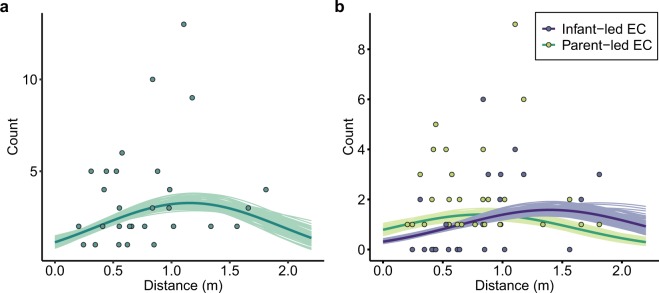
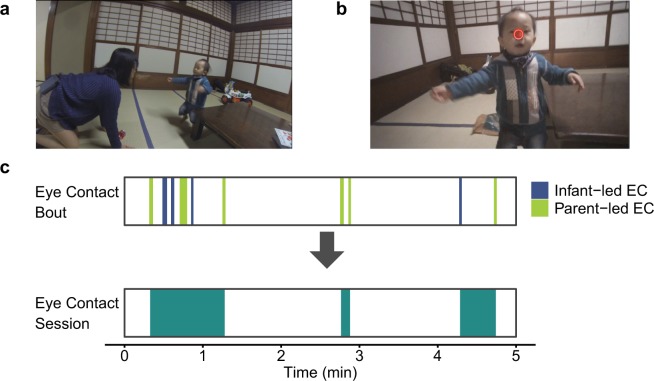
The unique morphology of human eyes enables gaze communication at various ranges of interpersonal distance. Although gaze communication contributes to infants' social development, little is known about how infant-parent distance affects infants' visual experience in daily gaze communication. The present study conducted longitudinal observations of infant-parent face-to-face interactions in the home environment as 5 infants aged from 10 to 15.5 months. Using head-mounted eye trackers worn by parents, we evaluated infants' daily visual experience of 3138 eye contact scenes recorded from the infants' second-person perspective. The results of a hierarchical Bayesian statistical analysis suggest that certain levels of interpersonal distance afforded smooth interaction with eye contact. Eye contacts were not likely to be exchanged when the infant and parent were too close or too far apart. The number of continuing eye contacts showed an inverse U-shaped pattern with interpersonal distance, regardless of whether the eye contact was initiated by the infant or the parent. However, the interpersonal distance was larger when the infant initiated the eye contact than when the parent initiated it, suggesting that interpersonal distance affects the infant's and parent's social look differently. Overall, the present study indicates that interpersonal distance modulates infant-parent gaze communication.

摘要

人类眼睛独特的形态使目光能够在各种人际距离范围内进行交流。虽然目光交流有助于婴儿的社会发展,但对于婴儿与父母的距离如何影响婴儿在日常目光交流中的视觉体验,我们知之甚少。本研究对 5 名 10 至 15.5 个月大的婴儿在家庭环境中的母婴面对面互动进行了纵向观察。我们使用父母佩戴的头戴式眼动追踪器,评估了从婴儿第二人称视角记录的 3138 个目光接触场景中婴儿的日常视觉体验。分层贝叶斯统计分析的结果表明,在一定的人际距离范围内,目光接触可以实现流畅的互动。当婴儿和父母靠得太近或太远时,他们不太可能进行目光接触。无论目光接触是由婴儿还是父母发起的,连续的目光接触次数都呈现出与人际距离的倒 U 型关系。然而,当婴儿发起目光接触时,人际距离比父母发起时更大,这表明人际距离对婴儿和父母的社交注视有不同的影响。总的来说,本研究表明人际距离调节了母婴之间的目光交流。
https://cdn.ncbi.nlm.nih.gov/pmc/blobs/4bf0/6637119/136524352d75/41598_2019_46650_Fig2_HTML.jpg
https://cdn.ncbi.nlm.nih.gov/pmc/blobs/4bf0/6637119/9055b12a33fc/41598_2019_46650_Fig1_HTML.jpg
https://cdn.ncbi.nlm.nih.gov/pmc/blobs/4bf0/6637119/136524352d75/41598_2019_46650_Fig2_HTML.jpg
https://cdn.ncbi.nlm.nih.gov/pmc/blobs/4bf0/6637119/9055b12a33fc/41598_2019_46650_Fig1_HTML.jpg
https://cdn.ncbi.nlm.nih.gov/pmc/blobs/4bf0/6637119/136524352d75/41598_2019_46650_Fig2_HTML.jpg

相似文献

1
Eye tracking in an everyday environment reveals the interpersonal distance that affords infant-parent gaze communication.眼动追踪技术在日常生活环境中的应用揭示了能够促进婴儿与父母眼神交流的人际距离。
Sci Rep. 2019 Jul 17;9(1):10352. doi: 10.1038/s41598-019-46650-6.
2
Transition From Crawling to Walking Changes Gaze Communication Space in Everyday Infant-Parent Interaction.从爬行到行走的转变改变了日常婴儿与父母互动中的注视交流空间。
Front Psychol. 2020 Jan 24;10:2987. doi: 10.3389/fpsyg.2019.02987. eCollection 2019.
3
Development of adaptive communication skills in infants of blind parents.发展盲童父母的婴儿适应性沟通技巧。
Dev Psychol. 2018 Dec;54(12):2265-2273. doi: 10.1037/dev0000564. Epub 2018 Oct 18.
4
The importance of the eyes: communication skills in infants of blind parents.眼睛的重要性:盲童父母的沟通技巧。
Proc Biol Sci. 2013 Apr 10;280(1760):20130436. doi: 10.1098/rspb.2013.0436. Print 2013 Jun 7.
5
Selective Medial Prefrontal Cortex Responses During Live Mutual Gaze Interactions in Human Infants: An fNIRS Study.人类婴儿实时相互注视互动过程中内侧前额叶皮质的选择性反应:一项功能近红外光谱研究
Brain Topogr. 2015 Sep;28(5):691-701. doi: 10.1007/s10548-014-0414-2. Epub 2014 Nov 4.
6
Head-mounted eye tracking: a new method to describe infant looking.头戴式眼动追踪:一种描述婴儿注视的新方法。
Child Dev. 2011 Nov-Dec;82(6):1738-50. doi: 10.1111/j.1467-8624.2011.01670.x. Epub 2011 Oct 24.
7
Early Social Experience Affects the Development of Eye Gaze Processing.早期社会经历影响目光注视加工的发展。
Curr Biol. 2015 Dec 7;25(23):3086-91. doi: 10.1016/j.cub.2015.10.019. Epub 2015 Nov 19.
8
Infant neural sensitivity to eye gaze depends on early experience of gaze communication.婴儿对眼神注视的神经敏感性取决于早期眼神交流的经验。
Dev Cogn Neurosci. 2018 Nov;34:1-6. doi: 10.1016/j.dcn.2018.05.007. Epub 2018 May 26.
9
The Role of Common Ground on Object Use in Shaping the Function of Infants' Social Gaze.共同基础在物体使用中对塑造婴儿社交注视功能的作用。
Front Psychol. 2020 Apr 16;11:619. doi: 10.3389/fpsyg.2020.00619. eCollection 2020.
10
Virtual social interactions in social anxiety--the impact of sex, gaze, and interpersonal distance.社交焦虑中的虚拟社交互动——性别、注视和人际距离的影响。
Cyberpsychol Behav Soc Netw. 2010 Oct;13(5):547-54. doi: 10.1089/cyber.2009.0432. Epub 2010 Apr 3.

引用本文的文献

1
The Association Between Pointing and Walking in Infants: A Longitudinal Observational Study.婴儿指物与行走之间的关联:一项纵向观察研究。
Infancy. 2025 Jul-Aug;30(4):e70037. doi: 10.1111/infa.70037.
2
Why the gaze behavior of expert physicians and novice medical students differ during a simulated medical interview: A mixed methods study.模拟医学问诊期间专家医生与医学专业新手学生的注视行为为何不同:一项混合方法研究。
PLoS One. 2025 Jan 2;20(1):e0315405. doi: 10.1371/journal.pone.0315405. eCollection 2025.
3
Face-Looking as a Real-Time Process in Mind-Mindedness: Timely Coordination Between Mothers' Gaze on Infants' Faces and Mind-Related Comments.

本文引用的文献

1
The Developing Infant Creates a Curriculum for Statistical Learning.发展中的婴儿为统计学习制定课程。
Trends Cogn Sci. 2018 Apr;22(4):325-336. doi: 10.1016/j.tics.2018.02.004. Epub 2018 Mar 5.
2
See and be seen: Infant-caregiver social looking during locomotor free play.看与被看:婴儿-照顾者在自由移动游戏中的社交目光接触。
Dev Sci. 2018 Jul;21(4):e12626. doi: 10.1111/desc.12626. Epub 2017 Oct 26.
3
Hand-Eye Coordination Predicts Joint Attention.手眼协调预测共同注意。
面孔识别即心灵感应的实时过程:母亲注视婴儿面部与心理相关评论之间的及时协调。
Infancy. 2025 Jan-Feb;30(1):e12644. doi: 10.1111/infa.12644.
4
The relationship between interpersonal distance preference and estimation accuracy in autism.自闭症个体人际距离偏好与估计准确性的关系。
PLoS One. 2024 Sep 9;19(9):e0306536. doi: 10.1371/journal.pone.0306536. eCollection 2024.
5
Dynamics of the dyad: How mothers and infants co-construct interaction spaces during object play.母子互动的动态:在物体游戏中,母亲和婴儿如何共同构建互动空间。
Dev Sci. 2023 Mar;26(2):e13281. doi: 10.1111/desc.13281. Epub 2022 May 30.
6
"Dancing" Together: Infant-Mother Locomotor Synchrony.“共舞”:母婴运动同步
Child Dev. 2021 Jul;92(4):1337-1353. doi: 10.1111/cdev.13513. Epub 2021 Jan 21.
7
Eye tracking in human interaction: Possibilities and limitations.眼动追踪在人类交互中的应用:可能性与局限性。
Behav Res Methods. 2021 Aug;53(4):1592-1608. doi: 10.3758/s13428-020-01517-x. Epub 2021 Jan 6.
8
Head and body structure infants' visual experiences during mobile, naturalistic play.头部和身体结构 婴儿在移动的、自然主义游戏中的视觉体验。
PLoS One. 2020 Nov 10;15(11):e0242009. doi: 10.1371/journal.pone.0242009. eCollection 2020.
9
What are the building blocks of parent-infant coordinated attention in free-flowing interaction?在自然流畅的互动中,亲子共同注意的构成要素是什么?
Infancy. 2020 Nov;25(6):871-887. doi: 10.1111/infa.12365. Epub 2020 Oct 6.
10
Transition From Crawling to Walking Changes Gaze Communication Space in Everyday Infant-Parent Interaction.从爬行到行走的转变改变了日常婴儿与父母互动中的注视交流空间。
Front Psychol. 2020 Jan 24;10:2987. doi: 10.3389/fpsyg.2019.02987. eCollection 2019.
Child Dev. 2017 Nov;88(6):2060-2078. doi: 10.1111/cdev.12730. Epub 2017 Feb 10.
4
Brief Report: Using a Point-of-View Camera to Measure Eye Gaze in Young Children with Autism Spectrum Disorder During Naturalistic Social Interactions: A Pilot Study.简短报告:在自然主义社交互动中使用视角摄像头测量自闭症谱系障碍幼儿的目光注视:一项初步研究。
J Autism Dev Disord. 2017 Mar;47(3):898-904. doi: 10.1007/s10803-016-3002-3.
5
Why are faces denser in the visual experiences of younger than older infants?为什么在视觉体验中,年龄较小的婴儿比年龄较大的婴儿看到的面孔更密集?
Dev Psychol. 2017 Jan;53(1):38-49. doi: 10.1037/dev0000230.
6
Real-world visual statistics and infants' first-learned object names.现实世界的视觉统计与婴儿最早习得的物体名称。
Philos Trans R Soc Lond B Biol Sci. 2017 Jan 5;372(1711). doi: 10.1098/rstb.2016.0055.
7
Infant Social Development across the Transition from Crawling to Walking.婴儿从爬行到行走过渡阶段的社会发展
Front Psychol. 2016 Jun 27;7:960. doi: 10.3389/fpsyg.2016.00960. eCollection 2016.
8
From faces to hands: Changing visual input in the first two years.从面部到双手:头两年视觉输入的变化
Cognition. 2016 Jul;152:101-107. doi: 10.1016/j.cognition.2016.03.005. Epub 2016 Apr 1.
9
Multiple Sensory-Motor Pathways Lead to Coordinated Visual Attention.多条感觉运动通路导致协调的视觉注意力。
Cogn Sci. 2017 Feb;41 Suppl 1(Suppl 1):5-31. doi: 10.1111/cogs.12366. Epub 2016 Mar 25.
10
Contributions of head-mounted cameras to studying the visual environments of infants and young children.头戴式摄像头在婴幼儿视觉环境研究中的作用。
J Cogn Dev. 2015;16(3):407-419. doi: 10.1080/15248372.2014.933430.