Wink Alle Meije
Radiology and Nuclear Medicine, Amsterdam University Medical Center, Amsterdam, Netherlands.
Front Neurosci. 2019 Jun 27;13:648. doi: 10.3389/fnins.2019.00648. eCollection 2019.
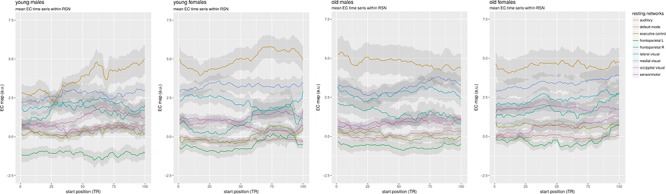
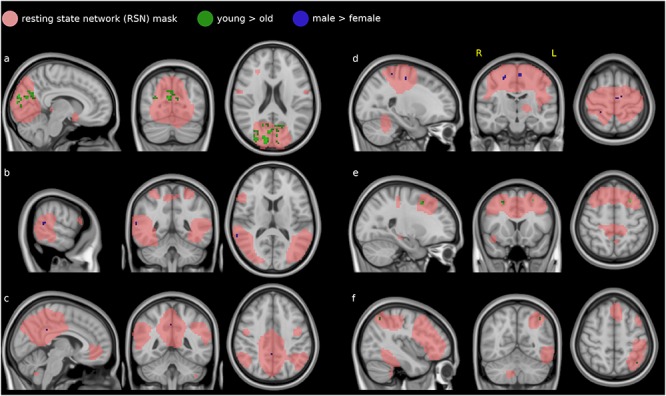
With the increasing use of functional brain network properties as markers of brain disorders, efficient visualization and evaluation methods have become essential. Eigenvector centrality mapping (ECM) of functional MRI (fMRI) data enables the representation of per-node graph theoretical measures as brain maps. This paper studies the use of centrality dynamics for measuring group differences in imaging studies. Imaging data were used from a publicly available imaging study, which included resting fMRI data. After warping the images to a standard space and masking cortical regions, ECM were computed in a sliding window. The dual regression method was used to identify dynamic centrality differences inside well-known resting-state networks between gender and age groups. Gender-related differences were found in the medial and lateral visual, motor, default mode, and executive control RSN, where male subjects had more consistent centrality variations within the network. Age-related differences between the youngest and oldest subjects, based on a median split, were found in the medial visual, executive control and left frontoparietal networks, where younger subjects had more consistent centrality variations within the network. Our findings show that centrality dynamics can be used to identify between-group functional brain network centrality differences, and that age and gender distributions studies need to be taken into account in functional imaging studies.
随着将功能性脑网络属性用作脑部疾病标志物的应用日益增多,高效的可视化和评估方法变得至关重要。功能磁共振成像(fMRI)数据的特征向量中心性映射(ECM)能够将每个节点的图论测量值表示为脑图谱。本文研究了在成像研究中使用中心性动态变化来测量组间差异。成像数据来自一项公开的成像研究,其中包括静息态fMRI数据。在将图像扭曲到标准空间并掩蔽皮质区域后,在滑动窗口中计算ECM。采用双回归方法来识别性别和年龄组之间在知名静息态网络内的动态中心性差异。在内侧和外侧视觉、运动、默认模式和执行控制静息态网络中发现了与性别相关的差异,男性受试者在网络内具有更一致的中心性变化。基于中位数分割,在最年轻和最年长受试者之间发现了在内侧视觉、执行控制和左额顶叶网络中的年龄相关差异,年轻受试者在网络内具有更一致的中心性变化。我们的研究结果表明,中心性动态变化可用于识别组间功能性脑网络中心性差异,并且在功能成像研究中需要考虑年龄和性别分布研究。