Borthakur Ayon, Cleland Thomas A
Computational Physiology Laboratory, Field of Computational Biology, Cornell University, Ithaca, NY, United States.
Computational Physiology Laboratory, Department of Psychology, Cornell University, Ithaca, NY, United States.
Front Neurosci. 2019 Jun 27;13:656. doi: 10.3389/fnins.2019.00656. eCollection 2019.
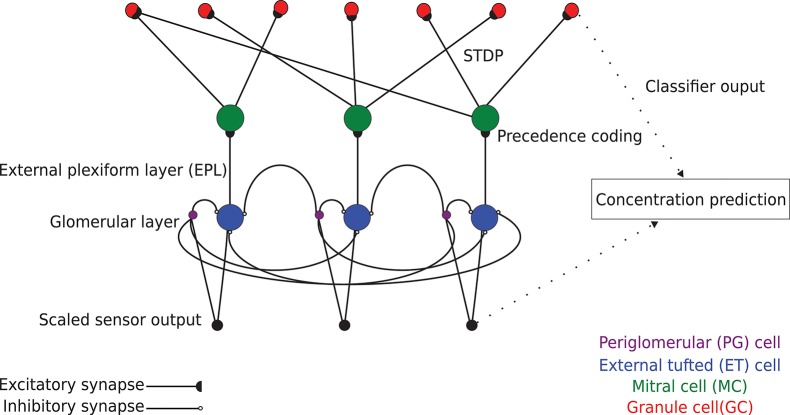
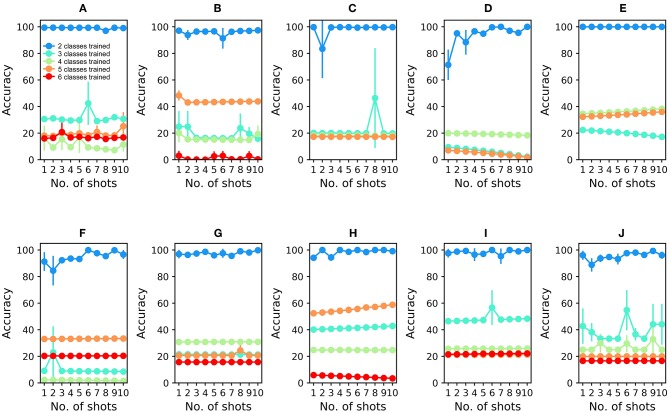
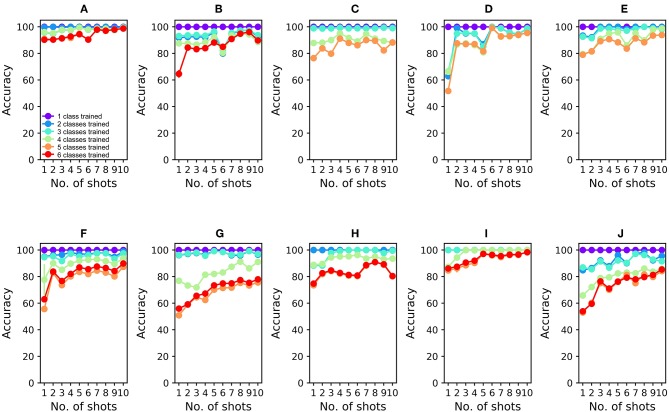
We have developed a spiking neural network (SNN) algorithm for signal restoration and identification based on principles extracted from the mammalian olfactory system and broadly applicable to input from arbitrary sensor arrays. For interpretability and development purposes, we here examine the properties of its initial feedforward projection. Like the full algorithm, this feedforward component is fully spike timing-based, and utilizes online learning based on local synaptic rules such as spike timing-dependent plasticity (STDP). Using an intermediate metric to assess the properties of this initial projection, the feedforward network exhibits high classification performance after few-shot learning without catastrophic forgetting, and includes a outcome to reflect classifier confidence. We demonstrate online learning performance using a publicly available machine olfaction dataset with challenges including relatively small training sets, variable stimulus concentrations, and 3 years of sensor drift.
我们基于从哺乳动物嗅觉系统中提取的原理,开发了一种用于信号恢复和识别的脉冲神经网络(SNN)算法,该算法广泛适用于来自任意传感器阵列的输入。为了便于解释和开发,我们在此研究其初始前馈投影的特性。与完整算法一样,该前馈组件完全基于脉冲时间,并且利用基于局部突触规则(如脉冲时间依赖可塑性(STDP))的在线学习。通过使用中间指标来评估此初始投影的特性,前馈网络在少样本学习后表现出高分类性能且不会发生灾难性遗忘,并且包含一个反映分类器置信度的结果。我们使用一个公开可用的机器嗅觉数据集展示在线学习性能,该数据集面临的挑战包括相对较小的训练集、可变的刺激浓度以及3年的传感器漂移。