Wen Luan, He Cara, Sifuentes Christopher J, Denver Robert J
Department of Molecular, Cellular and Developmental Biology, The University of Michigan, Ann Arbor, MI, United States.
Front Endocrinol (Lausanne). 2019 Jun 28;10:396. doi: 10.3389/fendo.2019.00396. eCollection 2019.
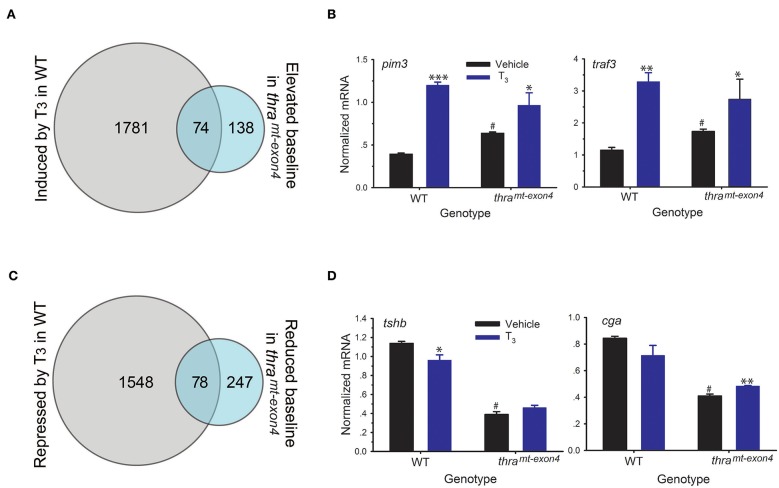
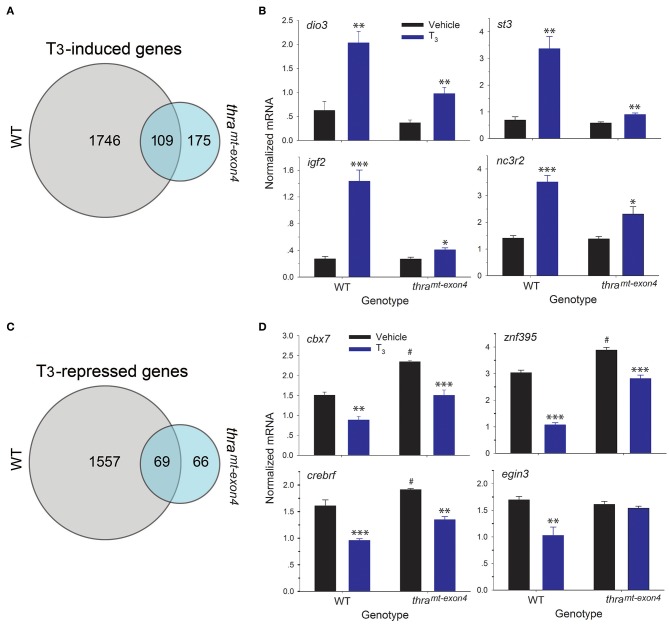
Thyroid hormone (T) plays several key roles in development of the nervous system in vertebrates, controlling diverse processes such as neurogenesis, cell migration, apoptosis, differentiation, and maturation. In anuran amphibians, the hormone exerts its actions on the tadpole brain during metamorphosis, a developmental period dependent on T. Thyroid hormone regulates gene transcription by binding to two nuclear receptors, TRα and TRβ. Our previous findings using pharmacological and other approaches supported that TRα plays a pivotal role in mediating T actions on neural cell proliferation in tadpole brain. Here we used tadpoles with an inactivating mutation in the gene that encodes TRα to investigate roles for TRα in mitosis and gene regulation in tadpole brain. Gross morphological analysis showed that mutant tadpoles had proportionally smaller brains, corrected for body size, compared with wildtype, both during prometamorphosis and at the completion of metamorphosis. This was reflected in a large reduction in phosphorylated histone 3 (pH3; a mitosis marker) immunoreactive (ir) nuclei in prometamorphic tadpole brain, when T-dependent cell proliferation is maximal. Treatment of wild type premetamorphic tadpoles with T for 48 h induced gross morphological changes in the brain, and strongly increased pH3-ir, but had no effect in mutant tadpoles. Thyroid hormone induction of the direct TR target genes , and was dysregulated in mutant tadpoles. Analysis of gene expression by RNA sequencing in the brain of premetamorphic tadpoles treated with or without T for 16 h showed that the TRα accounts for 95% of the gene regulation responses to T.
甲状腺激素(T)在脊椎动物神经系统发育中发挥着几个关键作用,控制着神经发生、细胞迁移、细胞凋亡、分化和成熟等多种过程。在无尾两栖动物中,该激素在变态发育期间对蝌蚪大脑发挥作用,变态发育是一个依赖甲状腺激素的发育阶段。甲状腺激素通过与两种核受体TRα和TRβ结合来调节基因转录。我们之前使用药理学和其他方法的研究结果支持TRα在介导甲状腺激素对蝌蚪大脑神经细胞增殖的作用中起关键作用。在这里,我们使用编码TRα的基因发生失活突变的蝌蚪来研究TRα在蝌蚪大脑有丝分裂和基因调控中的作用。大体形态学分析表明,与野生型相比,在变态前期和变态完成时,经体型校正后,突变型蝌蚪的大脑比例较小。这反映在变态前期蝌蚪大脑中磷酸化组蛋白3(pH3;一种有丝分裂标记物)免疫反应性(ir)细胞核大幅减少,此时依赖甲状腺激素的细胞增殖最为活跃。用甲状腺激素处理野生型变态前蝌蚪48小时会诱导大脑发生大体形态变化,并强烈增加pH3-ir,但对突变型蝌蚪没有影响。甲状腺激素对直接TR靶基因的诱导在突变型蝌蚪中失调。对用或不用甲状腺激素处理16小时的变态前蝌蚪大脑进行RNA测序分析基因表达,结果表明TRα占对甲状腺激素基因调控反应的95%。