Hope Kevin A, Flatten Daniel, Cavitch Peter, May Ben, Sutcliffe James S, O'Donnell Janis, Reiter Lawrence T
Integrated Program in Biological Sciences, The University of Tennessee Health Science Center, Memphis, TN, United States.
Department of Neurology, The University of Tennessee Health Science Center, Memphis, TN, United States.
Front Genet. 2019 Jun 19;10:574. doi: 10.3389/fgene.2019.00574. eCollection 2019.
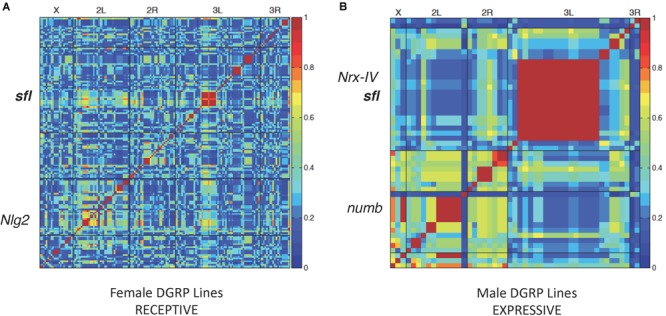
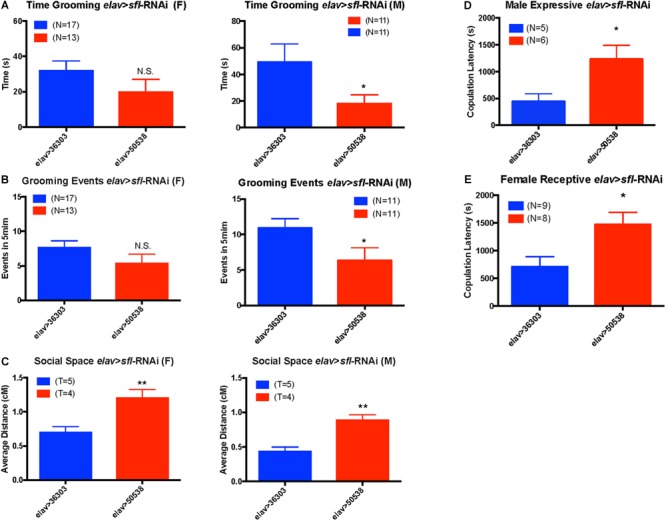
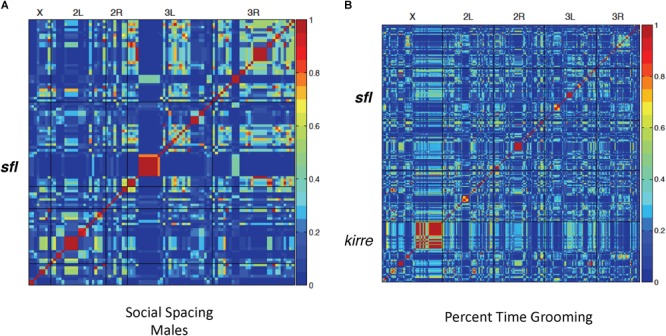
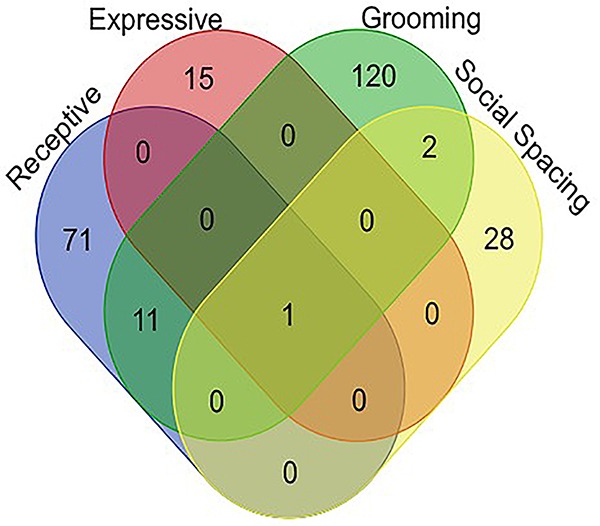
Major challenges to identifying genes that contribute to autism spectrum disorder (ASD) risk include the availability of large ASD cohorts, the contribution of many genes overall, and small effect sizes attributable to common gene variants. An alternative approach is to use a model organism to detect alleles that impact ASD-relevant behaviors and ask whether homologous human genes infer ASD risk. Here we utilized the Drosophila genetic reference panel (DGRP) as a tool to probe for perturbation in naturally occurring behaviors in that are analogous to three behavior domains: impaired social communication, social reciprocity and repetitive behaviors or restricted interests. Using 40 of the available DGRP lines, we identified single nucleotide polymorphisms (SNPs) in or near genes controlling these behavior domains, including ASD gene orthologs ( and ), an intellectual disability (ID) gene homolog (), and a gene encoding a heparan sulfate (HS) modifying enzyme called (). SNPs in were associated with all three ASD-like behaviors. Using RNAi knock-down of neuronal expression, we observed significant changes in expressive and receptive communication during mating, decreased grooming behavior, and increased social spacing. These results suggest a role for HS proteoglycan synthesis and/or modification in normal social communication, repetitive behavior, and social interaction in flies. Finally, using the DGRP to directly identify genetic effects relevant to a neuropsychiatric disorder further demonstrates the utility of the Drosophila system in the discovery of genes relevant to human disease.
识别导致自闭症谱系障碍(ASD)风险的基因面临的主要挑战包括是否有大规模的ASD队列、众多基因的总体贡献以及常见基因变异所导致的效应大小较小。另一种方法是使用模式生物来检测影响与ASD相关行为的等位基因,并询问同源人类基因是否能推断ASD风险。在这里,我们利用果蝇遗传参考面板(DGRP)作为工具,探究与三个行为领域类似的自然行为中的扰动:社交沟通受损、社交互惠以及重复行为或兴趣受限。使用40个可用的DGRP品系,我们在控制这些行为领域的基因内部或附近鉴定出单核苷酸多态性(SNP),包括ASD基因直系同源基因(和)、一种智力障碍(ID)基因同源物()以及一个编码硫酸乙酰肝素(HS)修饰酶的基因()。中的SNP与所有三种ASD样行为相关。通过RNA干扰敲低神经元表达,我们观察到交配期间表达性和接受性沟通的显著变化、梳理行为减少以及社交距离增加。这些结果表明HS蛋白聚糖合成和/或修饰在果蝇正常社交沟通、重复行为和社交互动中发挥作用。最后,使用DGRP直接识别与神经精神疾病相关的遗传效应,进一步证明了果蝇系统在发现与人类疾病相关基因方面的实用性。