Blair Gordon W, Appleton Jason P, Flaherty Katie, Doubal Fergus, Sprigg Nikola, Dooley Richard, Richardson Carla, Hamilton Iona, Law Zhe Kang, Shi Yulu, Stringer Michael S, Thrippleton Michael J, Boyd Julia, Shuler Kirsten, Bath Philip M, Wardlaw Joanna M
Brain Research Imaging Centre, Centre for Clinical Brain Sciences, 57 Little France Crescent, Edinburgh EH16 4TJ, UK.
Edinburgh Dementia Research Centre in the UK Dementia Research Initiative, UK.
EClinicalMedicine. 2019 Apr 24;11:34-43. doi: 10.1016/j.eclinm.2019.04.001. eCollection 2019 May-Jun.
Lacunar stroke, a frequent clinical manifestation of small vessel disease (SVD), differs pathologically from other ischaemic stroke subtypes and has no specific long-term secondary prevention. Licenced drugs, isosorbide mononitrate (ISMN) and cilostazol, have relevant actions to prevent SVD progression.
We recruited independent patients with clinically confirmed lacunar ischaemic stroke without cognitive impairment to a prospective randomised clinical trial, LACunar Intervention-1 (LACI-1). We randomised patients using a central web-based system, 1:1:1:1 with minimisation, to masked ISMN 25 mg bd, cilostazol 100 mg bd, both ISMN and cilostazol started immediately, or both with start delayed. We escalated doses to target over two weeks, sustained for eight weeks. Primary outcome was the proportion achieving target dose. Secondary outcomes included symptoms, safety (haemorrhage, recurrent vascular events), cognition, haematology, vascular function, and neuroimaging. LACI-1 was powered (80%, alpha 0.05) to detect 35% (90% versus 55%) difference between the proportion reaching target dose on one versus both drugs at 55 patients. Registration ISRCTN12580546.
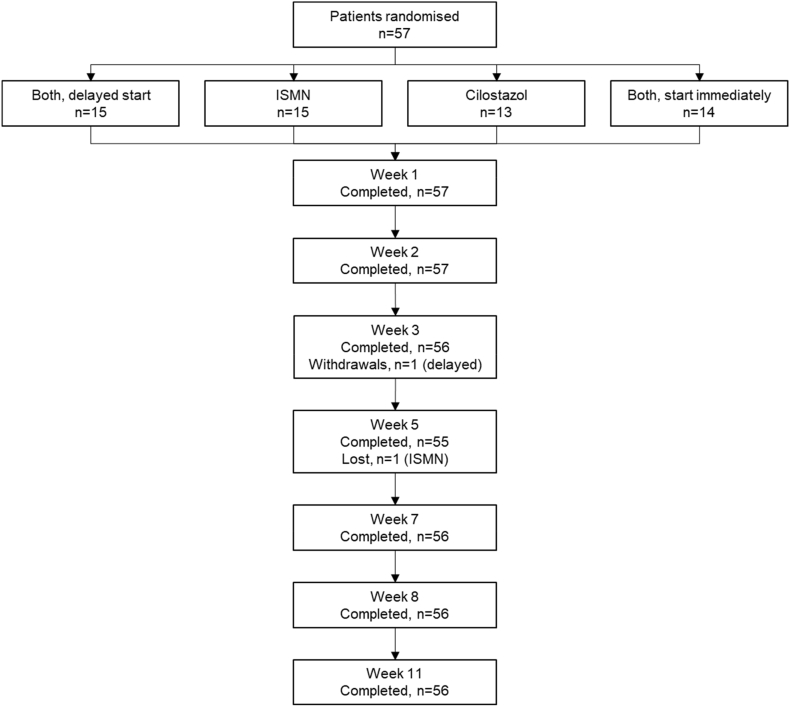
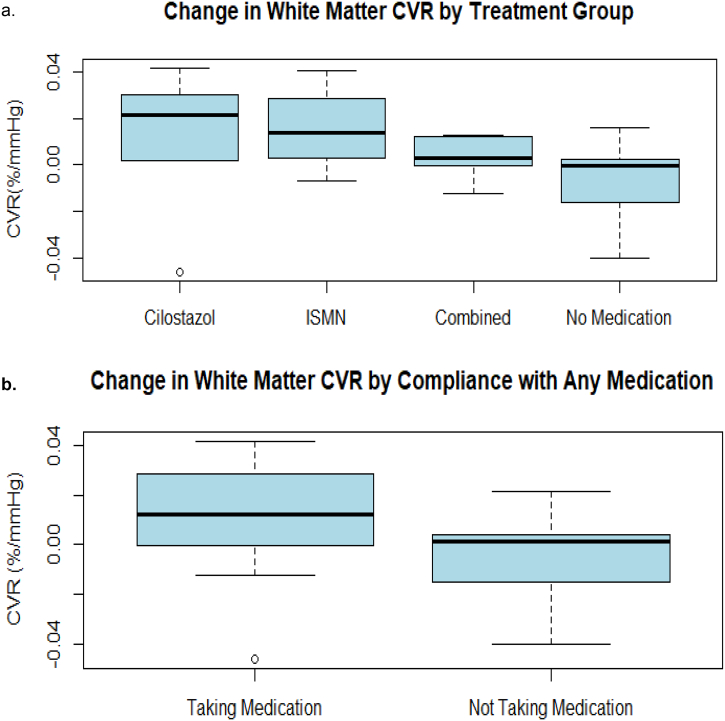
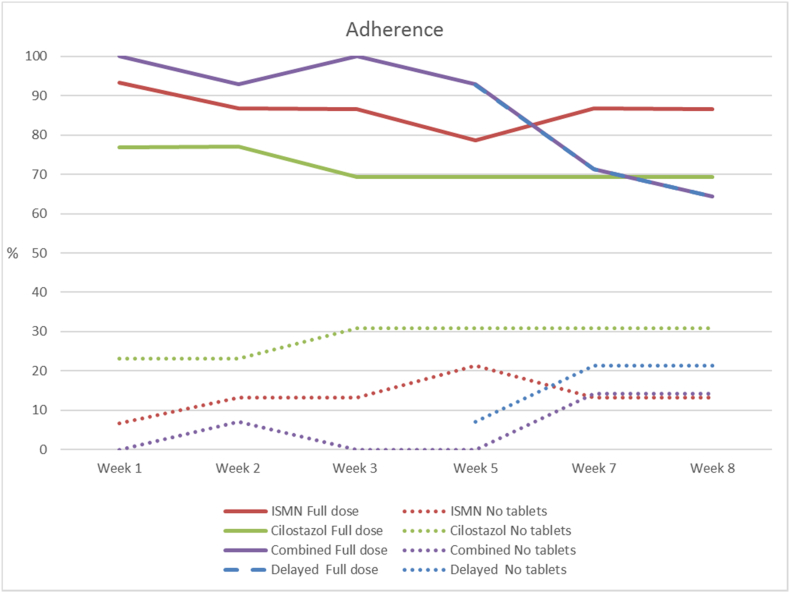
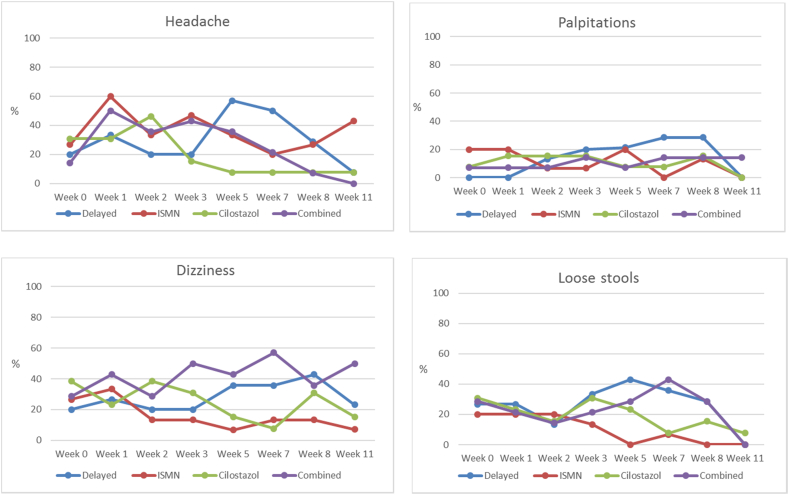
LACI-1 enrolled 57 participants between March 2016 and August 2017: 18 (32%) females, mean age 66 (SD 11, range 40-85) years, onset-randomisation 203 (range 6-920) days. Most achieved full (64%) or over half (87%) dose, with no difference between cilostazol vs ISMN, single vs dual drugs. Headache and palpitations increased initially then declined similarly with dual versus single drugs. There was no between-group difference in BP, pulse-wave velocity, haemoglobin or platelet function, but pulse rate was higher (mean difference, MD, 6.4, 95%CI 1.2-11.7, p = 0.02), platelet count higher (MD 35.7, 95%CI 2.8, 68.7, p = 0.03) and white matter hyperintensities reduced more (Chi-square p = 0.007) with cilostazol versus no cilostazol.
Cilostazol and ISMN are well tolerated when the dose is escalated, without safety concerns, in patients with lacunar stroke. Larger trials with longer term follow-up are justified.
Alzheimer's Society (AS-PG-14-033).
腔隙性卒中是小血管病(SVD)常见的临床表现,其病理特征与其他缺血性卒中亚型不同,且尚无特异性的长期二级预防措施。已获批药物单硝酸异山梨酯(ISMN)和西洛他唑对预防SVD进展具有相关作用。
我们招募了临床确诊为腔隙性缺血性卒中且无认知障碍的独立患者,进行一项前瞻性随机临床试验,即腔隙性卒中干预-1(LACI-1)试验。我们使用基于网络的中央系统,采用最小化法将患者按1:1:1:1随机分组,分别给予ISMN 25mg每日两次、西洛他唑100mg每日两次,两种药物均立即开始使用,或两种药物均延迟开始使用。在两周内逐步增加剂量至目标剂量,并持续八周。主要结局是达到目标剂量的比例。次要结局包括症状、安全性(出血、复发性血管事件)、认知、血液学、血管功能和神经影像学。LACI-1试验设定效能(80%,α=0.05),以检测55例患者中,使用一种药物与两种药物达到目标剂量的比例之间35%(90%对55%)的差异。注册号为ISRCTN12580546。
LACI-1试验在2016年3月至2017年8月期间招募了57名参与者:18名(32%)女性,平均年龄66(标准差11,范围40 - 85)岁,发病至随机分组时间为203(范围6 - 920)天。大多数患者达到了全量(64%)或超过半量(87%),西洛他唑与ISMN、单药与双药之间无差异。头痛和心悸最初增加,随后双药与单药的下降情况相似。血压、脉搏波速度、血红蛋白或血小板功能方面组间无差异,但脉搏率较高(平均差异,MD,6.4,95%置信区间1.2 - 11.7,p = 0.02),血小板计数较高(MD 35.7,95%置信区间2.8,68.7,p = 0.03),与未使用西洛他唑相比,使用西洛他唑时白质高信号减少更多(卡方检验p = 0.007)。
在腔隙性卒中患者中,逐步增加剂量时,西洛他唑和ISMN耐受性良好,无安全问题。有必要进行更大规模、长期随访的试验。
阿尔茨海默病协会(AS-PG-