Wardlaw Joanna, Bath Philip M W, Doubal Fergus, Heye Anna, Sprigg Nikola, Woodhouse Lisa J, Blair Gordon, Appleton Jason, Cvoro Vera, England Timothy, Hassan Ahamad, John Werring David, Montgomery Alan
The University of Edinburgh, Edinburgh, UK.
Stroke Trials Unit, Division of Clinical Neuroscience, The University of Nottingham, Nottingham, UK.
Eur Stroke J. 2020 Sep;5(3):297-308. doi: 10.1177/2396987320920110. Epub 2020 Apr 20.
Small vessel disease causes a quarter of ischaemic strokes (lacunar subtype), up to 45% of dementia either as vascular or mixed types, cognitive impairment and physical frailty. However, there is no specific treatment to prevent progression of small vessel disease.
We designed the LACunar Intervention Trial-2 (LACI-2) to test feasibility of a large trial testing cilostazol and/or isosorbide mononitrate (ISMN) by demonstrating adequate participant recruitment and retention in follow-up, drug tolerability, safety and confirm outcome event rates required to power a phase 3 trial.
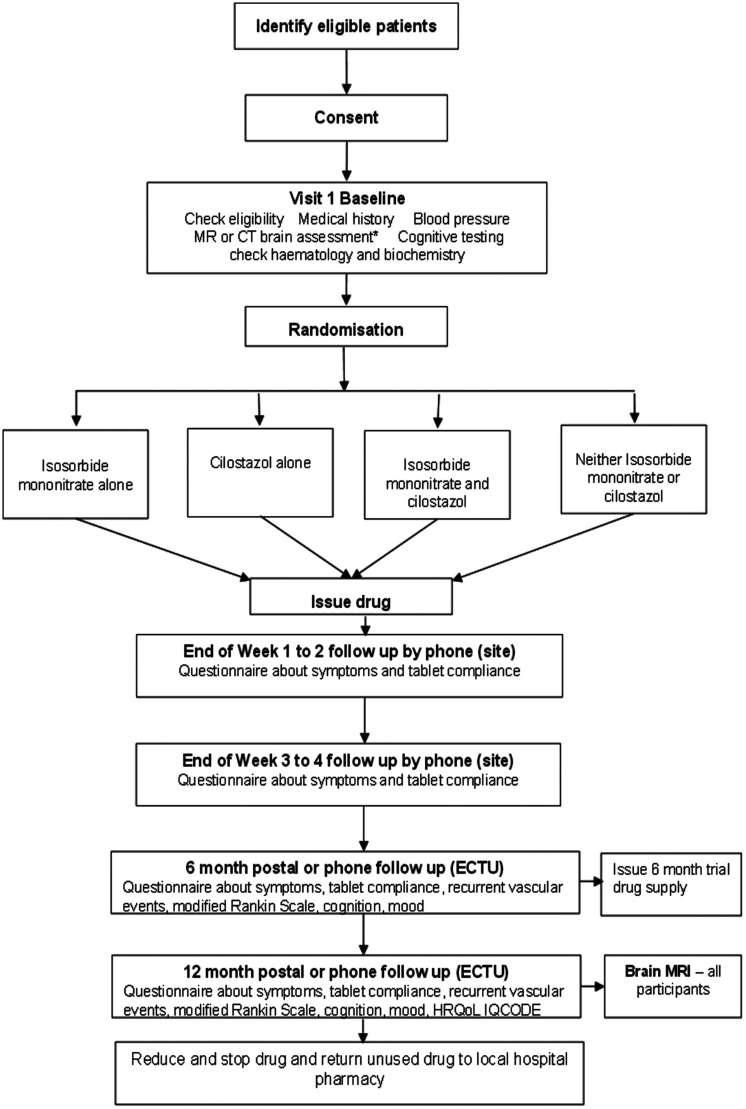
LACI-2 is an investigator-initiated, prospective randomised open label blinded endpoint (PROBE) trial aiming to recruit 400 patients with prior lacunar syndrome due to a small subcortical infarct. We randomise participants to cilostazol v no cilostazol and ISMN or no ISMN, minimising on key prognostic factors. All patients receive guideline-based best medical therapy. Patients commence trial drug at low dose, increment to full dose over 2-4 weeks, continuing on full dose for a year. We follow-up participants to one year for symptoms, tablet compliance, safety, recurrent vascular events, cognition and functional outcomes, Trails B and brain MRI. LACI-2 is registered ISRCTN 14911850, EudraCT 2016-002277-35. Primary outcome is feasibility of recruitment and compliance; secondary outcomes include safety (cerebral or systemic bleeding, falls, death), efficacy (recurrent cerebral and cardiac vascular events, cognition on TICS, Trails B) and tolerability.
LACI-2 will determine feasibility, tolerability and provide outcome rates to power a large phase 3 trial to prevent progression of cerebral small vessel disease.
小血管疾病导致四分之一的缺血性中风(腔隙性亚型),高达45%的血管性或混合型痴呆、认知障碍和身体虚弱。然而,尚无预防小血管疾病进展的特异性治疗方法。
我们设计了腔隙性干预试验-2(LACI-2),通过证明有足够的参与者招募和随访保留率、药物耐受性、安全性以及确定进行3期试验所需的结局事件发生率,来测试一项大型试验(测试西洛他唑和/或单硝酸异山梨酯(ISMN))的可行性。
LACI-2是一项由研究者发起的前瞻性随机开放标签盲终点(PROBE)试验,旨在招募400例因皮质下小梗死而患有既往腔隙综合征的患者。我们将参与者随机分为西洛他唑组与非西洛他唑组以及ISMN组与非ISMN组,同时在关键预后因素上进行最小化处理。所有患者均接受基于指南的最佳药物治疗。患者以低剂量开始试验药物治疗,在2至4周内递增至全剂量,并持续全剂量治疗一年。我们对参与者进行为期一年的随访,观察症状、片剂依从性、安全性、复发性血管事件、认知和功能结局、连线测验B以及脑部磁共振成像。LACI-2已在国际标准随机对照试验编号(ISRCTN)14911850、欧盟临床试验编号(EudraCT)2016-002277-35注册。主要结局是招募和依从性的可行性;次要结局包括安全性(脑或全身出血、跌倒、死亡)、疗效(复发性脑和心血管事件、连线测验B上的认知)和耐受性。
LACI-2将确定可行性、耐受性,并提供结局发生率,以为一项大型3期试验提供支持,以预防脑小血管疾病的进展。