School of Medicine, University of Leeds, Leeds, United Kingdom.
Leeds Institute for Data Analytics, University of Leeds, Leeds, United Kingdom.
Am J Epidemiol. 2019 Oct 1;188(10):1858-1867. doi: 10.1093/aje/kwz165.
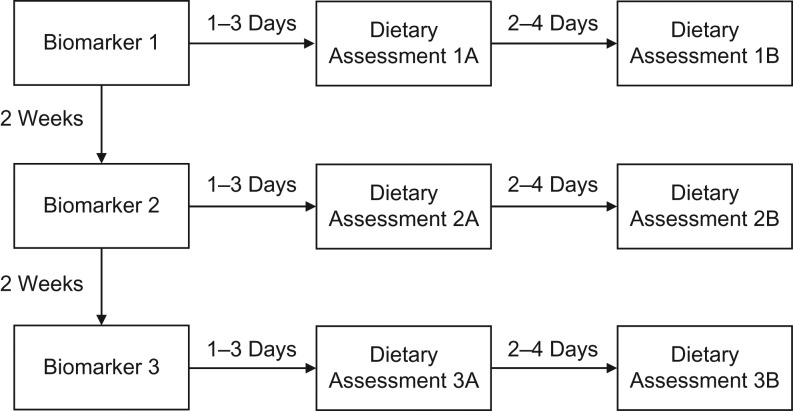
The Oxford WebQ is an online 24-hour dietary questionnaire that is appropriate for repeated administration in large-scale prospective studies, including the UK Biobank study and the Million Women Study. We compared the performance of the Oxford WebQ and a traditional interviewer-administered multiple-pass 24-hour dietary recall against biomarkers for protein, potassium, and total sugar intake and total energy expenditure estimated by accelerometry. We recruited 160 participants in London, United Kingdom, between 2014 and 2016 and measured their biomarker levels at 3 nonconsecutive time points. The measurement error model simultaneously compared all 3 methods. Attenuation factors for protein, potassium, total sugar, and total energy intakes estimated as the mean of 2 applications of the Oxford WebQ were 0.37, 0.42, 0.45, and 0.31, respectively, with performance improving incrementally for the mean of more measures. Correlation between the mean value from 2 Oxford WebQs and estimated true intakes, reflecting attenuation when intake is categorized or ranked, was 0.47, 0.39, 0.40, and 0.38, respectively, also improving with repeated administration. These correlations were similar to those of the more administratively burdensome interviewer-based recall. Using objective biomarkers as the standard, the Oxford WebQ performs well across key nutrients in comparison with more administratively burdensome interviewer-based 24-hour recalls. Attenuation improves when the average value is taken over repeated administrations, reducing measurement error bias in assessment of diet-disease associations.
牛津网络问卷(Oxford WebQ)是一种在线 24 小时饮食问卷,适用于大规模前瞻性研究中的重复管理,包括英国生物库研究(UK Biobank study)和百万妇女研究(Million Women Study)。我们将牛津网络问卷(Oxford WebQ)和传统的访员管理的多次通过 24 小时饮食回忆与生物标志物进行比较,以评估蛋白质、钾和总糖摄入量以及通过加速度计估计的总能量消耗。我们于 2014 年至 2016 年期间在英国伦敦招募了 160 名参与者,并在 3 个非连续时间点测量了他们的生物标志物水平。测量误差模型同时比较了所有 3 种方法。牛津网络问卷(Oxford WebQ)的 2 次应用的平均摄入量的蛋白质、钾、总糖和总能量摄入的衰减因子分别为 0.37、0.42、0.45 和 0.31,随着更多测量的应用,性能逐渐提高。2 个牛津网络问卷(Oxford WebQ)的平均值与估计的真实摄入量之间的相关性,反映了在摄入量分类或排名时的衰减,分别为 0.47、0.39、0.40 和 0.38,也随着重复管理而提高。这些相关性与更繁琐的访员管理的回忆相似。使用客观的生物标志物作为标准,与更繁琐的访员管理的 24 小时回忆相比,牛津网络问卷(Oxford WebQ)在关键营养素方面表现良好。当平均值在重复管理中取平均值时,衰减会得到改善,从而减少评估饮食-疾病关联中的测量误差偏倚。