Department of Agronomy, Iowa State University, Ames, Iowa, United States of America.
PLoS One. 2019 Jul 18;14(7):e0219847. doi: 10.1371/journal.pone.0219847. eCollection 2019.
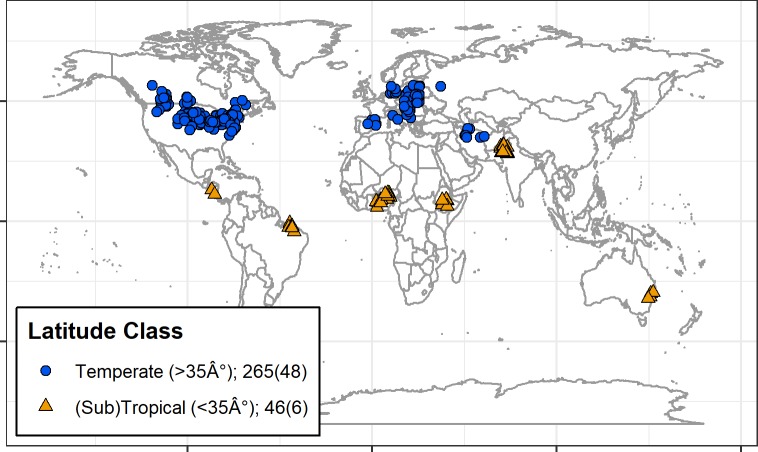
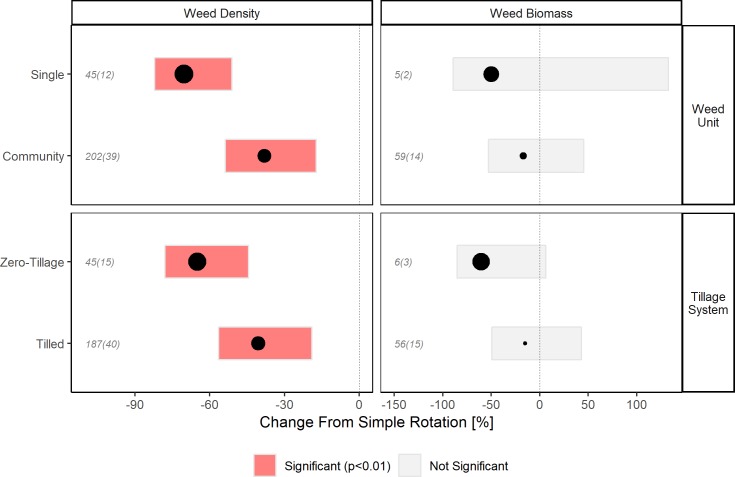
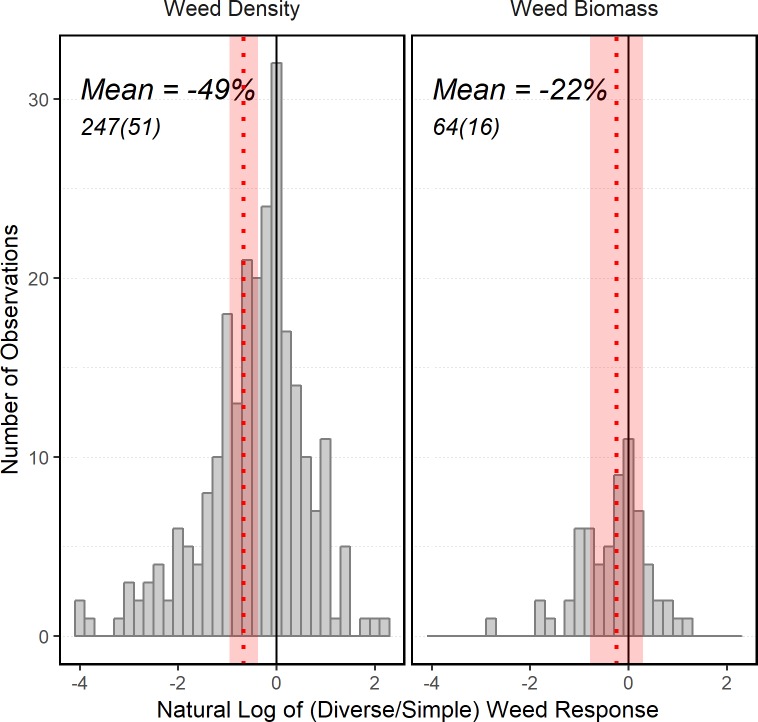
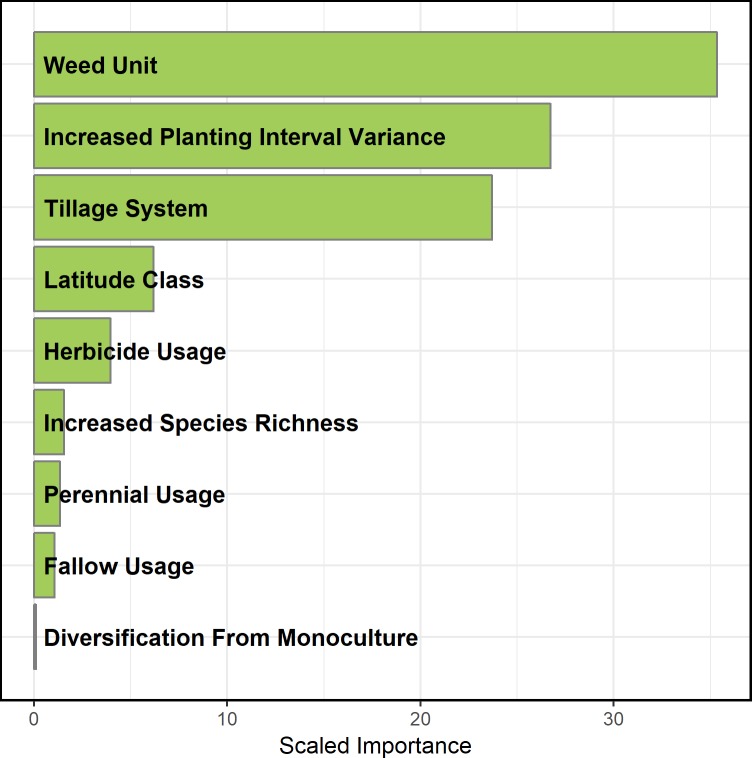
Over the past half-century, crop rotations have become increasingly simplified, with whole regions producing only one or two crops in succession. Simplification is problematic from a weed management perspective, because it results in weeds' repeated exposure to the same set of ecological and agronomic conditions. This can exacerbate weed infestations and promote the evolution of herbicide resistance. Diversifying crop rotations through addition of crop species and their associated managements may suppress weeds and reduce selection pressure for herbicide resistance by altering stress and mortality factors affecting weed dynamics. Here we report the results of a meta-analysis using 298 paired observations from 54 studies across six continents to compare weed responses due to simple and more diverse crop rotations. We found diversifying from simple rotations reduced weed density (49%), but did not have a significant effect on weed biomass. We investigated the effect of management practices, environmental factors, and rotation design on this effect. Diversification that increased the variance around crop planting dates was more effective in suppressing weeds than increasing crop species richness alone. Increasing rotational diversity reduced weed density more under zero-tillage conditions (65%) than tilled conditions (41%), and did so regardless of environmental context and auxiliary herbicide use. Our findings highlight the value of diversifying crop rotations to control weed populations, and support its efficacy under varied environmental conditions and management scenarios.
在过去的半个世纪里,作物轮作变得越来越简单,整个地区连续只种植一到两种作物。从杂草管理的角度来看,这种简化是有问题的,因为它导致杂草反复暴露在相同的生态和农艺条件下。这会加剧杂草的侵袭,并通过改变影响杂草动态的胁迫和死亡率因素,促进除草剂抗性的进化。通过增加作物种类及其相关管理来使作物轮作多样化,可以抑制杂草的生长,降低除草剂抗性的选择压力。在这里,我们使用来自六大洲 54 项研究的 298 对观测结果进行了荟萃分析,比较了简单轮作和多样化轮作对杂草的响应。我们发现,与简单轮作相比,多样化轮作降低了杂草密度(49%),但对杂草生物量没有显著影响。我们研究了管理实践、环境因素和轮作设计对这种效果的影响。与单独增加作物种类相比,增加作物种植时间的变异性更能有效地抑制杂草。在免耕条件下(65%),轮作多样化比耕翻条件下(41%)更能降低杂草密度,且无论环境背景和辅助除草剂的使用情况如何都是如此。我们的研究结果强调了使作物轮作多样化以控制杂草种群的重要性,并支持其在不同环境条件和管理情况下的有效性。