Bockstaller Christian, Blatz Aimé, Rapp Olivier, Koller Rémi, Slezack Sophie, Schaub Anne
Université Lorraine, INRAE, LAE, F-68000, Colmar, France.
Association pour la Relance Agronomique en Alsace (ARAA), Schiltigheim, F-67013, Strasbourg, France.
Heliyon. 2024 Apr 26;10(10):e30400. doi: 10.1016/j.heliyon.2024.e30400. eCollection 2024 May 30.
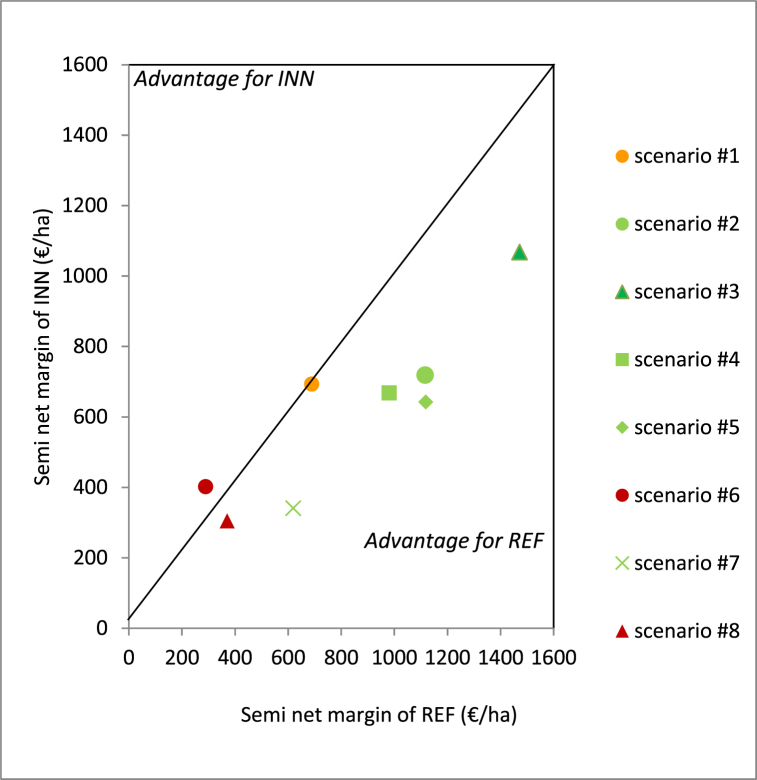
Maize is the most-produced food crop in the world and is grown in intensive rotations or in monoculture (continuous maize) systems. As maize production has expanded massively across the world, many concerns have emerged about its local environmental and other global impacts. Agronomists have designed innovative cropping systems and assessed them using system experiments to make arable systems more sustainable. However, knowledge is still lacking on the sustainability of innovative cropping systems compared to highly intensive systems such as irrigated maize-based monoculture. Here, we present the assessment results of a nine-year system experiment in Alsace, France, developed to compare an innovative system based on a diversified rotation and innovative management practices (three-year rotation of maize/soybean/winter wheat (plus a cover crop) combined with reduced tillage) with a continuous maize reference system. The results cover a six-year assessment period following an initial three-year design period. Classic criteria, such as profitability, workload, pesticide use, fossil energy consumption and nitrate leaching, were assessed along with other less studied criteria, such as pesticide leaching risk, soil structure, soil chemical quality and soil biological activity. Sustainability - which includes environmental, social and economic dimensions - was assessed with the MASC 2.0 method. Overall sustainability was substantially enhanced in the innovative system (5 out of 7 sustainability classes) in comparison with the low level of the reference system (2 out of 7). This was due to a clear improvement in the environmental performance (from 2 out of 5 to 5 out of 5) while social performance was high in both systems (4 out of 5) and economic performance was low (2 out of 5) due to very low contribution to economic development. Nevertheless, the innovative system had a major drawback: lower profitability, especially when scenarios included high maize prices. Furthermore, herbicide use on maize was higher in the innovative system than in the reference one. Avenues for progress, such as encouraging stakeholder participation at the assessment stage or additional innovations such as multiple cropping, are suggested.
玉米是世界上产量最高的粮食作物,种植方式为集约轮作或单一栽培(连续种植玉米)系统。随着玉米产量在全球范围内大幅增长,人们对其对当地环境及其他全球影响的诸多担忧也随之出现。农学家们设计了创新种植系统,并通过系统试验对其进行评估,以使耕作系统更具可持续性。然而,与高度集约的系统(如基于灌溉的玉米单一栽培)相比,关于创新种植系统可持续性的知识仍然匮乏。在此,我们展示了在法国阿尔萨斯进行的一项为期九年的系统试验的评估结果,该试验旨在比较基于多样化轮作和创新管理实践的创新系统(玉米/大豆/冬小麦三年轮作(外加一种覆盖作物)并结合少耕)与连续种植玉米的对照系统。结果涵盖了初始三年设计期后的六年评估期。评估了诸如盈利能力、工作量、农药使用、化石能源消耗和硝酸盐淋失等经典标准,以及其他研究较少的标准,如农药淋失风险、土壤结构、土壤化学质量和土壤生物活性。采用MASC 2.0方法评估了包括环境、社会和经济层面的可持续性。与对照系统的低水平(7个可持续性等级中的2级)相比,创新系统的总体可持续性大幅提高(7个可持续性等级中的5级)。这是由于环境绩效明显改善(从5个等级中的2级提高到5级),而两个系统的社会绩效都很高(5个等级中的4级),经济绩效较低(5个等级中的2级),因为对经济发展的贡献非常低。尽管如此,创新系统有一个主要缺点:盈利能力较低,尤其是在玉米价格较高的情况下。此外,创新系统中玉米的除草剂使用量高于对照系统。文章还提出了改进方向,例如鼓励利益相关者在评估阶段参与,或进行如间作等其他创新。