Department of Epidemiology and Biostatistics, School of Public Health, Imperial College London, London, United Kingdom.
MRC Centre for Transplantation, King's College London, London, United Kingdom.
Int J Cancer. 2020 May 15;146(10):2680-2693. doi: 10.1002/ijc.32576. Epub 2019 Aug 20.
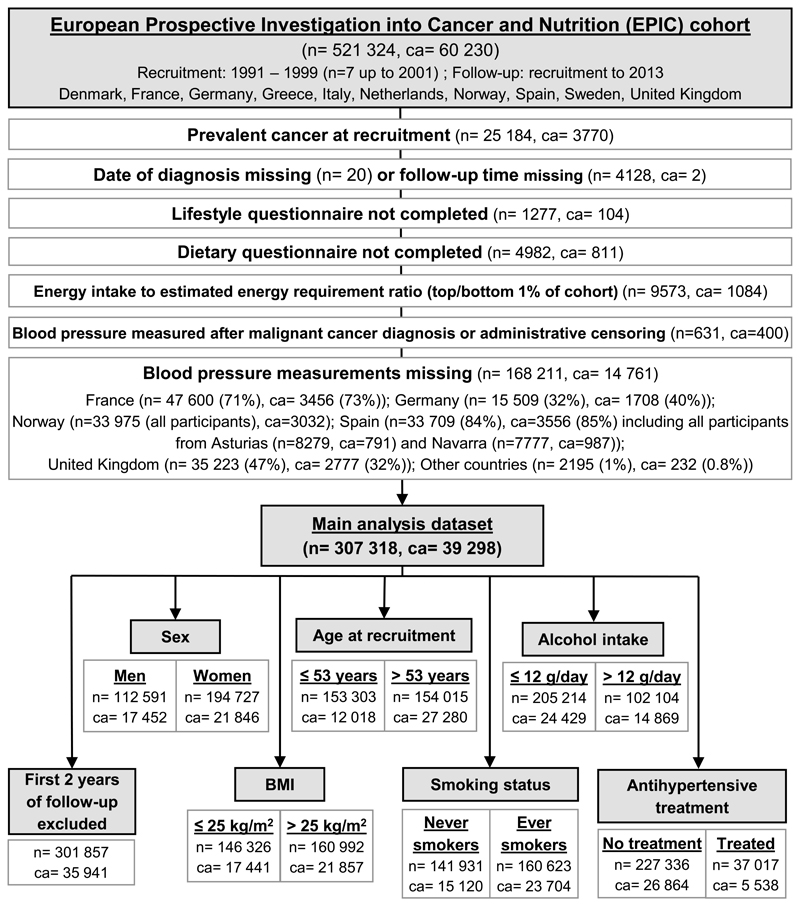
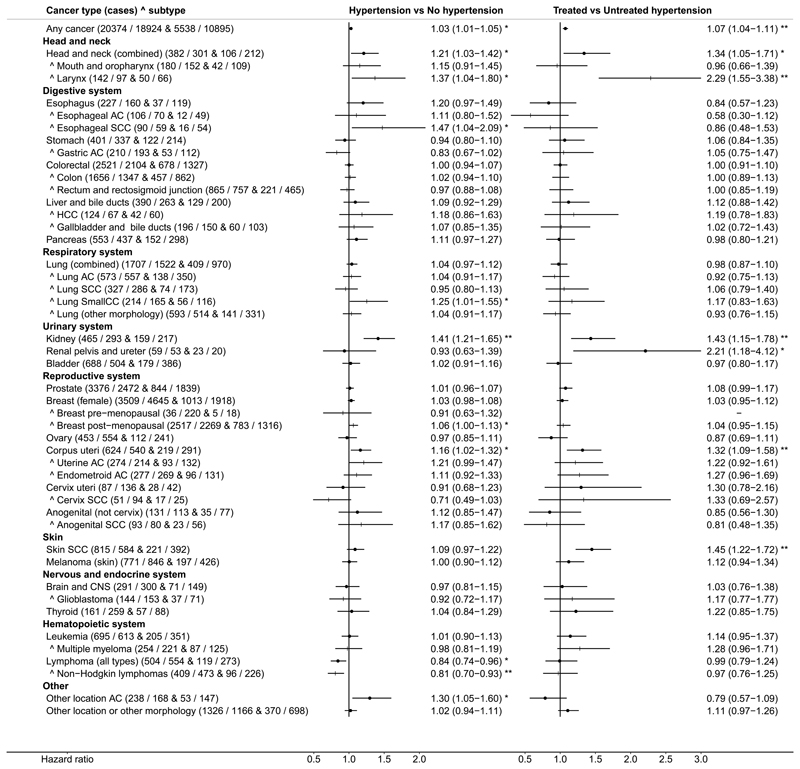
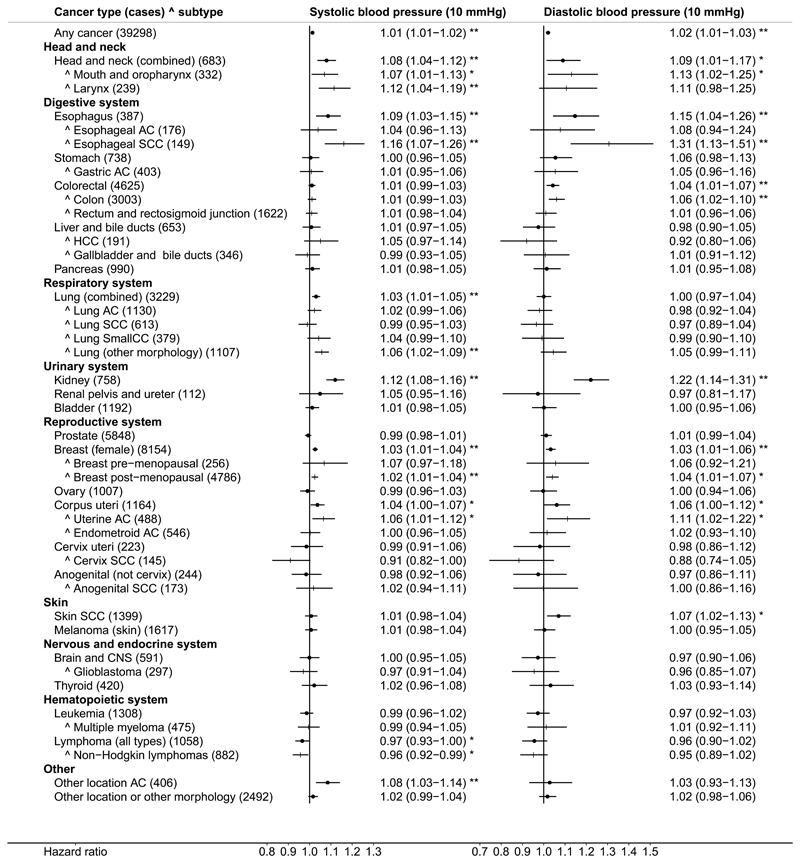
Several studies have reported associations of hypertension with cancer, but not all results were conclusive. We examined the association of systolic (SBP) and diastolic (DBP) blood pressure with the development of incident cancer at all anatomical sites in the European Prospective Investigation into Cancer and Nutrition (EPIC). Hazard ratios (HRs) (95% confidence intervals) were estimated using multivariable Cox proportional hazards models, stratified by EPIC-participating center and age at recruitment, and adjusted for sex, education, smoking, body mass index, physical activity, diabetes and dietary (in women also reproductive) factors. The study included 307,318 men and women, with an average follow-up of 13.7 (standard deviation 4.4) years and 39,298 incident cancers. We confirmed the expected positive association with renal cell carcinoma: HR = 1.12 (1.08-1.17) per 10 mm Hg higher SBP and HR = 1.23 (1.14-1.32) for DBP. We additionally found positive associations for esophageal squamous cell carcinoma (SCC): HR = 1.16 (1.07-1.26) (SBP), HR = 1.31 (1.13-1.51) (DBP), weaker for head and neck cancers: HR = 1.08 (1.04-1.12) (SBP), HR = 1.09 (1.01-1.17) (DBP) and, similarly, for skin SCC, colon cancer, postmenopausal breast cancer and uterine adenocarcinoma (AC), but not for esophageal AC, lung SCC, lung AC or uterine endometroid cancer. We observed weak inverse associations of SBP with cervical SCC: HR = 0.91 (0.82-1.00) and lymphomas: HR = 0.97 (0.93-1.00). There were no consistent associations with cancers in other locations. Our results are largely compatible with published studies and support weak associations of blood pressure with cancers in specific locations and morphologies.
已有多项研究报道了高血压与癌症之间的关联,但并非所有结果都具有结论性。我们在欧洲癌症与营养前瞻性调查(EPIC)中检查了收缩压(SBP)和舒张压(DBP)与所有解剖部位癌症发病的关联。使用多变量 Cox 比例风险模型估计危险比(HR)(95%置信区间),按 EPIC 参与中心和招募时的年龄分层,并按性别、教育程度、吸烟状况、体重指数、身体活动、糖尿病和饮食(女性还包括生殖)因素进行调整。该研究纳入了 307318 名男性和女性,平均随访 13.7 年(标准差 4.4 年),发生了 39298 例癌症。我们证实了与肾细胞癌的预期正相关:每升高 10mmHg SBP 的 HR 为 1.12(1.08-1.17),DBP 的 HR 为 1.23(1.14-1.32)。我们还发现了食管鳞状细胞癌(SCC)的阳性关联:SBP 的 HR = 1.16(1.07-1.26),DBP 的 HR = 1.31(1.13-1.51),头颈部癌症的关联较弱:SBP 的 HR = 1.08(1.04-1.12),DBP 的 HR = 1.09(1.01-1.17),同样,皮肤 SCC、结肠癌、绝经后乳腺癌和子宫腺癌(AC)也是如此,但食管 AC、肺 SCC、肺 AC 或子宫内膜癌则不然。我们观察到 SBP 与宫颈 SCC 的 HR = 0.91(0.82-1.00)和淋巴瘤的 HR = 0.97(0.93-1.00)之间存在弱负相关。其他部位的癌症没有一致的关联。我们的结果与已发表的研究基本一致,支持血压与特定部位和形态的癌症之间存在微弱关联。