• 文献检索
  • 文档翻译
  • 深度研究
  • 学术资讯
  • Suppr Zotero 插件Zotero 插件
  • 邀请有礼
  • 套餐&价格
  • 历史记录
应用&插件
Suppr Zotero 插件Zotero 插件浏览器插件Mac 客户端Windows 客户端微信小程序
定价
高级版会员购买积分包购买API积分包
服务
文献检索文档翻译深度研究API 文档MCP 服务
关于我们
关于 Suppr公司介绍联系我们用户协议隐私条款
关注我们

Suppr 超能文献

核心技术专利:CN118964589B侵权必究
粤ICP备2023148730 号-1Suppr @ 2026

文献检索

告别复杂PubMed语法,用中文像聊天一样搜索,搜遍4000万医学文献。AI智能推荐,让科研检索更轻松。

立即免费搜索

文件翻译

保留排版,准确专业,支持PDF/Word/PPT等文件格式,支持 12+语言互译。

免费翻译文档

深度研究

AI帮你快速写综述,25分钟生成高质量综述,智能提取关键信息,辅助科研写作。

立即免费体验

与获得性脑损伤后康复中同伴支持需求相关的患者特征:荷兰的一项前瞻性队列研究

Patient characteristics related to the need for peer support in rehabilitation after acquired brain injury: a prospective cohort study in the Netherlands.

作者信息

Wobma Ruth, Nijland Rinske, Kwakkel Gert

机构信息

Department of neurorehabilitation, Amsterdam Rehabilitation Research Centre, Amsterdam, The Netherlands.

Department of Rehabilitation Medicine, Amsterdam University Medical Centre, Amsterdam Movement Sciences, Amsterdam Neurosciences, Amsterdam, The Netherlands.

出版信息

BMJ Open. 2019 Jul 17;9(7):e025665. doi: 10.1136/bmjopen-2018-025665.

DOI:10.1136/bmjopen-2018-025665
PMID:31320344
原文链接:https://pmc.ncbi.nlm.nih.gov/articles/PMC6661638/
Abstract

OBJECTIVE

Peer support facilitates patients and caregivers in adjusting to long-term disabilities. This study aimed to determine which patient characteristics are related to need for peer support during rehabilitation after acquired brain injury (ABI) and investigate factors that explain whether peer support is perceived as meaningful or not.

DESIGN

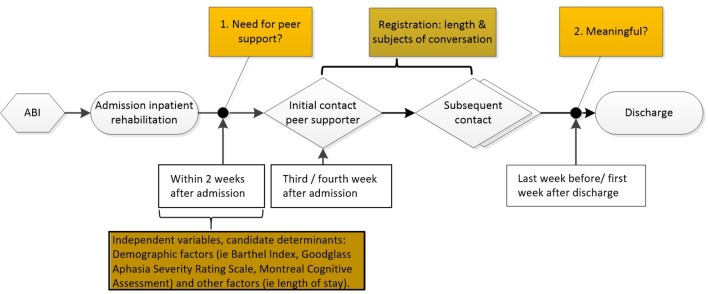
A prospective cohort study over a period of 17 months following patients with ABI during inpatient rehabilitation in the Netherlands. Multivariable logistic modelling was applied to identify patient and intervention characteristics that were related to (1) need for peer support and (2) whether or not peer support was perceived as meaningful. Additional information on duration and subjects of conversation was reported.

SETTING

Peer support was provided during inpatient rehabilitation.

PARTICIPANTS

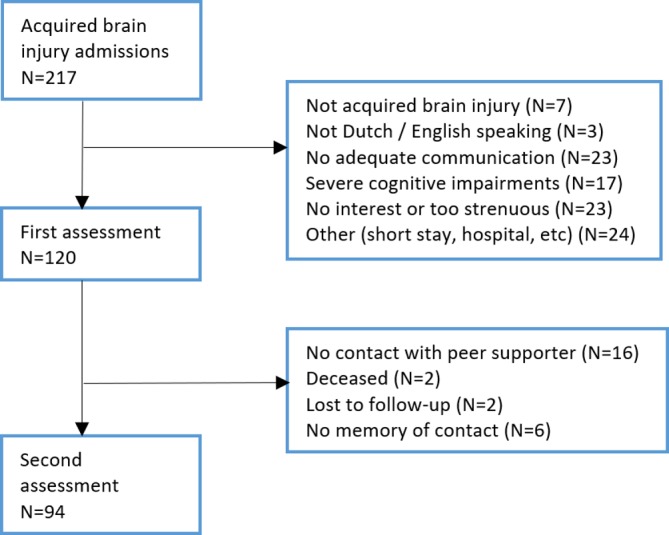
120 patients with ABI ≥18 years were included and assessed at admission, 94 patients were assessed at discharge. Seventy-three percent (n=88) expressed a need for peer support and at discharge 76.6% (n=72) perceived contact as meaningful.

RESULTS

Non-Western and single patients perceived a significantly higher need for peer support. Patients younger than 60 and those with time between ABI and discharge of >3 months perceived their contact significantly more meaningful.

CONCLUSIONS

Results provide more insight into characteristics of patients with ABI who may benefit from peer support during inpatient rehabilitation. Optimal dosage, length of contact, rehabilitation phase and strategy for the provision of peer support should be investigated as well as the effects for ABI survivors on outcomes such as coping, self-efficacy, depression and health-related quality of life.

摘要

目的

同伴支持有助于患者及其照顾者适应长期残疾状况。本研究旨在确定后天性脑损伤(ABI)康复期间,哪些患者特征与同伴支持需求相关,并调查解释同伴支持是否被视为有意义的因素。

设计

在荷兰,对ABI患者住院康复期间进行为期17个月的前瞻性队列研究。应用多变量逻辑模型来确定与以下方面相关的患者和干预特征:(1)同伴支持需求;(2)同伴支持是否被视为有意义。报告了关于谈话时长和主题的额外信息。

背景

在住院康复期间提供同伴支持。

参与者

纳入120名年龄≥18岁的ABI患者,入院时进行评估,94名患者在出院时进行评估。73%(n = 88)表示需要同伴支持,出院时76.6%(n = 72)认为这种接触有意义。

结果

非西方患者和单身患者对同伴支持的需求显著更高。年龄小于60岁的患者以及ABI与出院间隔时间超过3个月的患者,认为他们的接触明显更有意义。

结论

研究结果为ABI患者在住院康复期间可能从同伴支持中受益的特征提供了更多见解。应研究同伴支持的最佳剂量、接触时长、康复阶段和提供策略,以及ABI幸存者在应对、自我效能感、抑郁和健康相关生活质量等结果方面的影响。
https://cdn.ncbi.nlm.nih.gov/pmc/blobs/13c2/6661638/214ee1bb56ef/bmjopen-2018-025665f03.jpg
https://cdn.ncbi.nlm.nih.gov/pmc/blobs/13c2/6661638/a5ad927d6c35/bmjopen-2018-025665f01.jpg
https://cdn.ncbi.nlm.nih.gov/pmc/blobs/13c2/6661638/50a4ea1ddbfc/bmjopen-2018-025665f02.jpg
https://cdn.ncbi.nlm.nih.gov/pmc/blobs/13c2/6661638/214ee1bb56ef/bmjopen-2018-025665f03.jpg
https://cdn.ncbi.nlm.nih.gov/pmc/blobs/13c2/6661638/a5ad927d6c35/bmjopen-2018-025665f01.jpg
https://cdn.ncbi.nlm.nih.gov/pmc/blobs/13c2/6661638/50a4ea1ddbfc/bmjopen-2018-025665f02.jpg
https://cdn.ncbi.nlm.nih.gov/pmc/blobs/13c2/6661638/214ee1bb56ef/bmjopen-2018-025665f03.jpg

相似文献

1
Patient characteristics related to the need for peer support in rehabilitation after acquired brain injury: a prospective cohort study in the Netherlands.与获得性脑损伤后康复中同伴支持需求相关的患者特征:荷兰的一项前瞻性队列研究
BMJ Open. 2019 Jul 17;9(7):e025665. doi: 10.1136/bmjopen-2018-025665.
2
Prediction of Psychological Distress Among Persons With Spinal Cord Injury or Acquired Brain Injury and Their Significant Others.脊髓损伤或获得性脑损伤患者及其重要他人心理困扰的预测。
Arch Phys Med Rehabil. 2020 Dec;101(12):2093-2102. doi: 10.1016/j.apmr.2020.05.023. Epub 2020 Jun 27.
3
Self-Efficacy Predicts Personal and Family Adjustment Among Persons With Spinal Cord Injury or Acquired Brain Injury and Their Significant Others: A Dyadic Approach.自我效能感可预测脊髓损伤或获得性脑损伤患者及其重要他人的个人和家庭适应情况:一种对偶方法。
Arch Phys Med Rehabil. 2020 Nov;101(11):1937-1945. doi: 10.1016/j.apmr.2020.06.003. Epub 2020 Jun 23.
4
Predictors of health-related quality of life and participation after brain injury rehabilitation: The role of neuropsychological factors.脑损伤康复后与健康相关的生活质量和参与的预测因素:神经心理学因素的作用。
Neuropsychol Rehabil. 2017 Jun;27(4):581-598. doi: 10.1080/09602011.2015.1113996. Epub 2015 Nov 26.
5
Evidence for peer support in rehabilitation for individuals with acquired brain injury: A systematic review.后天性脑损伤个体康复中同伴支持的证据:一项系统综述。
J Rehabil Med. 2016 Nov 11;48(10):837-840. doi: 10.2340/16501977-2160.
6
Brain injury rehabilitation: the lived experience of inpatients and their family caregivers.脑损伤康复:住院患者及其家庭照顾者的亲身经历
Scand J Occup Ther. 2012 Mar;19(2):184-93. doi: 10.3109/11038128.2011.611531. Epub 2011 Sep 22.
7
Comparison of a Cognitive-Behavioral Coping Skills Group to a Peer Support Group in a Brain Injury Population.脑损伤人群中认知行为应对技能小组与同伴支持小组的比较。
Arch Phys Med Rehabil. 2016 Feb;97(2):281-91. doi: 10.1016/j.apmr.2015.10.097. Epub 2015 Nov 10.
8
A structured multicomponent group programme for carers of people with acquired brain injury: Effects on perceived criticism, strain, and psychological distress.一项针对后天性脑损伤患者照料者的结构化多成分团体项目:对感知到的批评、压力和心理困扰的影响。
Br J Health Psychol. 2016 Feb;21(1):224-43. doi: 10.1111/bjhp.12159. Epub 2015 Aug 28.
9
The experience of being a parent with an acquired brain injury (ABI) as an inpatient at a neuro-rehabilitation centre, 0-2 years post-injury.在神经康复中心作为住院患者,受伤后0至2年,身为一名患有后天性脑损伤(ABI)的家长的经历。
Brain Inj. 2014;28(13-14):1700-10. doi: 10.3109/02699052.2014.947633. Epub 2014 Sep 10.
10
Factors associated with living setting at discharge from inpatient rehabilitation after acquired brain injury in Ontario, Canada.加拿大安大略省获得性脑损伤患者住院康复出院后的居住环境相关因素。
J Rehabil Med. 2014 Feb;46(2):144-52. doi: 10.2340/16501977-1243.

引用本文的文献

1
Peer support needs, preferences and experiences of adults with acquired neurological disability: a scoping review protocol.成人获得性神经残疾的同伴支持需求、偏好和体验:范围综述方案。
BMJ Open. 2024 Oct 1;14(10):e088237. doi: 10.1136/bmjopen-2024-088237.
2
A Qualitative Study Exploring Rehabilitant and Informal Caregiver Perspectives of a Challenging Rehabilitation Environment for Geriatric Rehabilitation.一项定性研究:探索康复者及非正式照料者对老年康复中具有挑战性的康复环境的看法
J Patient Exp. 2023 Jan 17;10:23743735231151532. doi: 10.1177/23743735231151532. eCollection 2023.
3
Peer Support to Enhance Social and Emotional Self-Management Following Acquired Brain Injury Rehabilitation: Design of a Pre-post Study With Process Evaluation.

本文引用的文献

1
Epidemiology of traumatic brain injuries in Europe: a cross-sectional analysis.欧洲创伤性脑损伤的流行病学:一项横断面分析。
Lancet Public Health. 2016 Dec;1(2):e76-e83. doi: 10.1016/S2468-2667(16)30017-2. Epub 2016 Nov 29.
2
A systematic review of peer mentoring interventions for people with traumatic brain injury.创伤性脑损伤患者同伴指导干预的系统评价。
Clin Rehabil. 2017 Aug;31(8):1030-1038. doi: 10.1177/0269215516676303. Epub 2016 Nov 15.
3
Evidence for peer support in rehabilitation for individuals with acquired brain injury: A systematic review.
同伴支持以增强获得性脑损伤康复后的社交和情绪自我管理能力:一项带有过程评估的前后对照研究设计
Front Neurol. 2021 Jul 29;12:647773. doi: 10.3389/fneur.2021.647773. eCollection 2021.
后天性脑损伤个体康复中同伴支持的证据:一项系统综述。
J Rehabil Med. 2016 Nov 11;48(10):837-840. doi: 10.2340/16501977-2160.
4
Screening for cognitive impairment with the Montreal Cognitive Assessment in Chinese patients with acute mild stroke and transient ischaemic attack: a validation study.使用蒙特利尔认知评估量表对中国急性轻度卒中患者和短暂性脑缺血发作患者进行认知障碍筛查:一项验证性研究。
BMJ Open. 2016 Jul 12;6(7):e011310. doi: 10.1136/bmjopen-2016-011310.
5
Montreal Cognitive Assessment: One Cutoff Never Fits All.蒙特利尔认知评估:一刀切并不适用于所有人。
Stroke. 2015 Dec;46(12):3547-50. doi: 10.1161/STROKEAHA.115.011226. Epub 2015 Oct 15.
6
Coping strategies and health-related quality of life after stroke.中风后的应对策略与健康相关生活质量
J Health Psychol. 2017 Jan;22(1):16-28. doi: 10.1177/1359105315595117. Epub 2016 Jul 10.
7
Health-related quality of life after TBI: a systematic review of study design, instruments, measurement properties, and outcome.创伤性脑损伤后的健康相关生活质量:对研究设计、工具、测量属性和结果的系统评价
Popul Health Metr. 2015 Feb 17;13:4. doi: 10.1186/s12963-015-0037-1. eCollection 2015.
8
Peer support for stroke survivors: a case study.中风幸存者的同伴支持:一项案例研究。
BMC Health Serv Res. 2014 Jun 16;14:256. doi: 10.1186/1472-6963-14-256.
9
Better reporting of interventions: template for intervention description and replication (TIDieR) checklist and guide.更好的干预措施报告:干预描述和复制(TIDieR)清单和指南模板。
BMJ. 2014 Mar 7;348:g1687. doi: 10.1136/bmj.g1687.
10
Global and regional burden of stroke during 1990-2010: findings from the Global Burden of Disease Study 2010.1990-2010 年全球及各区域卒中负担变化:来自 2010 年全球疾病负担研究的结果。
Lancet. 2014 Jan 18;383(9913):245-54. doi: 10.1016/s0140-6736(13)61953-4.