Human Anti-Aging Standards Research Institute, Uiryeong-gun, Gyeongsangnam-do, Republic of Korea.
Korea Institute of Oriental Medicine, Yusung-gu, Deajon, Republic of Korea.
Sci Rep. 2019 Jul 18;9(1):10468. doi: 10.1038/s41598-019-46789-2.
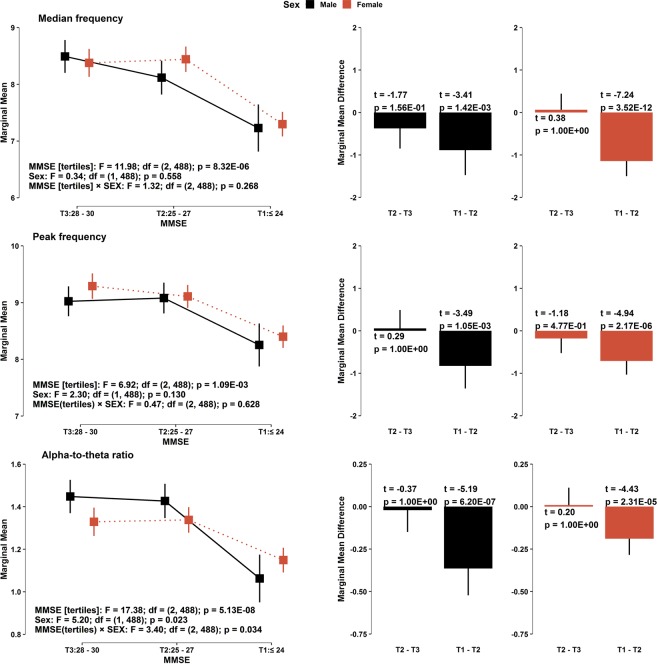
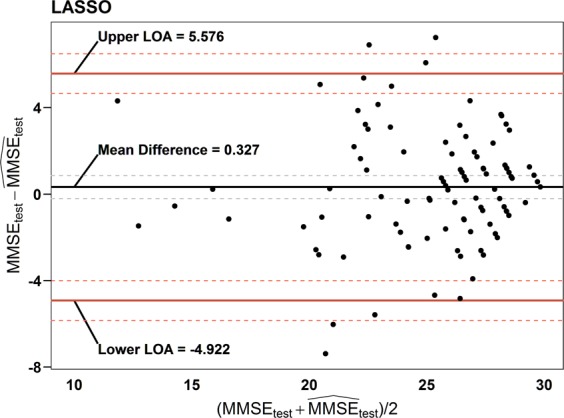
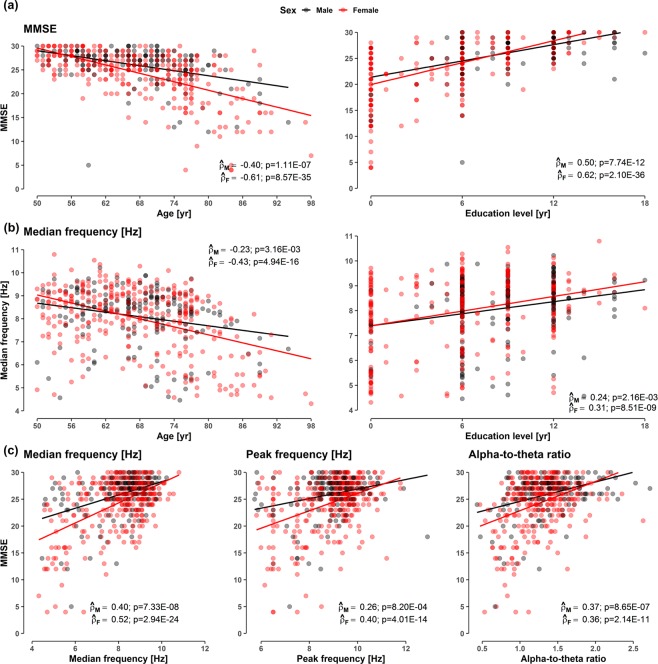
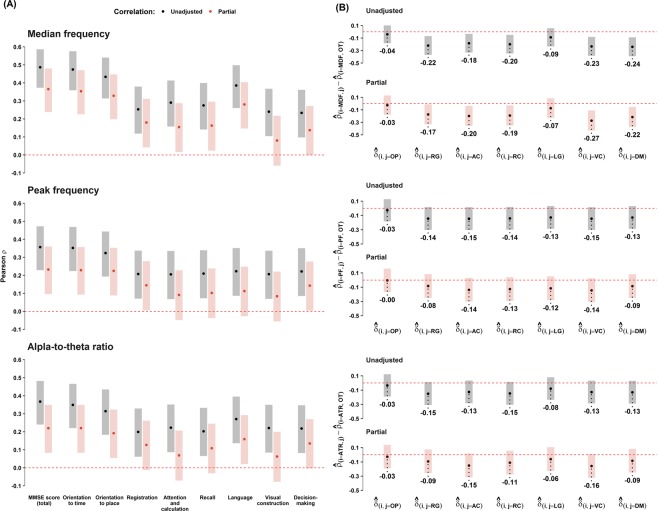
We investigated whether cognitive decline could be explained by resting-state electroencephalography (EEG) biomarkers measured in prefrontal regions that reflect the slowing of intrinsic EEG oscillations. In an aged population dwelling in a rural community (total = 496, males = 165, females = 331), we estimated the global cognitive decline using the Mini-Mental State Examination (MMSE) and measured resting-state EEG parameters at the prefrontal regions of Fp1 and Fp2 in an eyes-closed state. Using a tertile split method, the subjects were classified as T3 (MMSE 28-30, N = 162), T2 (MMSE 25-27, N = 179), or T1 (MMSE ≤ 24, N = 155). The EEG slowing biomarkers of the median frequency, peak frequency and alpha-to-theta ratio decreased as the MMSE scores decreased from T2 to T1 for both sexes (-5.19 ≤ t-value ≤ -3.41 for males and -7.24 ≤ t-value ≤ -4.43 for females) after adjusting for age and education level. Using a double cross-validation procedure, we developed a prediction model for the MMSE scores using the EEG slowing biomarkers and demographic covariates of sex, age and education level. The maximum intraclass correlation coefficient between the MMSE scores and model-predicted values was 0.757 with RMSE = 2.685. The resting-state EEG biomarkers showed significant changes in people with early cognitive decline and correlated well with the MMSE scores. Resting-state EEG slowing measured in the prefrontal regions may be useful for the screening and follow-up of global cognitive decline in elderly individuals.
我们研究了静息态脑电图(EEG)标志物在前额区域的测量是否可以解释认知能力下降,这些标志物反映了内在 EEG 振荡的减慢。在一个居住在农村社区的老年人群中(总计 496 人,男性 165 人,女性 331 人),我们使用 Mini-Mental State Examination(MMSE)来估计整体认知能力下降,并在闭眼状态下测量前额区域 Fp1 和 Fp2 的静息态 EEG 参数。使用三分位分割方法,将受试者分为 T3(MMSE 28-30,N=162)、T2(MMSE 25-27,N=179)或 T1(MMSE≤24,N=155)。在调整了年龄和教育程度后,对于男性,从中等 MMSE 评分(T2)到较低 MMSE 评分(T1),中值频率、峰频率和α-θ 比值的 EEG 减慢生物标志物下降(男性的 t 值范围为-5.19 至-3.41,女性的 t 值范围为-7.24 至-4.43)。使用双交叉验证程序,我们使用 EEG 减慢生物标志物和性别、年龄和教育程度的人口统计学协变量开发了 MMSE 评分的预测模型。MMSE 评分和模型预测值之间的最大组内相关系数为 0.757,RMSE=2.685。在有早期认知能力下降的人群中,静息态 EEG 生物标志物显示出显著变化,与 MMSE 评分密切相关。前额区域的静息态 EEG 减慢可能有助于筛选和随访老年人的整体认知能力下降。