Department of Neurobiology, Weizmann Institute of Science, Rehovot, 76000, Israel.
Department of Physiology and Biophysics, University of Washington, Seattle, WA, 98195, USA.
Sci Rep. 2019 Jul 18;9(1):10448. doi: 10.1038/s41598-019-46908-z.
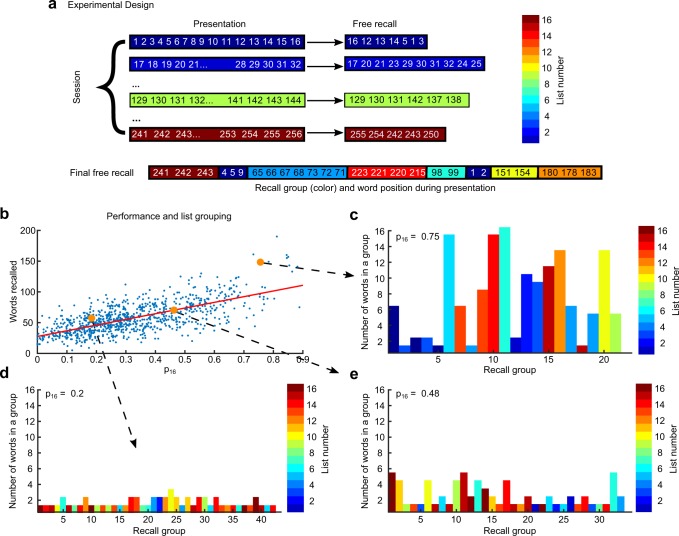
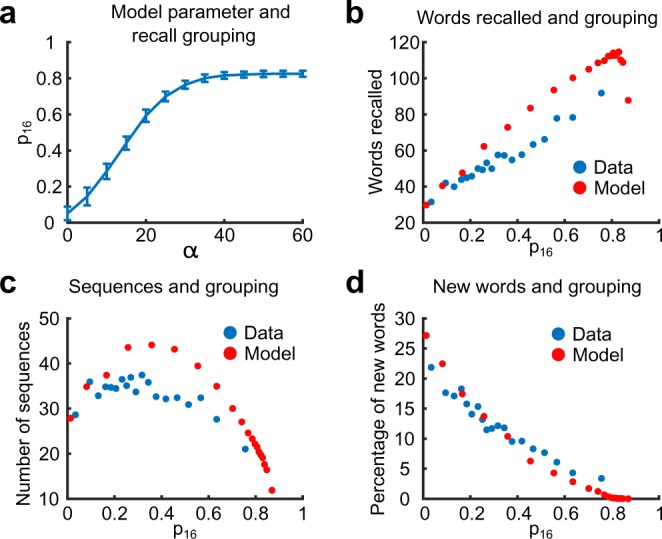
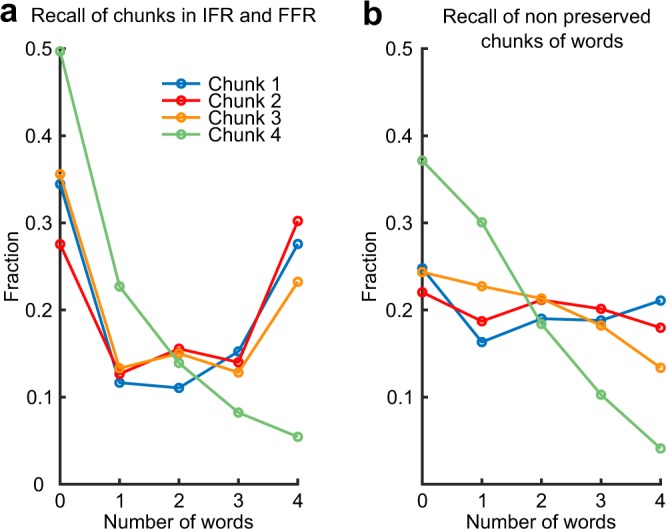
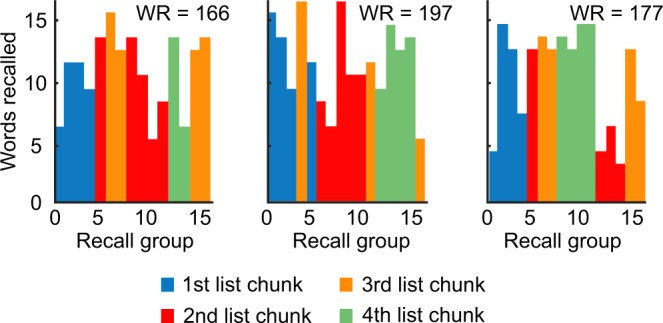
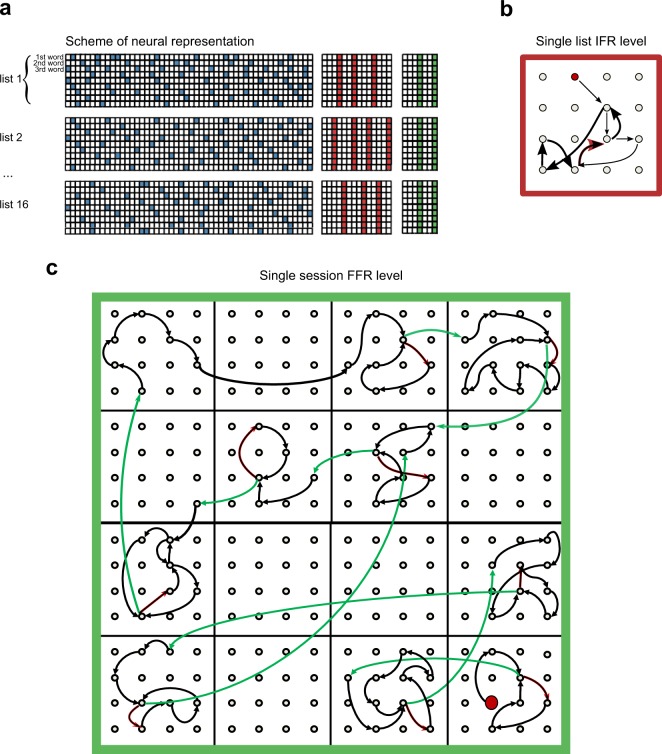
Structured information is easier to remember and recall than random one. In real life, information exhibits multi-level hierarchical organization, such as clauses, sentences, episodes and narratives in language. Here we show that multi-level grouping emerges even when participants perform memory recall experiments with random sets of words. To quantitatively probe brain mechanisms involved in memory structuring, we consider an experimental protocol where participants perform 'final free recall' (FFR) of several random lists of words each of which was first presented and recalled individually. We observe a hierarchy of grouping organizations of FFR, most notably many participants sequentially recalled relatively long chunks of words from each list before recalling words from another list. Moreover, participants who exhibited strongest organization during FFR achieved highest levels of performance. Based on these results, we develop a hierarchical model of memory recall that is broadly compatible with our findings. Our study shows how highly controlled memory experiments with random and meaningless material, when combined with simple models, can be used to quantitatively probe the way meaningful information can efficiently be organized and processed in the brain.
结构信息比随机信息更容易记忆和回忆。在现实生活中,信息表现出多层次的层次组织,如语言中的子句、句子、情节和叙述。在这里,我们表明,即使参与者使用随机单词集进行记忆回忆实验,也会出现多层次的分组。为了定量探测参与记忆结构的大脑机制,我们考虑了一种实验方案,其中参与者对几个随机单词列表进行“最终自由回忆”(FFR),每个列表首先呈现并单独回忆。我们观察到 FFR 的分组组织层次结构,最值得注意的是,许多参与者在回忆另一个列表中的单词之前,会从每个列表中顺序回忆相对较长的单词块。此外,在 FFR 期间表现出最强组织能力的参与者达到了最高的表现水平。基于这些结果,我们开发了一种记忆回忆的层次模型,该模型与我们的发现广泛兼容。我们的研究表明,如何使用随机和无意义的材料进行高度受控的记忆实验,并结合简单的模型,可以用于定量探测大脑中有效组织和处理有意义信息的方式。