Department of Neurology, Affiliated Hospital of Jiangsu University, Zhenjiang, Jiangsu 212000, P.R. China.
School of Medicine, Jiangsu University, Zhenjiang, Jiangsu 212000, P.R. China.
Mol Med Rep. 2019 Sep;20(3):2135-2142. doi: 10.3892/mmr.2019.10483. Epub 2019 Jul 9.
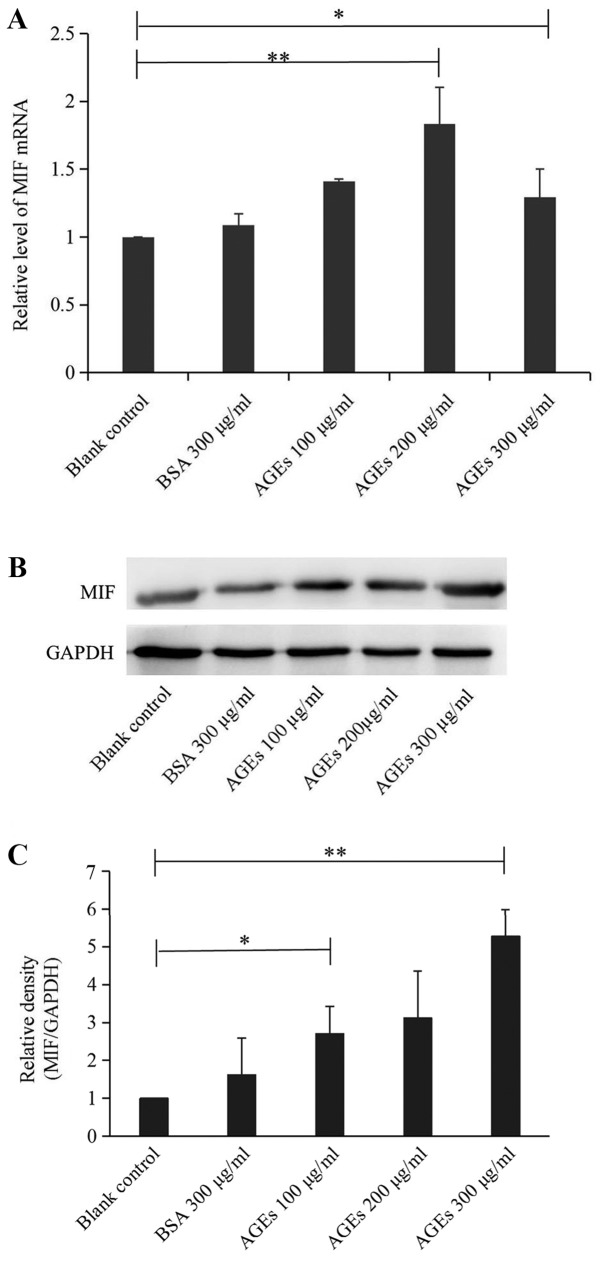
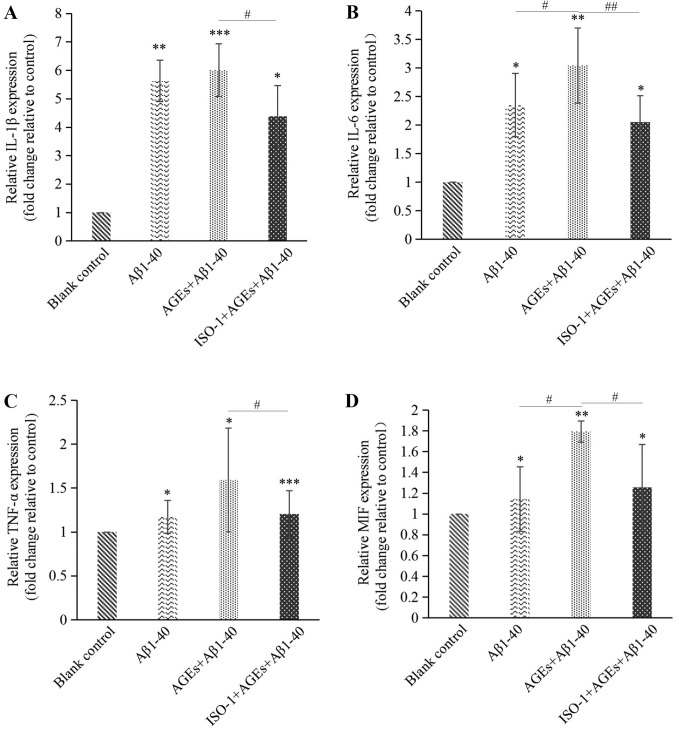
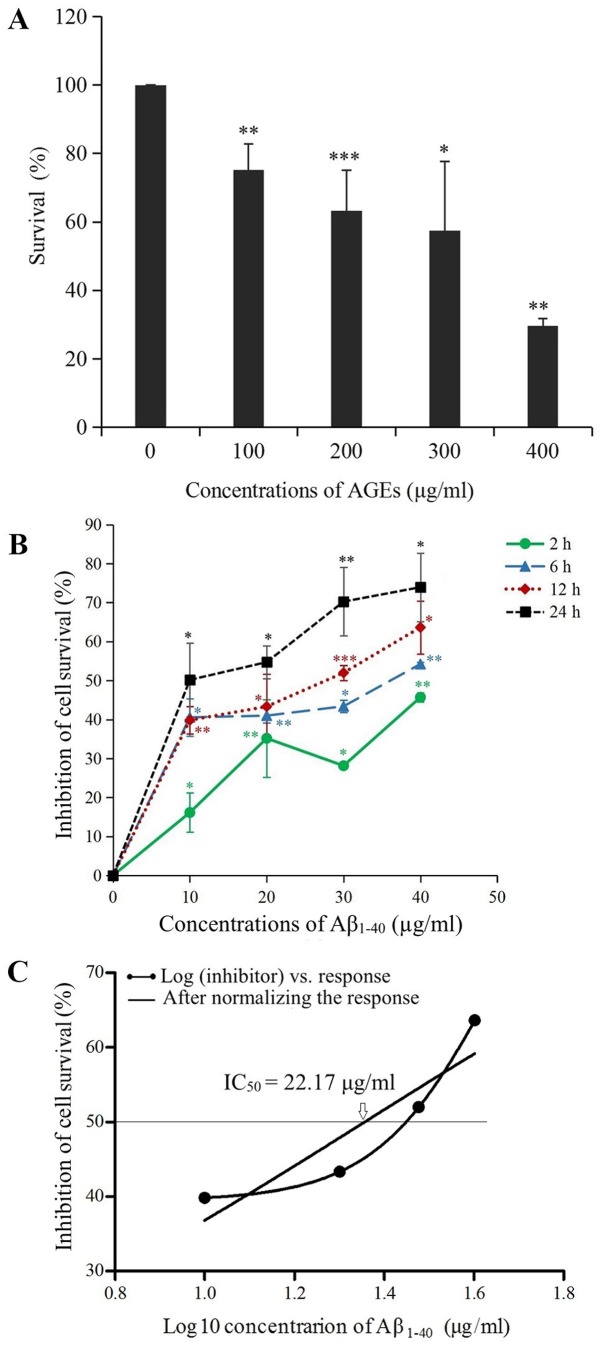
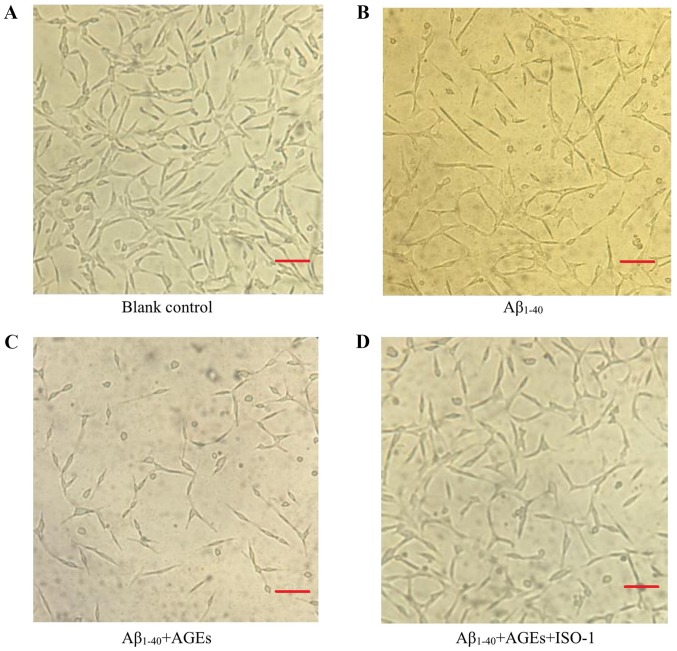
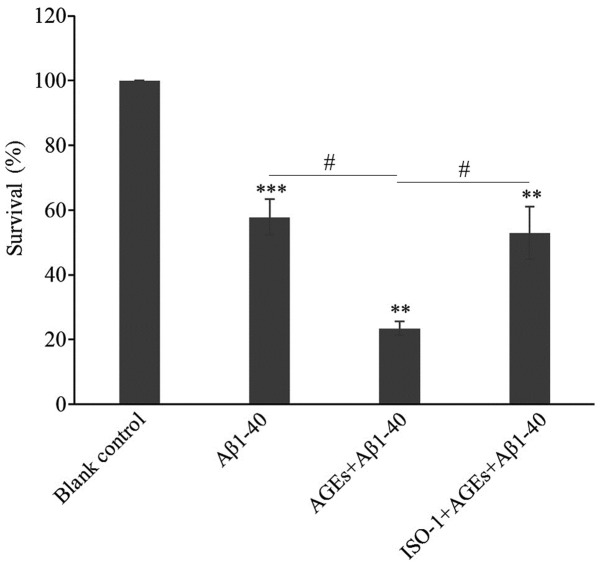
Advanced glycation end products (AGEs) are important pathogenic substances involved in diabetes mellitus (DM) and its complications. AGEs also serve important roles in promoting the development of Alzheimer's disease (AD). Macrophage migration inhibitory factor (MIF), an inflammatory stimulant and a pathogenic factor involved in DM, was previously reported to be present at increased levels in the cerebrospinal fluid of patients with AD and mild cognitive impairment compared with age‑matched healthy controls. By investigating the association between AGEs and MIF, and the effects of neuroinflammation on AD, the present study aimed to increase understanding of the specific molecular mechanisms involved in the pathogenesis of DM and AD, and the connection between these diseases. PC12 cells were cultured in vitro; the levels of MIF mRNA and protein were determined using reverse transcription‑quantitative (RT‑q)PCR and western blot analyses. The optimal concentrations of AGEs and amyloid β 1‑40 (Aβ1‑40) were also determined in the cell model of AD using Cell Counting Kit‑8 and MTT assays. Cell numbers and morphological changes were observed following the treatment of Aβ1‑40‑stimulated PC12 cells with AGEs and the MIF inhibitor (S,R)‑3‑(4‑hydroxyphenyl)‑4,5‑dihydro‑5‑isoxazole acetic acid methyl ester (ISO‑1). The mRNA expression levels of interleukin (IL)‑1β, IL‑6, tumor necrosis factor‑α (TNF‑α) and MIF were determined via RT‑qPCR analysis. The results showed that the levels of MIF mRNA and protein were significantly increased in cells treated with AGEs compared with the control group. In the AD model group, the inhibition of PC12 cell growth was significantly increased, and the mRNA expression levels of IL‑1β, IL‑6, TNF‑α and MIF were also increased. Compared with treatment with AGEs alone, the combination of AGEs treatment with ISO‑1 significantly improved the survival rate and resulted in the reduced expression of inflammatory mediators in the AD cell model. Thus, ISO‑1 reduced AGEs‑mediated damage in the AD cell model. This may be a consequence of AGEs‑mediated MIF expression promoting neuritis in the AD cell model, whereas ISO‑1 decreased the expression of neuroinflammatory mediators.
晚期糖基化终产物(AGEs)是糖尿病(DM)及其并发症的重要致病物质。AGEs 在促进阿尔茨海默病(AD)的发展中也起着重要作用。先前有报道称,巨噬细胞移动抑制因子(MIF)作为一种炎症刺激物和 DM 的致病因素,在 AD 和轻度认知障碍患者的脑脊液中水平升高,与年龄匹配的健康对照组相比。通过研究 AGEs 与 MIF 之间的关系,以及神经炎症对 AD 的影响,本研究旨在增加对 DM 和 AD 发病机制中特定分子机制的理解,以及这些疾病之间的联系。体外培养 PC12 细胞;采用逆转录-定量(RT-q)PCR 和 Western blot 分析测定 MIF mRNA 和蛋白水平。通过细胞计数试剂盒-8 和 MTT 测定法,还确定了 AD 细胞模型中 AGEs 和淀粉样β 1-40(Aβ1-40)的最佳浓度。用 AGEs 和 MIF 抑制剂(S,R)-3-(4-羟基苯基)-4,5-二氢-5-异噁唑乙酸甲酯(ISO-1)处理 Aβ1-40 刺激的 PC12 细胞后,观察细胞数量和形态变化。通过 RT-qPCR 分析测定白细胞介素(IL)-1β、IL-6、肿瘤坏死因子-α(TNF-α)和 MIF 的 mRNA 表达水平。结果显示,与对照组相比,AGEs 处理的细胞中 MIF mRNA 和蛋白水平显著升高。在 AD 模型组中,PC12 细胞生长抑制明显增加,IL-1β、IL-6、TNF-α和 MIF 的 mRNA 表达水平也升高。与单独用 AGEs 处理相比,AGEs 联合 ISO-1 处理显著提高了 AD 细胞模型的存活率,并降低了炎症介质的表达。因此,ISO-1 减轻了 AD 细胞模型中 AGEs 介导的损伤。这可能是由于 AGEs 介导的 MIF 表达促进了 AD 细胞模型中的神经炎,而 ISO-1 降低了神经炎症介质的表达。