Department of Immunology and Molecular Biology, Makerere University College of Health Sciences, Kampala, Uganda.
Medical Research Council/Uganda Virus Research Institute, Uganda Research Unit on AIDS, Entebbe, Uganda.
J Infect Dis. 2019 Sep 26;220(9):1414-1419. doi: 10.1093/infdis/jiz320.
Monocyte dysfunction may persist during antiretroviral therapy (ART).
Frozen peripheral blood mononuclear cells of 30 human immunodeficiency virus (HIV)-infected ART-treated adults with sustained viral suppression and CD4 counts ≥500 cells/µL were consecutively analyzed for monocyte phenotypes and function.
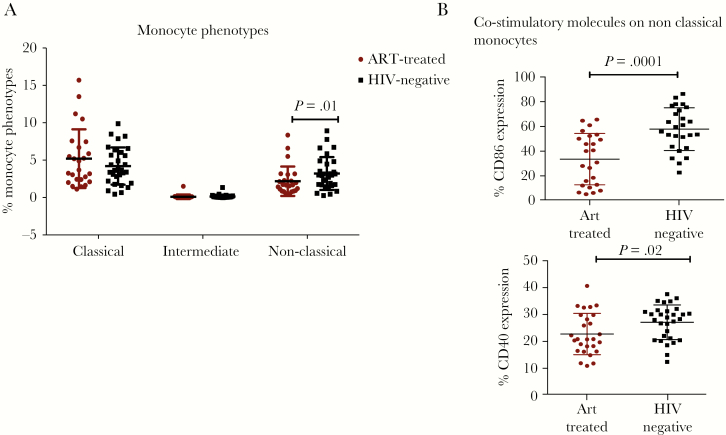
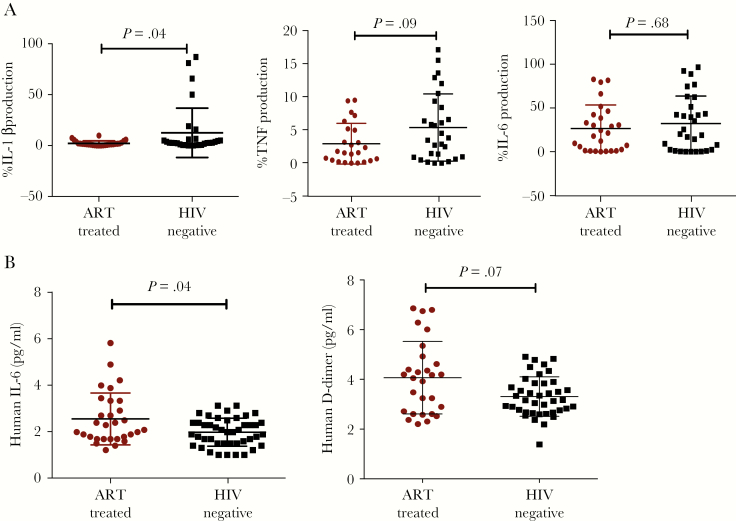
Nonclassical monocytes (CD14+, CD16++), interleukin (IL)-1β production, and expression of CD40 and CD86 were lower among ART-treated HIV-infected adults relative to age-matched HIV-negative adults (P = .01, P = .01, and P = .02, respectively). Intestinal fatty acid-binding protein, IL6, and soluble CD14 were higher among HIV-infected adults relative to HIV-negative adults (P = .0002, P = .04, and P = .0017, respectively).
Further investigation is required to understand drivers of persistent monocyte activation and dysfunction.
在抗逆转录病毒治疗 (ART) 期间,单核细胞功能障碍可能持续存在。
连续分析了 30 名 HIV 感染的接受 ART 治疗的成年人的冷冻外周血单核细胞,这些成年人的病毒载量持续抑制且 CD4 计数≥500 个/µL,以分析单核细胞表型和功能。
与年龄匹配的 HIV 阴性成年人相比,ART 治疗的 HIV 感染成年人的非经典单核细胞(CD14+,CD16++)、白细胞介素 (IL)-1β 的产生以及 CD40 和 CD86 的表达水平较低(P =.01,P =.01 和 P =.02,分别)。与 HIV 阴性成年人相比,HIV 感染成年人的肠脂肪酸结合蛋白、IL6 和可溶性 CD14 水平更高(P =.0002,P =.04 和 P =.0017,分别)。
需要进一步研究以了解持续的单核细胞活化和功能障碍的驱动因素。