Thomas Graham, Tacke Robert, Hedrick Catherine C, Hanna Richard N
From the Division of Inflammation Biology, La Jolla Institute for Allergy and Immunology, CA.
Arterioscler Thromb Vasc Biol. 2015 Jun;35(6):1306-16. doi: 10.1161/ATVBAHA.114.304650. Epub 2015 Apr 2.
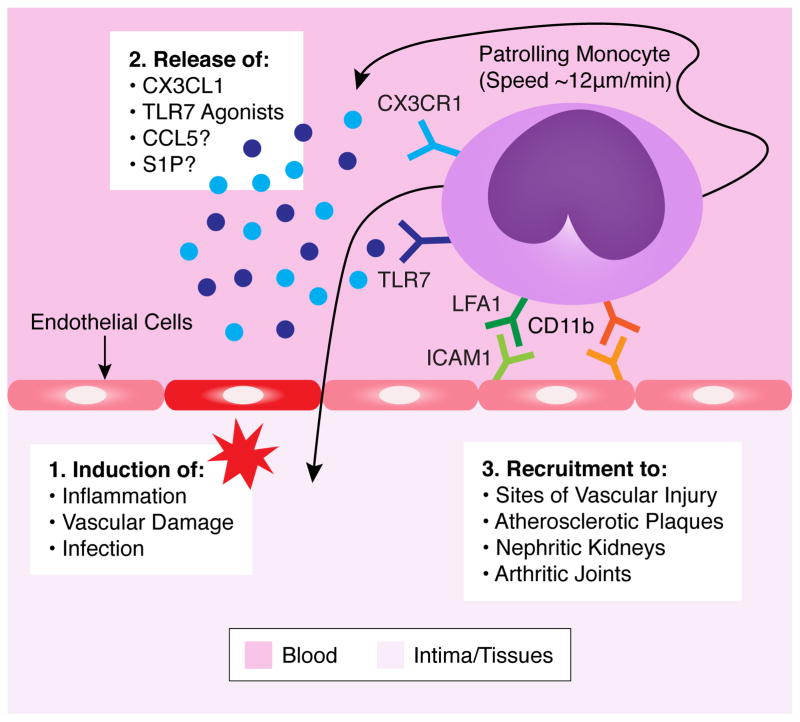
Nonclassical patrolling monocytes are characterized by their unique ability to actively patrol the vascular endothelium under homeostatic and inflammatory conditions. Patrolling monocyte subsets (CX3CR1(high)Ly6C(-) in mouse and CX3CR1(high)CD14(dim)CD16(+) in humans) are distinct from the classical monocyte subsets (CCR2(high)Ly6C(+) in mouse and CCR2(high)CD14(+)CD16(-) in humans) and exhibit unique functions in the vasculature and inflammatory disease. Patrolling monocytes function in several disease settings to remove damaged cells and debris from the vasculature and have been associated with wound healing and the resolution of inflammation in damaged tissues. This review highlights the unique functions of these patrolling monocytes in the vasculature and during inflammation.
非经典巡逻单核细胞的特征在于其在稳态和炎症条件下主动巡逻血管内皮的独特能力。巡逻单核细胞亚群(小鼠中的CX3CR1(高)Ly6C(-)和人类中的CX3CR1(高)CD14(低)CD16(+))与经典单核细胞亚群(小鼠中的CCR2(高)Ly6C(+)和人类中的CCR2(高)CD14(+)CD16(-))不同,并且在血管系统和炎症性疾病中表现出独特功能。巡逻单核细胞在多种疾病环境中发挥作用,以清除血管系统中的受损细胞和碎片,并与伤口愈合以及受损组织炎症的消退相关。本综述强调了这些巡逻单核细胞在血管系统和炎症过程中的独特功能。