Cincinnati Children's Hospital Medical Center.
University of Cincinnati.
Motor Control. 2020 Jan 1;24(1):75-90. doi: 10.1123/mc.2017-0076.
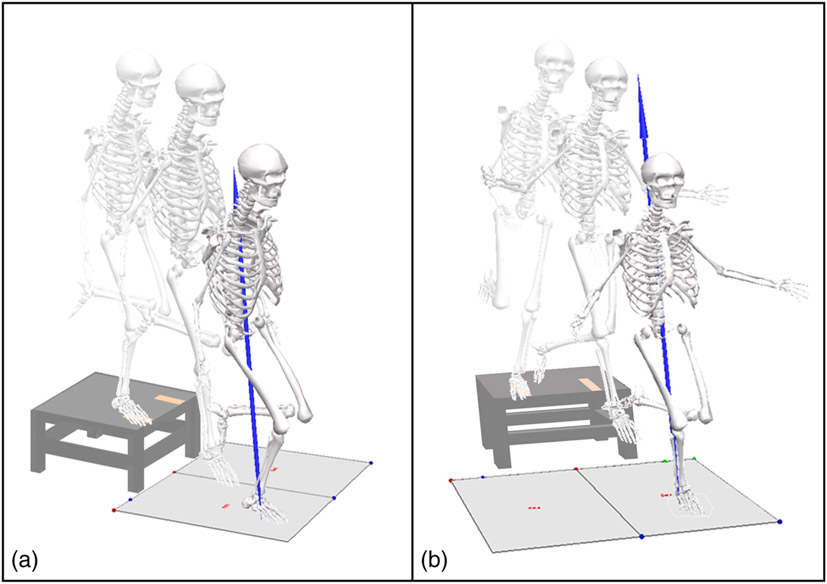
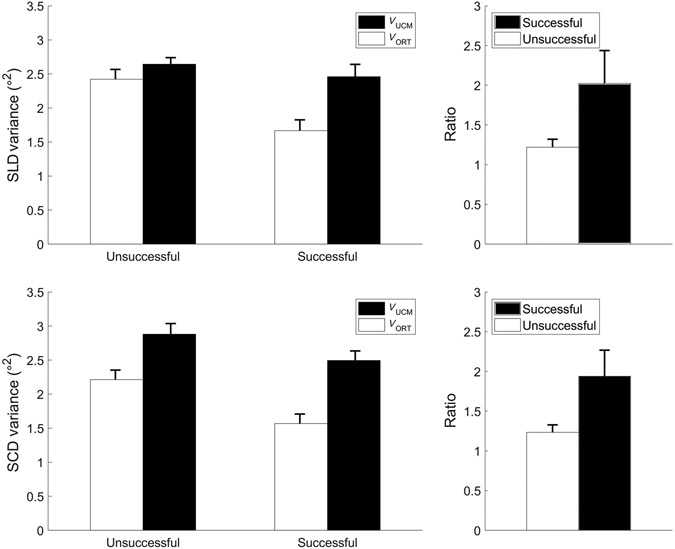
Biomechanical analysis can effectively identify factors associated with task performance and injury risk, but often does not account for the interaction among the components that underlie task execution. Uncontrolled manifold (UCM) analyses were applied to data from 38 female, adolescent athletes performing single-leg drop landings and were used to differentiate successful and unsuccessful task performance by examining the frontal plane joint variance within the UCM (VUCM) that stabilized the horizontal center of mass position (VUCM) and within the orthogonal subspace (VORT). The UCM revealed stronger coordination, indicated by the VUCM/VORT ratio, in the successful condition. This may inform future research examining reduced motor coordination in failed movement tasks and its relation to injury risk and allow for targeted interventions that consider coordination processes rather than joint-specific outcomes.
生物力学分析可以有效地识别与任务表现和受伤风险相关的因素,但通常无法解释任务执行所涉及的各个组成部分之间的相互作用。本研究将非受控制运动自由度(uncontrolled manifold,UCM)分析应用于 38 名执行单腿跳下着地的女性青少年运动员的数据,通过检查 UCM 内(VUCM)稳定水平重心位置的关节变异性和正交子空间(VORT)内的 UCM,来区分成功和失败的任务表现。UCM 揭示了成功条件下更强的协调,表现为 VUCM/VORT 比值更高。这可能为未来研究提供信息,研究在失败的运动任务中运动协调能力降低及其与受伤风险的关系,并允许进行有针对性的干预,考虑协调过程而不是关节特异性结果。