Weinkamer Richard, Eberl Christoph, Fratzl Peter
Department of Biomaterials, Max Planck Institute of Colloids and Interfaces, 14476 Potsdam, Germany.
Fraunhofer Institute for Mechanics of Materials, 79108 Freiburg, Germany.
Biomimetics (Basel). 2019 Jul 9;4(3):46. doi: 10.3390/biomimetics4030046.
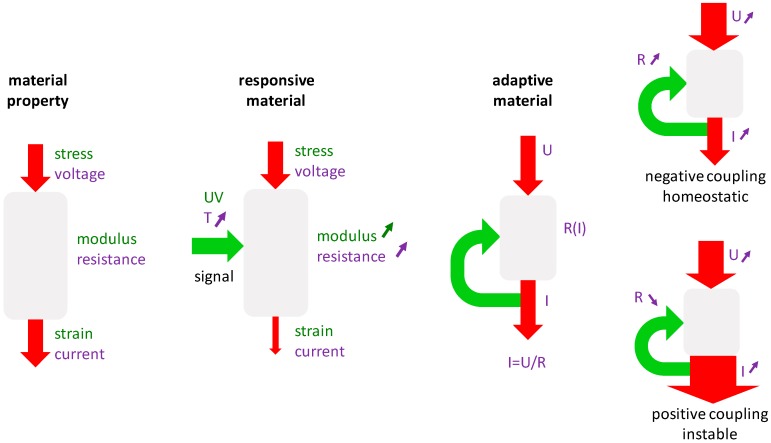
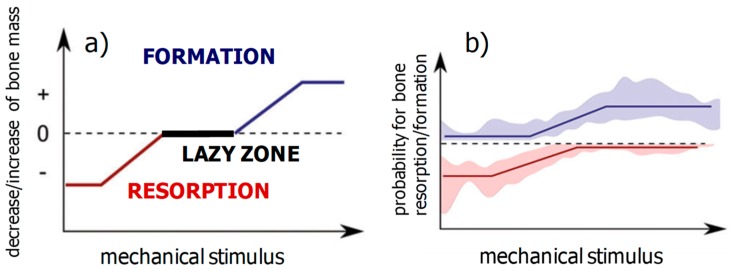
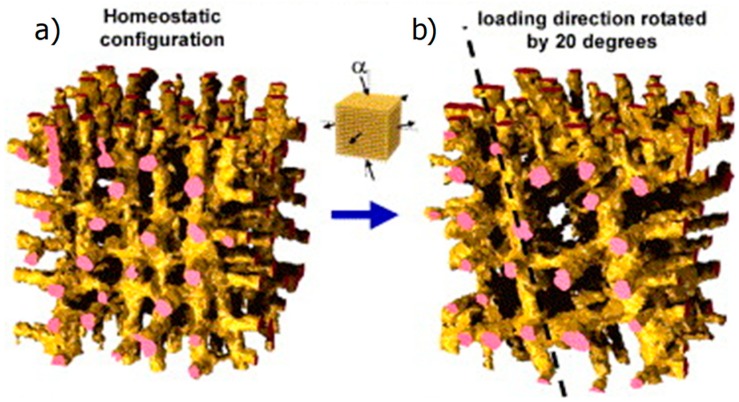
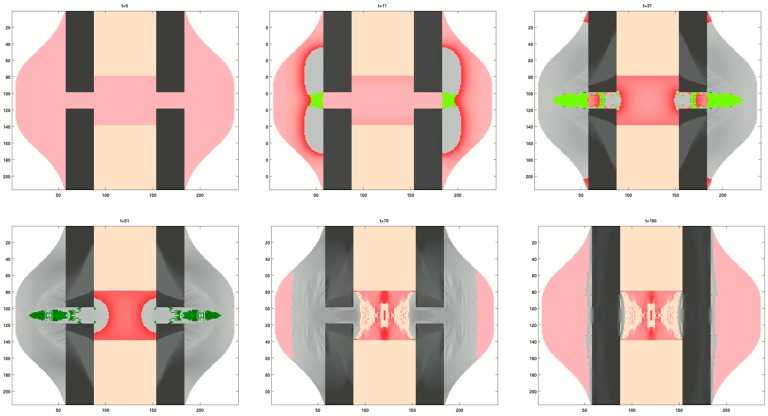
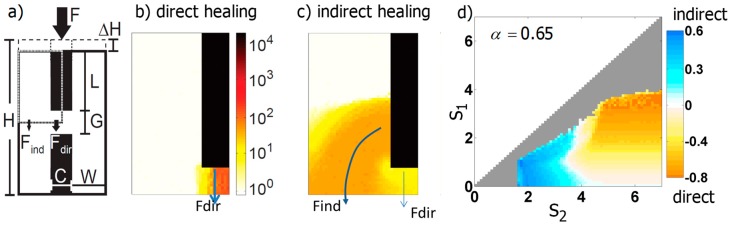
The material bone has attracted the attention of material scientists due to its fracture resistance and ability to self-repair. A mechanoregulated exchange of damaged bone using newly synthesized material avoids the accumulation of fatigue damage. This remodeling process is also the basis for structural adaptation to common loading conditions, thereby reducing the probability of material failure. In the case of fracture, an initial step of tissue formation is followed by a mechanobiological controlled restoration of the pre-fracture state. The present perspective focuses on these mechanobiological aspects of bone remodeling and healing. Specifically, the role of the control function is considered, which describes mechanoregulation as a link between mechanical stimulation and the local response of the material through changes in structure or material properties. Mechanical forces propagate over large distances leading to a complex non-local feedback between mechanical stimulation and material response. To better understand such phenomena, computer models are often employed. As expected from control theory, negative and positive feedback loops lead to entirely different time evolutions, corresponding to stable and unstable states of the material system. After some background information about bone remodeling and healing, we describe a few representative models, the corresponding control functions, and their consequences. The results are then discussed with respect to the potential design of synthetic materials with specific self-repair properties.
骨材料因其抗断裂性和自我修复能力而吸引了材料科学家的关注。利用新合成材料对受损骨进行机械调节交换可避免疲劳损伤的积累。这种重塑过程也是结构适应常见载荷条件的基础,从而降低材料失效的概率。在骨折的情况下,组织形成的初始步骤之后是对骨折前状态的力学生物学控制修复。本文观点聚焦于骨重塑和愈合的这些力学生物学方面。具体而言,考虑了控制功能的作用,它将机械调节描述为通过结构或材料特性的变化在机械刺激与材料局部响应之间的联系。机械力在远距离传播,导致机械刺激与材料响应之间形成复杂的非局部反馈。为了更好地理解此类现象,经常使用计算机模型。正如控制理论所预期的那样,负反馈和正反馈回路会导致完全不同的时间演化,分别对应于材料系统的稳定和不稳定状态。在介绍了一些关于骨重塑和愈合的背景信息之后,我们描述了一些代表性模型、相应的控制功能及其结果。然后就具有特定自我修复特性的合成材料的潜在设计对结果进行了讨论。