Department of Applied Physics, Aalto University, P.O. Box 15100, Espoo, FI 02150, Finland.
Nat Commun. 2023 Jun 22;14(1):3717. doi: 10.1038/s41467-023-39446-w.
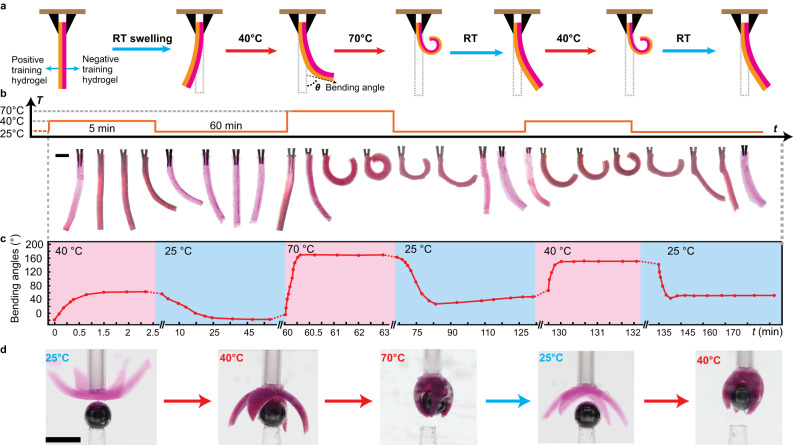
Inspired by biological systems, trainable responsive materials have received burgeoning research interests for future adaptive and intelligent material systems. However, the trainable materials to date typically cannot perform active work, and the training allows only one direction of functionality change. Here, we demonstrate thermally trainable hydrogel systems consisting of two thermoresponsive polymers, where the volumetric response of the system upon phase transitions enhances or decreases through a training process above certain threshold temperature. Positive or negative training of the thermally induced deformations can be achieved, depending on the network design. Importantly, softening, stiffening, or toughening of the hydrogel can be achieved by the training process. We demonstrate trainable hydrogel actuators capable of performing increased active work or implementing an initially impossible task. The reported dual network hydrogels provide a new training strategy that can be leveraged for bio-inspired soft systems such as adaptive artificial muscles or soft robotics.
受生物系统启发,可训练响应材料因其未来的适应性和智能材料系统而受到越来越多的研究关注。然而,迄今为止,可训练的材料通常不能进行主动工作,并且训练仅允许功能变化的一个方向。在这里,我们展示了由两种热响应聚合物组成的热可训练水凝胶系统,其中系统在相变时的体积响应通过在超过一定阈值温度的训练过程增强或降低。可以根据网络设计实现热诱导变形的正或负训练。重要的是,通过训练过程可以实现水凝胶的软化、硬化或增韧。我们展示了可训练水凝胶致动器,它们能够执行增加的主动工作或执行最初不可能的任务。所报道的双网络水凝胶提供了一种新的训练策略,可用于仿生软系统,例如自适应人工肌肉或软机器人。