Universidade de São Paulo (USP), São Paulo, SP, Brazil.
Universidade de São Paulo (USP), Hospital de Reabilitação de Anomalias Craniofaciais, Seção de Implante Coclear, Bauru, SP, Brazil.
Braz J Otorhinolaryngol. 2020 Nov-Dec;86(6):720-726. doi: 10.1016/j.bjorl.2019.05.006. Epub 2019 Jun 18.
The increase in the spectral information offered by the sound processing strategy HiRes 120 has led to great expectations for the pediatric population. Due to a shorter duration of auditory deprivation and higher neural plasticity, children could benefit more substantially from the spectral information of this sound processing strategy.
To compare auditory and language skills in Brazilian children with cochlear implants using the HiRes and HiRes 120 sound processing strategies.
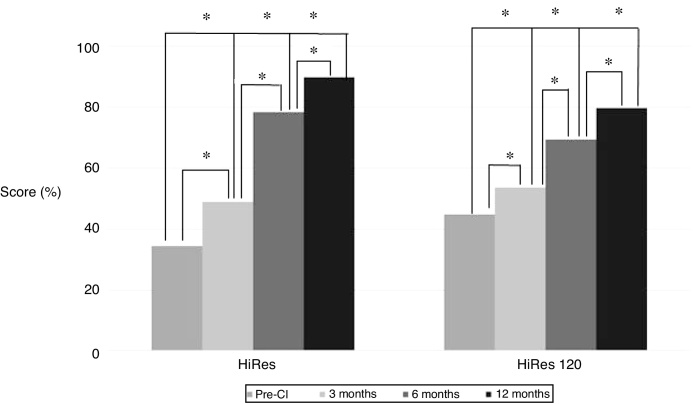
Thirty children, aged 1-3 years, with congenital hearing loss, were divided into two groups, according to the signal processing strategy adjusted at the time of the cochlear implant activation. The assessed children were matched according to chronological age and the time of the cochlear implant use. The auditory and language skills were evaluated longitudinally through the Infant-Toddler Meaningful Auditory Integration Scale and Production Infant Scale Evaluation, carried out before surgery, and 3, 6 and 12 months after device implantation. The Mann-Whitney test was applied for the comparison between the two groups with a 5% significance level.
The findings indicated development of hearing and language skills in the first year of cochlear implant use; however, there was no statistically significant difference in the evolution of such skills due to the adjusted processing strategy in the activation of the cochlear implant electrodes.
The development of auditory and language skills in the assessed children was similar during the entire study period, regardless of which signal processing strategy was used.
高分辨率 120 声音处理策略所提供的频谱信息增加,使人们对儿科人群寄予厚望。由于听觉剥夺时间较短和神经可塑性较高,儿童可能会从这种声音处理策略的频谱信息中获益更多。
比较使用高分辨率和高分辨率 120 声音处理策略的巴西儿童的听觉和语言技能。
将 30 名年龄在 1-3 岁之间、患有先天性听力损失的儿童分为两组,根据耳蜗植入激活时调整的信号处理策略进行分组。对评估的儿童根据年龄和耳蜗植入使用时间进行匹配。通过婴儿-幼儿有意义听觉整合量表和婴儿生产量表评估进行纵向评估听觉和语言技能,在手术前、植入设备后 3、6 和 12 个月进行评估。采用曼-惠特尼检验比较两组,显著性水平为 5%。
研究结果表明,在耳蜗植入使用的第一年中,听力和语言技能有所发展;然而,由于耳蜗植入电极激活时调整的处理策略,这些技能的发展并没有统计学上的显著差异。
在整个研究期间,无论使用哪种信号处理策略,评估儿童的听觉和语言技能发展都相似。