Neuroscience Graduate Program, University of Cincinnati College of Medicine, Cincinnati, OH 45219.
Division of Neurosurgery, Cincinnati Children's Hospital Medical Center, Cincinnati, OH 45229.
eNeuro. 2019 Aug 6;6(4). doi: 10.1523/ENEURO.0492-18.2019. Print 2019 Jul/Aug.
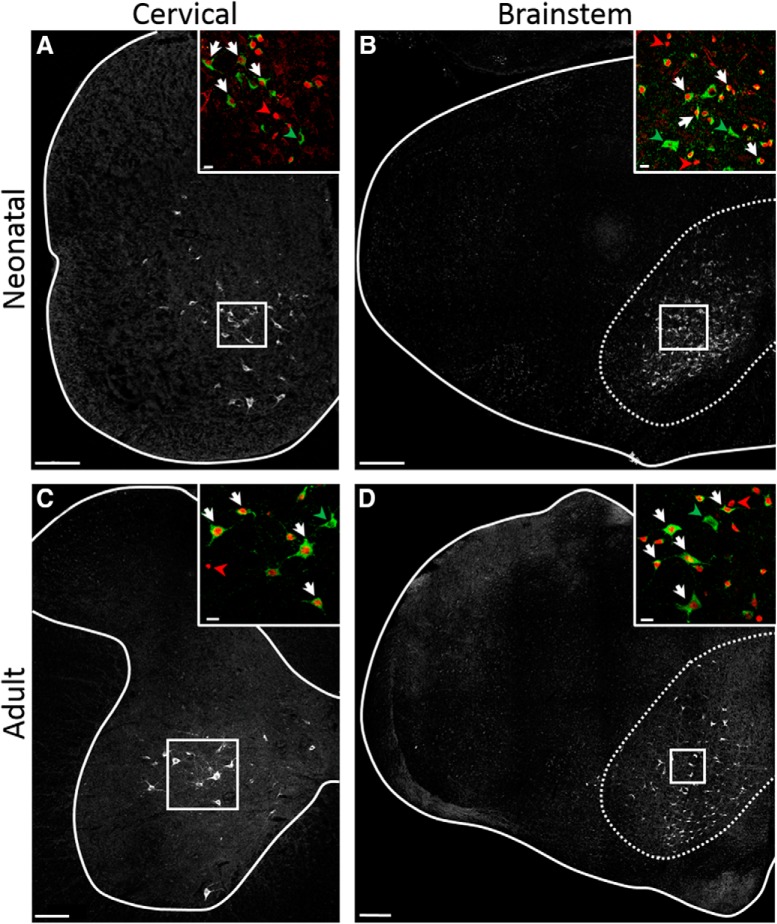
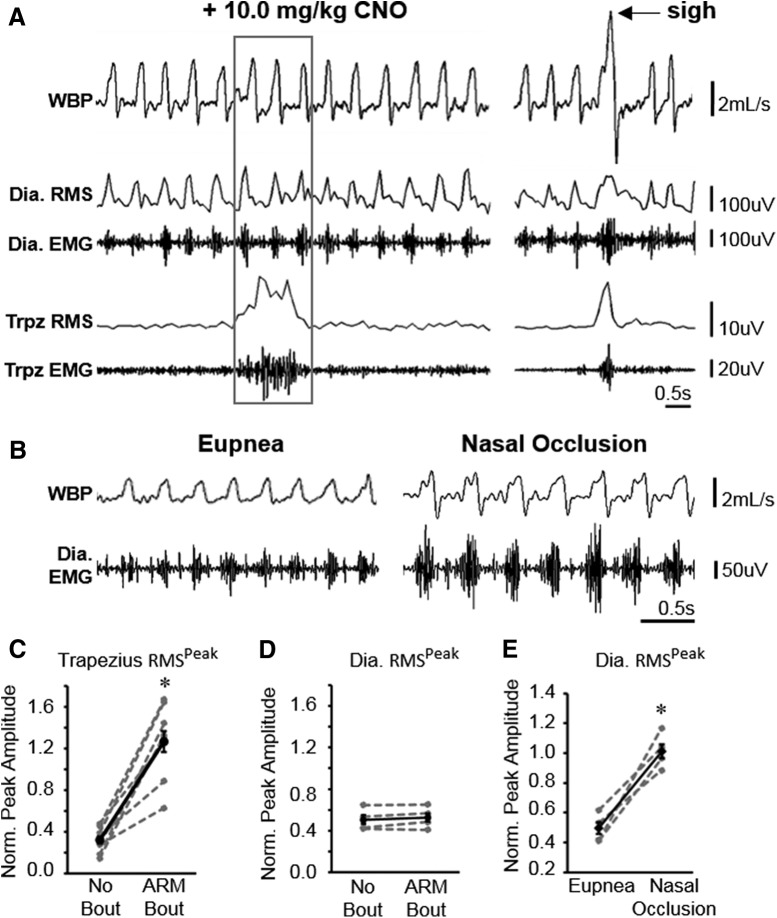
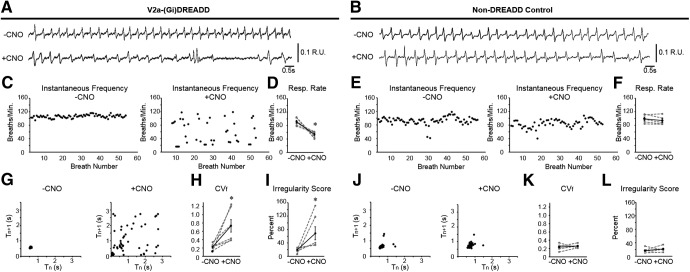
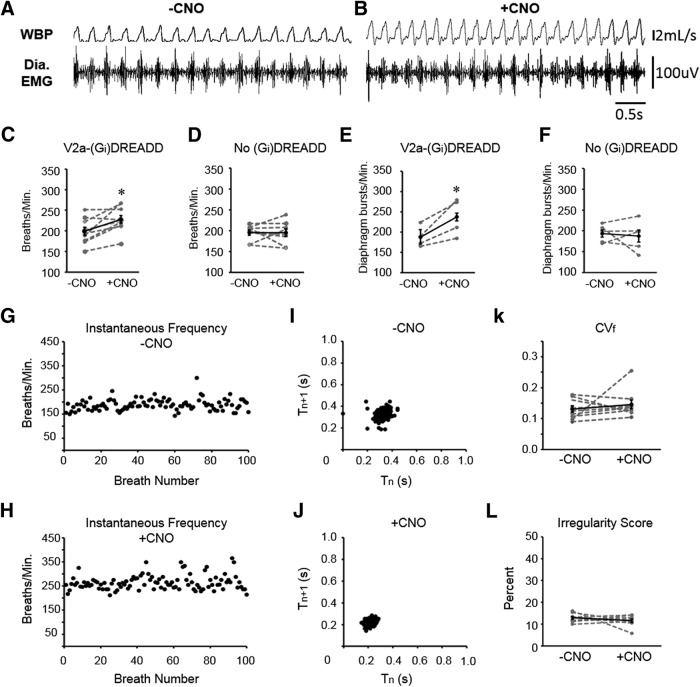
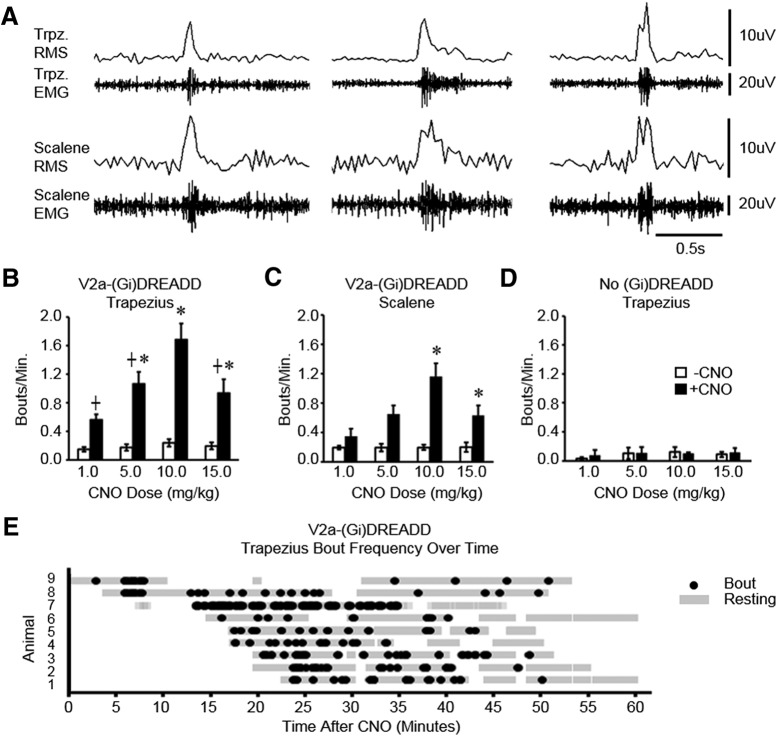
Breathing requires precise control of respiratory muscles to ensure adequate ventilation. Neurons within discrete regions of the brainstem produce oscillatory activity to control the frequency of breathing. Less is understood about how spinal and pontomedullary networks modulate the activity of respiratory motor neurons to produce different patterns of activity during different behaviors (i.e., during exercise, coughing, swallowing, vocalizing, or at rest) or following disease or injury. Here, we use a chemogenetic approach to inhibit the activity of glutamatergic V2a neurons in the brainstem and spinal cord of neonatal and adult mice to assess their potential roles in respiratory rhythm generation and patterning respiratory muscle activity. Using whole-body plethysmography (WBP), we show that V2a neuron function is required in neonatal mice to maintain the frequency and regularity of respiratory rhythm. However, silencing V2a neurons in adult mice increases respiratory frequency and ventilation, without affecting regularity. Thus, the excitatory drive provided by V2a neurons is less critical for respiratory rhythm generation in adult compared to neonatal mice. In addition, we used simultaneous EMG recordings of the diaphragm and extradiaphragmatic respiratory muscles in conscious adult mice to examine the role of V2a neurons in patterning respiratory muscle activity. We find that silencing V2a neurons activates extradiaphragmatic respiratory muscles at rest, when they are normally inactive, with little impact on diaphragm activity. Thus, our results indicate that V2a neurons participate in a circuit that serves to constrain the activity of extradiaphragmatic respiratory muscles so that they are active only when needed.
呼吸需要精确控制呼吸肌以确保充足的通气。脑桥和延髓内的离散区域的神经元产生振荡活动以控制呼吸的频率。对于脊髓和桥脑延髓网络如何调节呼吸运动神经元的活动以在不同行为(例如,运动、咳嗽、吞咽、发声或休息时)或疾病或损伤后产生不同的活动模式,人们了解较少。在这里,我们使用化学遗传方法抑制新生和成年小鼠脑桥和脊髓中的谷氨酸能 V2a 神经元的活性,以评估它们在呼吸节律产生和调节呼吸肌活动中的潜在作用。使用全身 plethysmography(WBP),我们表明 V2a 神经元功能在新生小鼠中维持呼吸节律的频率和规律性是必需的。然而,在成年小鼠中沉默 V2a 神经元会增加呼吸频率和通气,而不会影响规律性。因此,与新生小鼠相比,V2a 神经元提供的兴奋性驱动对于成年小鼠的呼吸节律产生不太关键。此外,我们使用清醒成年小鼠的膈神经和膈外呼吸肌的同时 EMG 记录来研究 V2a 神经元在调节呼吸肌活动模式中的作用。我们发现,沉默 V2a 神经元会在休息时激活膈外呼吸肌,而在正常情况下它们是不活跃的,对膈神经活动的影响很小。因此,我们的结果表明,V2a 神经元参与了一个回路,该回路用于限制膈外呼吸肌的活动,以使它们仅在需要时才活跃。