Institute of Food Science and Technology, Chinese Academy of Agricultural Sciences/Key Laboratory of Agro-products Quality and Safety Control in Storage and Transport Process, Ministry of Agriculture, Beijing, 100193, P.R. China.
State Key Laboratory of Food Science and Technology, School of Food Science, Synergetic Innovation Center of Food Safety and Nutrition, Jiangnan University, Wuxi, Jiangsu, 214122, P.R. China.
Sci Rep. 2019 Jul 19;9(1):10499. doi: 10.1038/s41598-019-47003-z.
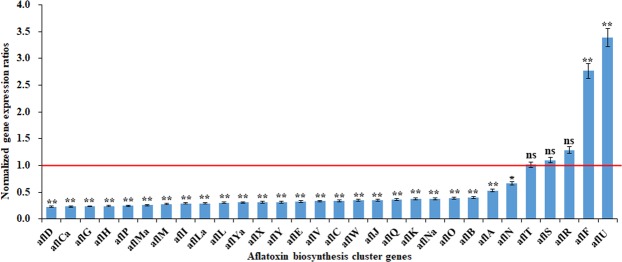
Aflatoxin B (AFB), the predominant and most carcinogenic naturally polyketide, is mainly produced by Aspergillus flavus and Aspergillus parasiticus. Cinnamaldehyde has been reported for inhibiting the growth and aflatoxin biosynthesis in A. flavus. But its molecular mechanism of action still remains largely ambiguous. Here, the anti-aflatoxigenic mechanism of cinnamaldehyde in A. flavus was investigated via a comparative transcriptomic analysis. The results indicated that twenty five of thirty genes in aflatoxin cluster showed down-regulation by cinnamaldehyde although the cluster regulators aflR and aflS were slightly up-regulated. This may be due to the up-regulation of the oxidative stress-related genes srrA, msnA and atfB being caused by the significant down-regulation of the diffusible factor FluG. Cinnamaldehyde also inhibited aflatoxin formation by perturbing GPCRs and oxylipins normal function, cell wall biosynthesis and redox equilibrium. In addition, accumulation of NADPH due to up-regulation of pentose phosphate pathway drove acetyl-CoA to lipids synthesis rather than polyketides. Both GO and KEGG analysis suggested that pyruvate and phenylalanine metabolism, post-transcriptional modification and key enzymes biosynthesis might be involved in the suppression of AFB production by cinnamaldehyde. This study served to decipher the anti-aflatoxigenic properties of cinnamaldehyde in A. flavus and provided powerful evidence for its use in practice.
黄曲霉毒素 B(AFB)是主要由黄曲霉和寄生曲霉产生的主要且最具致癌性的天然聚酮化合物。肉桂醛已被报道可抑制黄曲霉的生长和黄曲霉毒素的生物合成。但其作用的分子机制仍很大程度上不清楚。在这里,通过比较转录组分析研究了肉桂醛在黄曲霉中的抗产毒机制。结果表明,尽管簇调节因子 aflR 和 aflS 略有上调,但黄曲霉毒素簇中的三十个基因中有二十五个基因的表达受到肉桂醛的下调。这可能是由于扩散因子 FluG 的显著下调导致与氧化应激相关的基因 srrA、msnA 和 atfB 的上调所致。肉桂醛还通过干扰 GPCRs 和氧化脂类的正常功能、细胞壁生物合成和氧化还原平衡来抑制黄曲霉毒素的形成。此外,戊糖磷酸途径的上调导致 NADPH 的积累,从而将乙酰辅酶 A 转向脂质合成而不是聚酮化合物。GO 和 KEGG 分析均表明,丙酮酸和苯丙氨酸代谢、转录后修饰和关键酶生物合成可能参与了肉桂醛对 AFB 产生的抑制作用。这项研究阐明了肉桂醛在黄曲霉中的抗产毒特性,并为其实际应用提供了有力证据。