Department of Epidemiology, Institute of Social Medicine, Rio de Janeiro State University, Rua São Francisco Xavier 524, Rio de Janeiro, 20550-013, Brazil.
MOISA, INRA, CIHEAM-IAMM, CIRAD, Montpellier SupAgro, Université de Montpellier, 34060, Montpellier, Cedex 2, France.
Nutr J. 2019 Jul 20;18(1):40. doi: 10.1186/s12937-019-0466-y.
Meeting nutrient intake recommendations may demand substantial modifications in dietary patterns, and may increase diet cost. Incentives for modifying one's dietary intake that disregard prices are unlikely to be effective in the general population, especially among low-income strata, due to the high percentage of income committed to food purchases. The aim of this study is to evaluate how much the nutrient content can be increased through a modeled diet, without any cost increase, for low-income Brazilian households.
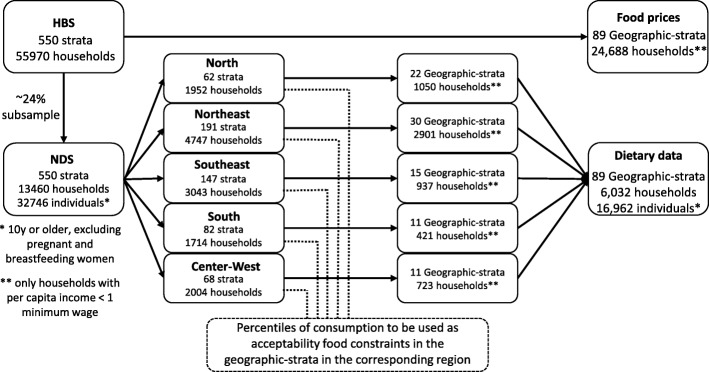
Low-income households were selected from the Household Budget Survey (24,688 households) and National Dietary Survey (6,032 households, 16,962 individuals), from where we obtained food prices and consumption data. Food quantities were modeled using linear programming to find diets that meet nutritional recommendations in two sets of models: cost-constrained (the cost should not be higher than the observed diet cost) and cost-free. Minimum and maximum amounts of each food in the modelled diets were allowed at three levels of food acceptability: rigorous (least deviance from the current observed diets), moderate, and flexible (higher deviance from the current observed diets).
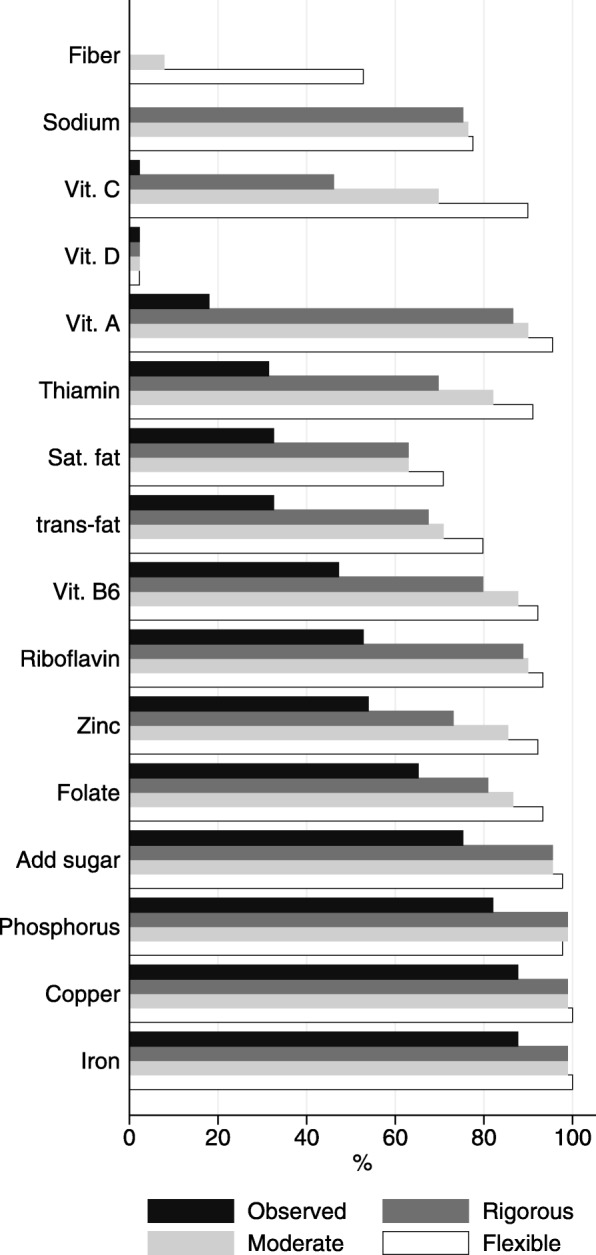
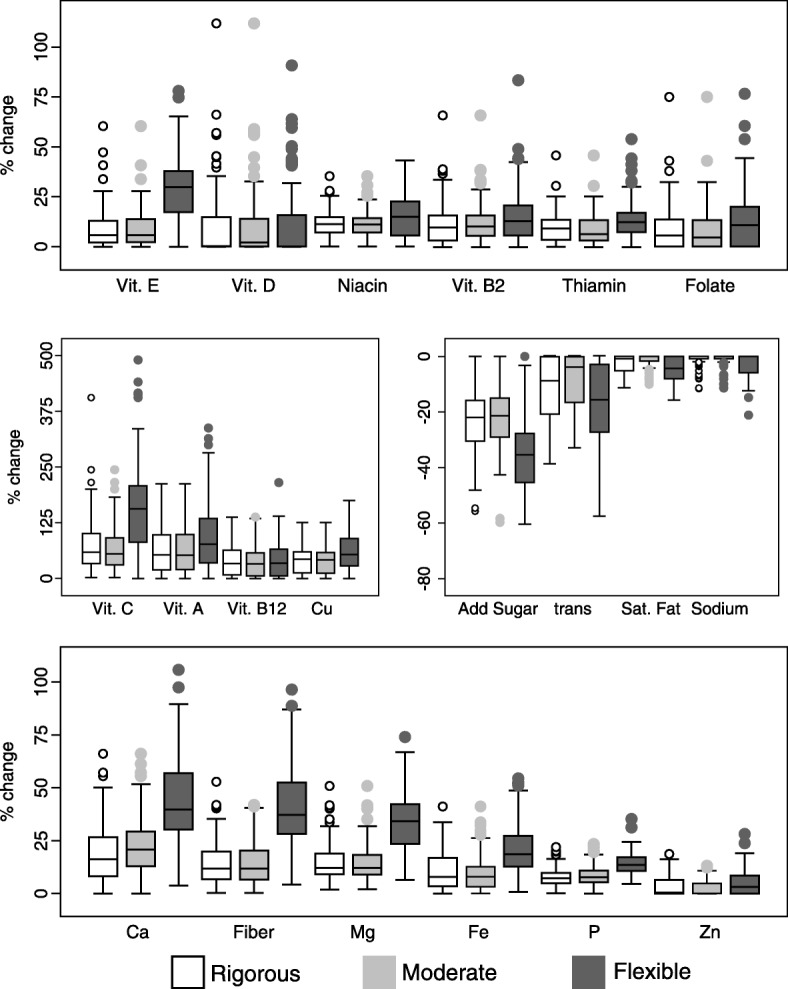
We found no feasible solution that would accommodate all the nutritional targets. The most frequent limiting nutrients were calcium; vitamins D, E, and A; zinc; fiber; sodium; and saturated and trans-fats. However, increases in nutrient contents were observed, especially for fiber, calcium, copper, magnesium, vitamin A, vitamin C, and vitamin E. In general, the best achievement was obtained with cost-free models. Fruits and beans increased in all models; large increase in whole cereals was observed only in the flexible models; large increase in vegetables was observed only in the cost-free models; and fish increased only in the cost-free models. Reductions were observed for rice, red and processed meats, sugar-sweetened beverages, and sweets. The mean observed cost was US$2.16 per person/day. The mean cost in the cost-free models was US$2.90 (moderate), US$2.70 (rigorous), and US$2.60 (flexible).
The complete nutritional adequacy is unattainable, although feasible changes would substantially improve diet quality by improving nutrient content without additional costs.
满足营养摄入建议可能需要对饮食模式进行大量修改,并可能增加饮食成本。对于一般人群,特别是低收入阶层,忽视价格的饮食摄入激励措施不太可能有效,因为他们将很大一部分收入用于购买食品。本研究旨在评估通过模拟饮食,在不增加任何成本的情况下,低收入巴西家庭的营养含量可以增加多少。
从家庭预算调查(24688 户家庭)和国家饮食调查(6032 户家庭,16962 人)中选择低收入家庭,从中我们获得了食品价格和消费数据。使用线性规划来模拟食物数量,以找到满足两种模型中营养建议的饮食:成本约束(成本不应高于观察到的饮食成本)和免费。在三种食物接受程度水平下,允许模型饮食中每种食物的最低和最高量:严格(与当前观察到的饮食差异最小)、适度和灵活(与当前观察到的饮食差异较大)。
我们没有找到能够容纳所有营养目标的可行解决方案。最常见的限制营养素是钙;维生素 D、E 和 A;锌;纤维;钠;以及饱和脂肪和反式脂肪。然而,观察到营养成分含量增加,特别是纤维、钙、铜、镁、维生素 A、维生素 C 和维生素 E。一般来说,免费模型的效果最好。水果和豆类在所有模型中都增加了;只有在灵活模型中才观察到全谷物的大幅增加;只有在免费模型中才观察到蔬菜的大幅增加;只有在免费模型中才观察到鱼类的增加。大米、红肉和加工肉类、加糖饮料和甜食的摄入量有所减少。观察到的平均人均成本为 2.16 美元。免费模型的平均成本为 2.90 美元(适度)、2.70 美元(严格)和 2.60 美元(灵活)。
虽然可行的改变可以在不增加额外成本的情况下通过提高营养含量来显著提高饮食质量,但完全达到营养充足是不可能的。