Halium Mounier M Abdel, Salib Fayez A, Marouf S A, Massieh Emil S Abdel
Department of Medicine and Infectious Diseases, Faculty of Veterinary Medicine, Cairo University, Giza, Egypt.
Department of Microbiology and Mycology, Faculty of Veterinary Medicine, Cairo University, Giza, Egypt.
Vet World. 2019 May;12(5):664-670. doi: 10.14202/vetworld.2019.664-670. Epub 2019 May 13.
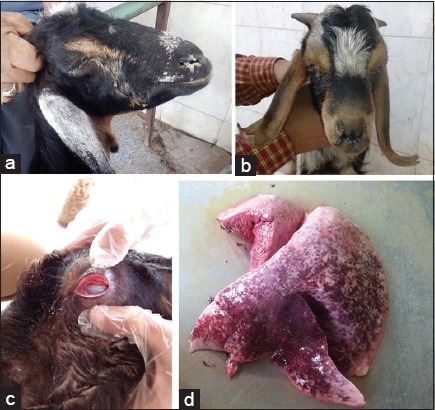
Different species of are associated with many pathological problems in small ruminants including respiratory manifestation, this problem results in significant losses, especially in African countries. This study aimed to (I) study some epidemiological aspects of species infections in Egyptian sheep and goats at Giza Governorate, (II) diagnosis of species affections using bacterial isolation and identification, (III) apply the polymerase chain reaction (PCR) for typing of different species, and (IV) illustrate the phylogenetic tree for the isolated species and other species from GenBank using the purified PCR product.
A total of 335 samples were collected from sheep and goats from Giza Governorate in Egypt as 142 nasal swabs from clinically affected animals, 167 pneumonic lungs, 18 samples from tracheal bifurcation, and 8 samples by bronchial wash were cultured on pleuropneumonia-like organisms (PPLOs) media for cultivation of species. PCR and sequencing and phylogenetic analysis were adopted to identify and classify the isolated species.
A total of 24 isolates were isolated on PPLO media, identified by biochemical tests, and confirmed and typed by PCR using specific primers. 10 isolates were confirmed as , four isolates as by PCR, and 10 isolates as undifferentiated . A purified isolate of and was sequenced and phylogenetic analysis was illustrated.
and are prevalent in Egyptian sheep and goats. Further studies on are required due to its high frequency of isolation from pneumonic sheep and goats and also from animals suffer from different respiratory manifestations.
不同种类的[未提及具体病原体名称]与小型反刍动物的许多病理问题相关,包括呼吸道症状,这个问题导致了重大损失,尤其是在非洲国家。本研究旨在:(I)研究埃及吉萨省绵羊和山羊感染[未提及具体病原体名称]种类的一些流行病学方面;(II)通过细菌分离和鉴定诊断[未提及具体病原体名称]种类感染;(III)应用聚合酶链反应(PCR)对不同的[未提及具体病原体名称]种类进行分型;(IV)使用纯化的PCR产物绘制分离出的[未提及具体病原体名称]种类以及来自GenBank的其他种类的系统发育树。
从埃及吉萨省的绵羊和山羊身上共采集了335份样本,其中142份来自临床患病动物的鼻拭子,167份来自肺炎肺组织,18份来自气管分叉处,8份通过支气管灌洗获得,将这些样本在类胸膜肺炎微生物(PPLOs)培养基上培养以培养[未提及具体病原体名称]种类。采用PCR、测序和系统发育分析来鉴定和分类分离出的[未提及具体病原体名称]种类。
在PPLO培养基上共分离出24株[未提及具体病原体名称]分离株,通过生化试验进行鉴定,并使用特异性引物通过PCR进行确认和分型。10株分离株经PCR确认为[未提及具体病原体名称]某一类型,4株确认为[未提及具体病原体名称]另一类型,10株为未分化的[未提及具体病原体名称]。对一株纯化的[未提及具体病原体名称]某一类型和[未提及具体病原体名称]另一类型分离株进行了测序并绘制了系统发育分析图。
[未提及具体病原体名称]某一类型和[未提及具体病原体名称]另一类型在埃及绵羊和山羊中普遍存在。由于从患肺炎的绵羊和山羊以及患有不同呼吸道症状的动物中分离到该病原体的频率较高,因此需要对[未提及具体病原体名称]进行进一步研究。