Brown A G M, Houser R F, Mattei J, Lichtenstein A H, Folta S C
National Heart, Lung, and Blood Institute, National Institutes of Health, 6701 Rockledge Drive, Bethesda, MA 20892, USA.
Department of Nutrition, Harvard T.H. Chan School of Public Health, 665 Huntington Avenue, Building 2, Boston, MA 02115, USA.
J Nutr Sci. 2019 Jul 16;8:e23. doi: 10.1017/jns.2019.19. eCollection 2019.
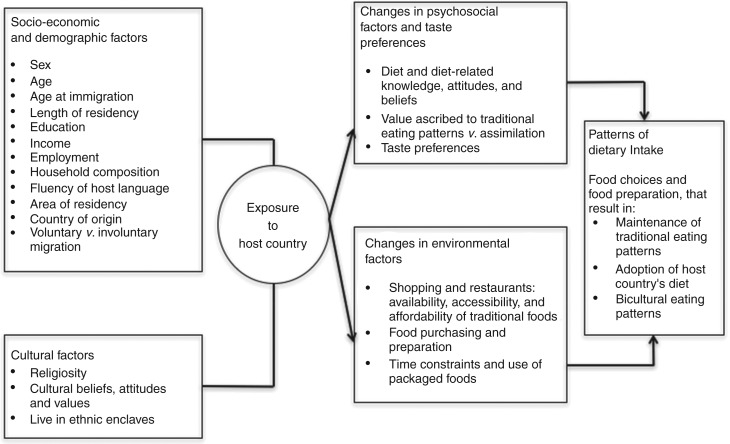
Limited research considers the ethnic and cultural diversity among the US Black population, and how this diversity influences diet. The purpose of the present qualitative study is to (1) explore the influence of culture, nativity and ethnicity on the diet of US-born, African-born and Caribbean/Latin American-born Blacks and (2) explore a model of dietary acculturation among the African-born and Caribbean/Latin American-born Blacks. The purposive sample included twenty-two US-born, fifteen Caribbean/Latin American-born and ten African-born Blacks ( 47) living in Boston, who participated in either an in-depth interview ( 12) or a focus group (five groups, size 5-9). Satia-Abouta's model of dietary acculturation informed the interview and focus group questions, which explored the influence of psychosocial factors, taste preferences and environmental factors on dietary changes. NVivo 10 software was utilised for the coding and analysis. Topics based on and analyses included differences in psychosocial factors and taste preferences and environmental factors by nativity. Caribbean/Latin American-born and African-born Blacks expressed the importance of cultural identity in their dietary preferences and found adaptive strategies to maintain cultural diet, while US-born Blacks demonstrated a variety of preferences for traditionally African American foods. Environmental factors varied by place of birth and residence, with US-born Blacks citing poorer quality and limited affordability of foods. These findings suggest the importance of psychosocial and environmental factors in shaping the diet of the ethnically diverse US Black population and underscore the dietary diversity within and across the different ethnic groups of Blacks.
有限的研究考虑了美国黑人人口中的种族和文化多样性,以及这种多样性如何影响饮食。本定性研究的目的是:(1)探讨文化、出生地和种族对在美国出生、非洲出生以及加勒比/拉丁美洲出生的黑人饮食的影响;(2)探索非洲出生和加勒比/拉丁美洲出生的黑人的饮食文化适应模式。目的抽样包括居住在波士顿的22名美国出生的黑人、15名加勒比/拉丁美洲出生的黑人以及10名非洲出生的黑人(共47人),他们参与了深度访谈(12人)或焦点小组讨论(五个小组,每组5 - 9人)。萨蒂亚 - 阿博塔的饮食文化适应模型为访谈和焦点小组问题提供了指导,这些问题探讨了心理社会因素、口味偏好和环境因素对饮食变化的影响。使用NVivo 10软件进行编码和分析。基于主题和分析得出的主题包括心理社会因素、口味偏好以及按出生地划分的环境因素差异。加勒比/拉丁美洲出生和非洲出生的黑人表示文化认同在他们的饮食偏好中很重要,并找到了保持文化饮食的适应策略,而美国出生的黑人则对传统非裔美国人食物表现出各种偏好。环境因素因出生地和居住地而异,美国出生的黑人提到食物质量较差且价格可承受性有限。这些发现表明心理社会和环境因素在塑造种族多样的美国黑人人口饮食方面的重要性,并强调了不同黑人种族群体内部和之间的饮食多样性。