Farr Ryan J, Wong Wilson K M, Maynard Cody-Lee, Tersey Sarah A, Mirmira Raghavendra G, Hardikar Anandwardhan A, Joglekar Mugdha V
Diabetes and Islet Biology Group, NHMRC Clinical Trials Centre, Faculty of Medicine, The University of Sydney, Level 6, Medical Foundation Building, 92-94 Parramatta Road, Camperdown, NSW 2050, Australia.
Herman B Wells Center for Pediatric Research, Center for Diabetes and Metabolic Diseases, and Department of Pediatrics, Indiana University School of Medicine, Indianapolis, IN 46202, USA.
J Biol Methods. 2019;6(2). doi: 10.14440/jbm.2019.280. Epub 2019 Jun 3.
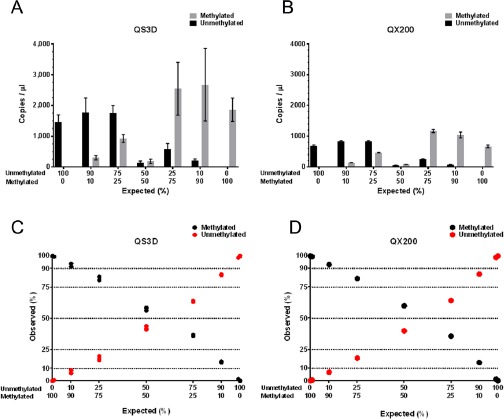
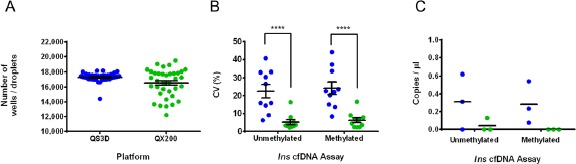
Circulating cell-free DNA (cfDNA) has been intensively investigated as a diagnostic and prognostic marker for various cancers. In recent years, presence of unmethylated insulin cfDNA in the circulation has been correlated with pancreatic β-cell death and risk of developing type 1 diabetes. Digital (d)PCR is an increasingly popular method of quantifying insulin cfDNA due to its ability to determine absolute copy numbers, and its increased sensitivity when compared to the more routinely used quantitative PCR. Multiple platforms have been developed to carry out dPCR. However, not all technologies perform comparably, thereby necessitating evaluation of each platform. Here, we compare two dPCR platforms: the QuantStudio 3D (QS3D, Applied Biosystems) and the QX200 (Bio-Rad), to measure copies of unmethylated/methylated insulin plasmids. The QS3D detected greater copy numbers of the plasmids than the QX200 (manual mode), whereas QX200 demonstrated minimal replicate variability, increased throughput, ease of use and the potential for automation. Overall, the performance of QX200, in our hands, was better suited to measure differentially methylated insulin cfDNA.
循环游离DNA(cfDNA)已被深入研究,作为各种癌症的诊断和预后标志物。近年来,循环中未甲基化胰岛素cfDNA的存在与胰腺β细胞死亡及1型糖尿病发病风险相关。数字(d)PCR是一种越来越受欢迎的定量胰岛素cfDNA的方法,因为它能够确定绝对拷贝数,并且与更常用的定量PCR相比,灵敏度更高。已经开发了多个平台来进行dPCR。然而,并非所有技术的性能都相当,因此需要对每个平台进行评估。在这里,我们比较了两个dPCR平台:QuantStudio 3D(QS3D,应用生物系统公司)和QX200(伯乐公司),以测量未甲基化/甲基化胰岛素质粒的拷贝数。QS3D检测到的质粒拷贝数比QX200(手动模式)多,而QX200表现出最小的重复变异性、更高的通量、易用性和自动化潜力。总体而言,在我们手中,QX200的性能更适合测量差异甲基化的胰岛素cfDNA。