Institute for Veterinary Public Health, University of Veterinary Medicine Vienna, Vienna, Austria.
IHAP, INRA, ENVT, Université de Toulouse, Toulouse, France.
Transbound Emerg Dis. 2019 Nov;66(6):2426-2439. doi: 10.1111/tbed.13300. Epub 2019 Jul 30.
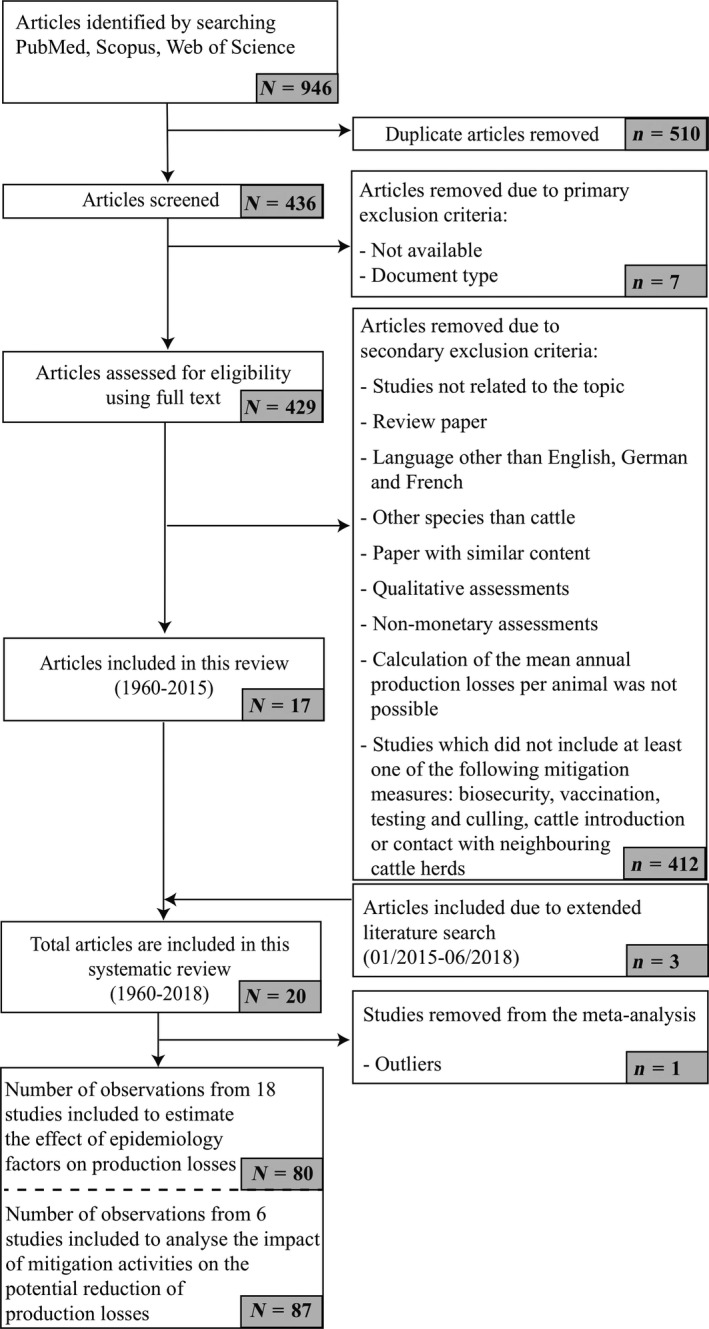
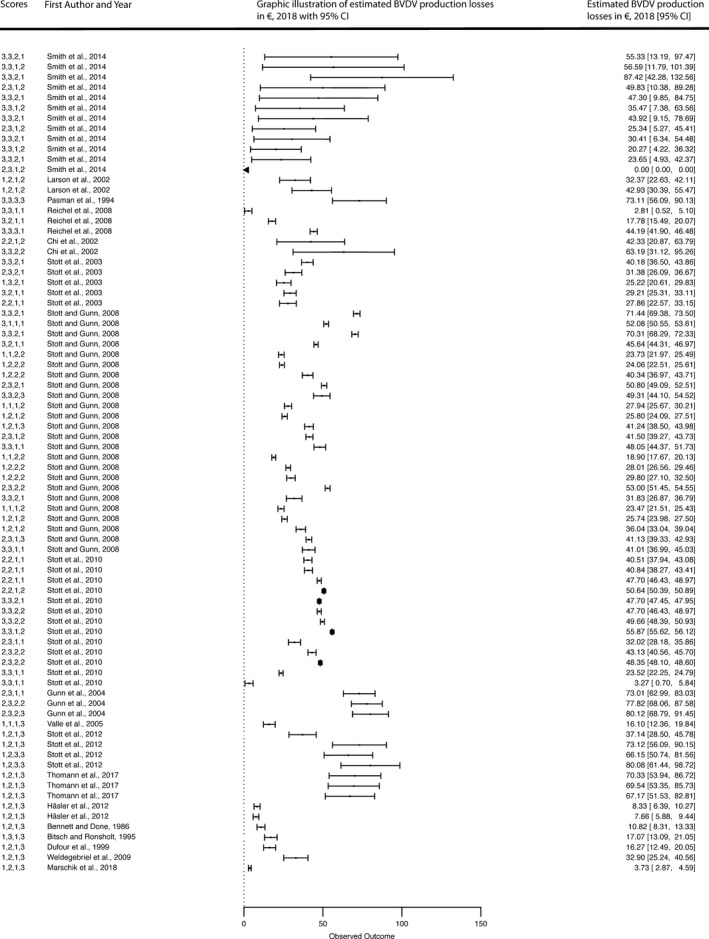
Infection with bovine viral diarrhoea virus (BVDV) is associated with a loss in productivity in cattle farms. Determining which factors influence monetary losses due to BVDV could facilitate the implementation of mitigation measures to reduce the burden of BVDV. Mixed-effect meta-analysis models were performed to estimate the extent to which the costs of mean annual BVDV production losses per animal may be influenced by epidemiological factors such as BVDV introduction risk, initial prevalence, viral circulation intensity and circulation duration (trial 1). Additionally, changes in mean annual BVDV production losses per animal due to specific mitigation measures (i.e., biosecurity, vaccination, testing and culling, cattle introduction or contact with neighbouring cattle herds) were analysed (trial 2). In total, 19 studies were included in the meta-analysis to assess mean annual BVDV production losses. The mean annual direct losses were determined to be €42.14 per animal (trial 1). The multivariate meta-regression showed that four of the previously mentioned epidemiological factors significantly influenced the mean annual BVDV production losses per animal. Indeed, the per animal costs increased to €67.19 when these four factors (trial 1) were considered as "high or moderate" compared to "low". The meta-regression analysis revealed that implementation of vaccination and biosecurity measures were associated with an 8%-12% and 28%-29% decrease in BVDV production losses on average, respectively, when simulated herds were compared with or without such mitigation measures (trial 2). This reduction of mean annual BVDV production losses per animal due to mitigation measures was partially counteracted when farmers brought new cattle on to farm or allowed contact with neighbouring cattle herds. The influencing mitigation factors presented here could help to guide farmers in their decision to implement mitigation strategies for the control of BVDV at farm level.
牛病毒性腹泻病毒(BVDV)感染会导致奶牛场生产力下降。确定哪些因素会影响 BVDV 造成的经济损失,可以促进实施减轻措施,以降低 BVDV 的负担。采用混合效应荟萃分析模型来估算,每头动物因 BVDV 造成的年均生产损失的成本可能受 BVDV 引入风险、初始流行率、病毒循环强度和循环持续时间等流行病学因素的影响(试验 1)。此外,还分析了由于特定减轻措施(即生物安全、疫苗接种、检测和淘汰、牛的引入或与邻近牛群接触)导致每头动物年均 BVDV 生产损失的变化(试验 2)。共有 19 项研究被纳入荟萃分析以评估年均 BVDV 生产损失。确定年均直接损失为每头动物 42.14 欧元(试验 1)。多元荟萃回归表明,上述四个流行病学因素显著影响每头动物年均 BVDV 生产损失。事实上,当考虑到这四个因素(试验 1)为“高或中”时,每头动物的成本增加到 67.19 欧元,而当这四个因素被认为是“低”时,每头动物的成本增加到 42.14 欧元。荟萃回归分析表明,与没有采取这些减轻措施的模拟牛群相比,实施疫苗接种和生物安全措施平均可分别减少 8%-12%和 28%-29%的 BVDV 生产损失(试验 2)。当农民将新牛引入农场或允许与邻近牛群接触时,由于减轻措施而导致的年均 BVDV 生产损失的减少部分被抵消。这里提出的影响减轻因素可以帮助指导农民在农场层面实施控制 BVDV 的减轻策略时做出决策。