Department of International Public Health, Liverpool School of Medicine, Liverpool, United Kingdom.
Centre for Sexual Health and HIV AIDS Research (CSHHAR) Zimbabwe, Harare, Zimbabwe.
J Int AIDS Soc. 2019 Jul;22 Suppl 4(Suppl Suppl 4):e25320. doi: 10.1002/jia2.25320.
UNAIDS' goal of ending AIDS by 2030 is unreachable without better targeting of testing, prevention and care. Female sex workers (FSW) in Zimbabwe are at high risk of HIV acquisition and transmission. Here, we report on collated programme and research data from Zimbabwe's national sex work programme. We also assess the potential for wider population impact of FSW programmes by modelling the impact on HIV incidence of eliminating transmission through FSW (i.e. calculate the population attributable fraction of incidence attributable to sex work).
Descriptive analyses of individual-level programme data collected from FSW between 2009 and June 2018 are triangulated with data collected through 37 respondent driven sampling surveys from 19 sites in Zimbabwe 2011 to 2017. We describe programme coverage, uptake, retention and patterns of sex work behaviour and gaps in service provision. An individual-level stochastic simulation model is used to reconstruct the epidemic and then the incidence compared with the counter-factual trend in incidence from 2010 had transmission through sex work been eliminated from that date.
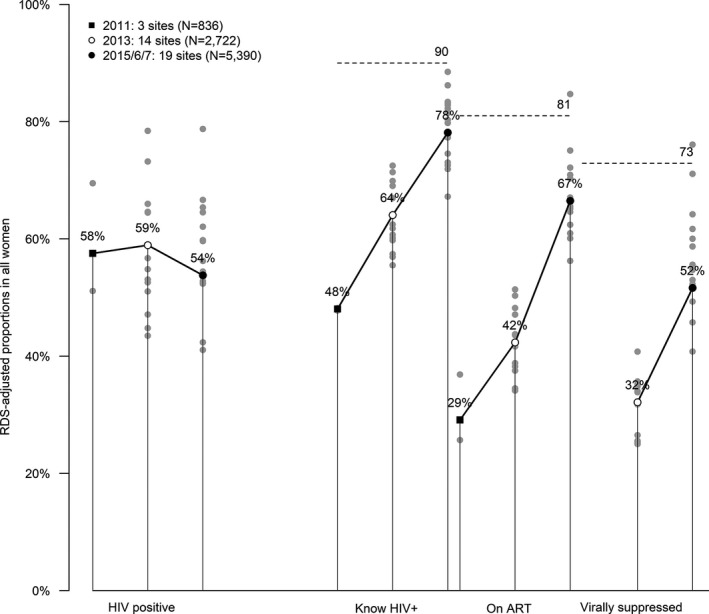
Sisters has reached >67,000 FSW since 2009, increasing attendance as number of sites, programme staff and peer educators were increased. Over 57% of all FSW estimated to be working in Zimbabwe in 2017 (n = 40,000) attended the programme at least once. The proportion of young FSW reached has increased with introduction of the "Young Sisters programme." There are no clear differences in pattern of sex work across settings. Almost all women report condom use with clients at last sex (95%); however, consistent condom use with clients in the last month varies from 52% to 95% by site. Knowledge of HIV-positive status has increased from 48 to 78% between 2011 and 2016, as has prevalence of ART use among diagnosed women (29 to 67%). Although subject to uncertainty, modelling suggests that 70% (90% range: 32%, 93%) of all new infections in Zimbabwe from 2010 are directly or indirectly attributable to transmission via sex work.
It is feasible to increase coverage and impact of sex work programming through community-led scale-up of evidence-based interventions. Eliminating transmission through commercial sex would likely have a substantial impact on new infections occurring more widely across Zimbabwe.
如果不能更有针对性地进行检测、预防和护理,联合国艾滋病规划署(UNAIDS)到 2030 年终结艾滋病的目标将无法实现。津巴布韦的性工作者(FSW)感染艾滋病毒和传播艾滋病毒的风险很高。在这里,我们报告了津巴布韦国家性工作方案的综合方案和研究数据。我们还通过对通过性工作消除传播对艾滋病毒发病率的影响进行建模(即计算性工作归因于发病率的人群归因分数),评估了性工作者方案对更广泛人群的潜在影响。
对 2009 年至 2018 年期间从性工作者那里收集的个人层面方案数据进行描述性分析,并与 2011 年至 2017 年期间通过在津巴布韦 19 个地点进行的 37 次基于受访者的抽样调查收集的数据进行三角剖分。我们描述了方案覆盖范围、参与率、保留率以及性工作行为模式和服务提供方面的差距。使用个体水平随机模拟模型重建疫情,然后将发病率与从 2010 年起消除性传播以来的发病率进行对比。
自 2009 年以来,Sisters 项目已经覆盖了超过 67000 名性工作者,随着参与项目的地点、项目工作人员和同伴教育者的增加,参与人数也在增加。在 2017 年(n=40000)津巴布韦估计从事性工作的所有性工作者中,有超过 57%的人至少参加过一次该项目。随着“年轻姐妹项目”的引入,年轻性工作者的比例有所增加。不同地点的性工作模式没有明显差异。几乎所有妇女(95%)报告在最近一次性交中使用了安全套,但最近一个月内与客户持续使用安全套的比例因地点而异,从 52%到 95%不等。从 2011 年到 2016 年,艾滋病毒阳性状况的知晓率从 48%增加到 78%,诊断为艾滋病毒的妇女中抗逆转录病毒疗法(ART)的使用率从 29%增加到 67%。尽管存在不确定性,但建模表明,2010 年津巴布韦所有新感染病例中有 70%(90%的范围:32%,93%)直接或间接归因于通过性交易传播。
通过以社区为基础扩大基于证据的干预措施的规模,增加性工作方案的覆盖面和影响力是可行的。消除商业性传播可能会对津巴布韦更广泛地区发生的新感染产生重大影响。