Institute for Global Health, UCL, London, UK.
Department of HIV/AIDS and STIs, Ministry of Health and Childcare, Harare, Zimbabwe.
J Int AIDS Soc. 2018 Nov;21(11):e25205. doi: 10.1002/jia2.25205.
The 90-90-90 targets set by the United Nations aspire to 73% of people living with HIV (PLHIV) being virally suppressed by 2020. Using the HIV Synthesis Model, we aim to mimic the epidemic in Zimbabwe and make projections to assess whether Zimbabwe is on track to meet the 90-90-90 targets and assess whether recently proposed UNAIDS HIV transition metrics are likely to be met.
We used an approximate Bayesian computation approach to identify model parameter values which result in model outputs consistent with observed data, evaluated using a calibration score. These parameter values were then used to make projections to 2020 to compare with the 90-90-90 targets and other key indicators. We also calculated HIV transition metrics proposed by UNAIDS (percentage reduction in new HIV infections and AIDS-related mortality from 2010 to 2020, absolute rate of new infections and AIDS-related mortality, incidence-mortality ratio and incidence-prevalence ratios).
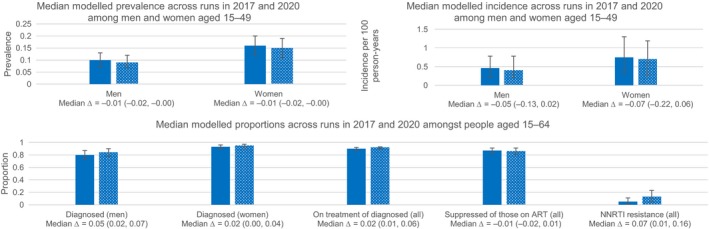
After calibration, there was general agreement between modelled and observed data. The median predicted outcomes in 2020 were: proportion of PLHIV (aged 15 to 65) diagnosed 0.91 (90% uncertainty range 0.87, 0.94) (0.84 men, 0.95 women); of those diagnosed, proportion on treatment 0.92 (0.90, 0.93); of those receiving treatment, proportion with viral suppression 0.86 (0.81, 0.91). This results in 72% of PLHIV having viral suppression in 2020. We estimated a percentage reduction of 36.5% (13.7% increase to 67.4% reduction) in new infections from 2010 to 2020, and of 30.4% (9.7% increase to 56.6% reduction) in AIDS-related mortality (UNAIDS target 75%). The modelled absolute rates of HIV incidence and AIDS-related mortality in 2020 were 5.48 (2.26, 9.24) and 1.93 (1.31, 2.71) per 1000 person-years respectively. The modelled incidence-mortality ratio and incidence-prevalence ratios in 2020 were 1.05 (0.46, 1.66) and 0.009 (0.004, 0.013) respectively.
Our model was able to produce outputs that are simultaneously consistent with an array of observed data and predicted that while the 90-90-90 targets are within reach in Zimbabwe, increased efforts are required in diagnosing men in particular. Calculation of the HIV transition metrics suggest increased efforts are needed to bring the HIV epidemic under control.
联合国提出的 90-90-90 目标,旨在到 2020 年使 73%的艾滋病毒感染者(PLHIV)病毒得到抑制。本研究利用 HIV 综合模型,旨在模拟津巴布韦的流行情况,并进行预测,以评估津巴布韦是否有望实现 90-90-90 目标,并评估最近提出的艾滋病署 HIV 过渡指标是否可能实现。
我们使用近似贝叶斯计算方法来确定模型参数值,这些参数值可以使模型输出与观察数据一致,并使用校准评分进行评估。然后,我们使用这些参数值进行到 2020 年的预测,以与 90-90-90 目标和其他关键指标进行比较。我们还计算了艾滋病署提出的 HIV 过渡指标(2010 年至 2020 年新 HIV 感染和艾滋病相关死亡率的百分比降低、新感染和艾滋病相关死亡率的绝对率、发病率死亡率比和发病率流行率比)。
经过校准后,模型预测结果与观察数据总体上一致。2020 年的预测结果中位数为:诊断出的 PLHIV(15 至 65 岁)比例为 0.91(90%置信区间为 0.87,0.94)(男性 0.84,女性 0.95);在诊断出的患者中,接受治疗的比例为 0.92(0.90,0.93);在接受治疗的患者中,病毒抑制比例为 0.86(0.81,0.91)。这导致 2020 年有 72%的 PLHIV 病毒得到抑制。我们估计,从 2010 年到 2020 年,新感染病例减少 36.5%(增加 13.7%至减少 67.4%),艾滋病相关死亡率减少 30.4%(增加 9.7%至减少 56.6%)(艾滋病署目标为 75%)。2020 年 HIV 发病率和艾滋病相关死亡率的模型预测绝对数值分别为每 1000 人年 5.48(2.26,9.24)和 1.93(1.31,2.71)。2020 年模型预测的发病率死亡率比和发病率流行率比分别为 1.05(0.46,1.66)和 0.009(0.004,0.013)。
我们的模型能够生成与一系列观察数据一致的输出,并预测津巴布韦有望实现 90-90-90 目标,但需要特别加强对男性的诊断力度。计算 HIV 过渡指标表明,需要加大努力控制 HIV 流行。