Department of Biochemistry and Molecular Biology, Dalhousie University, Halifax, Nova Scotia, Canada.
Centre for Comparative Genomics and Evolutionary Bioinformatics, Dalhousie University, Halifax, Nova Scotia, Canada.
Genome Biol Evol. 2019 Oct 1;11(10):2727-2740. doi: 10.1093/gbe/evz155.
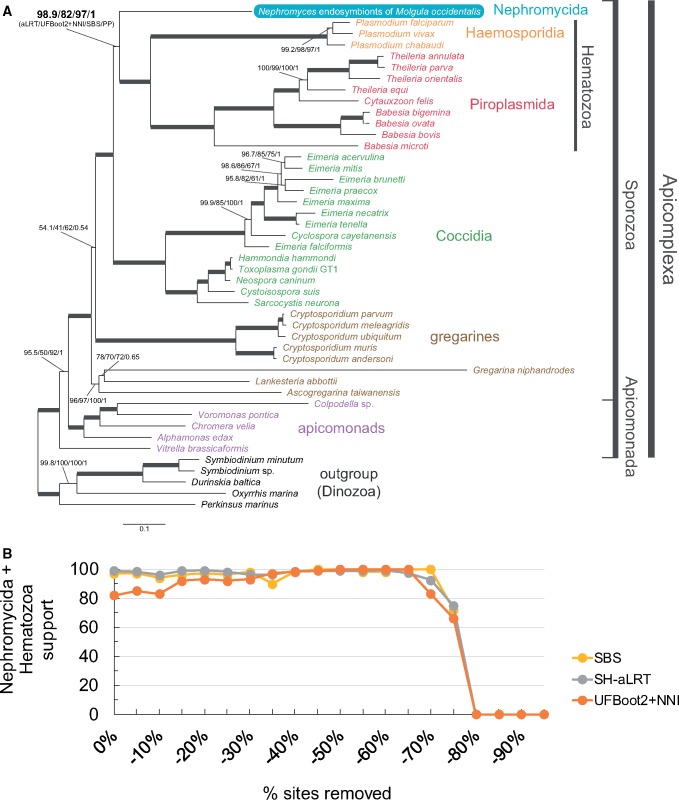
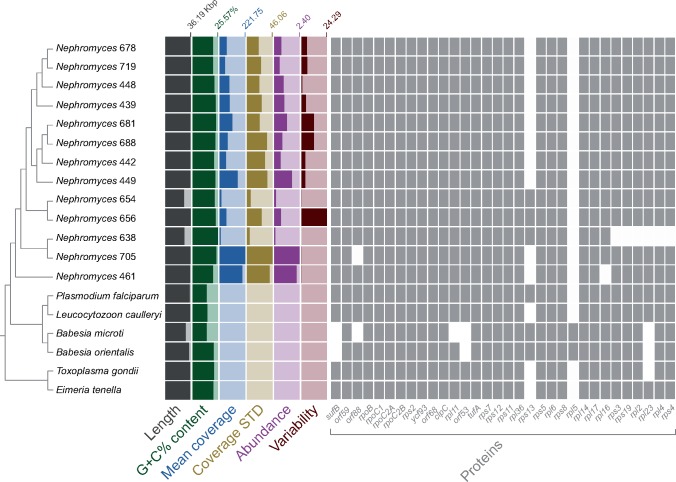
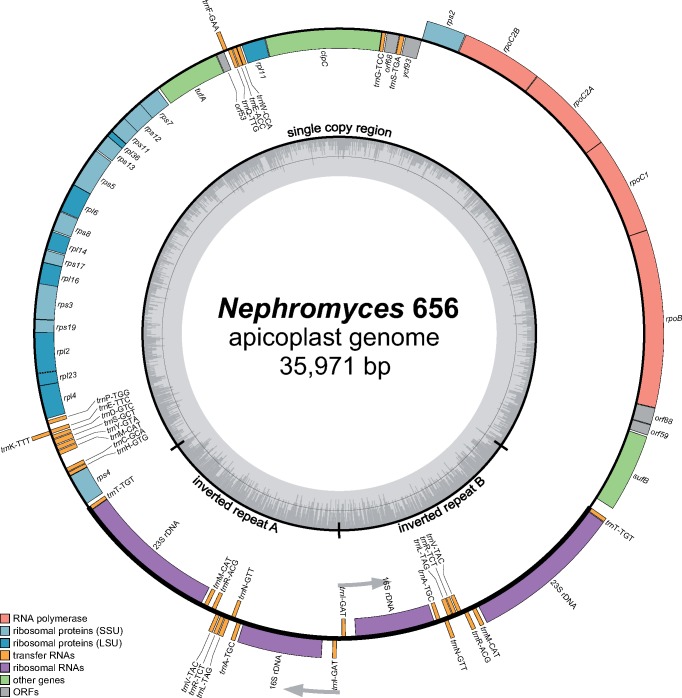
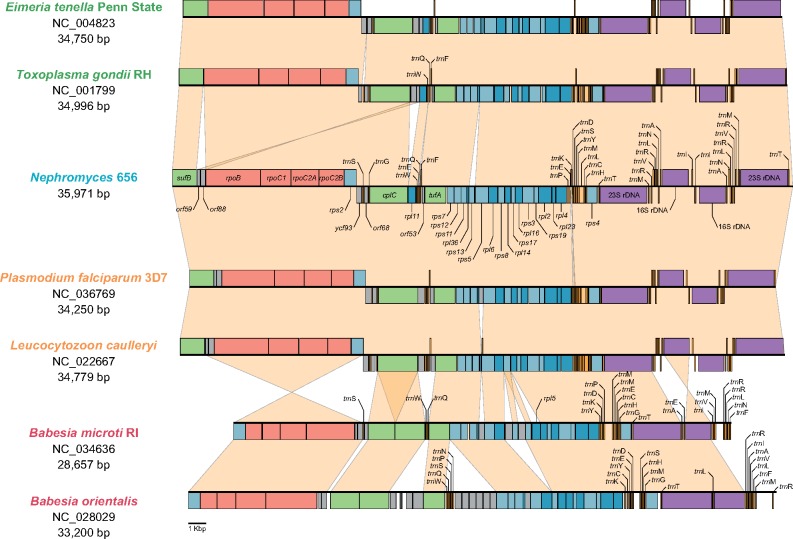
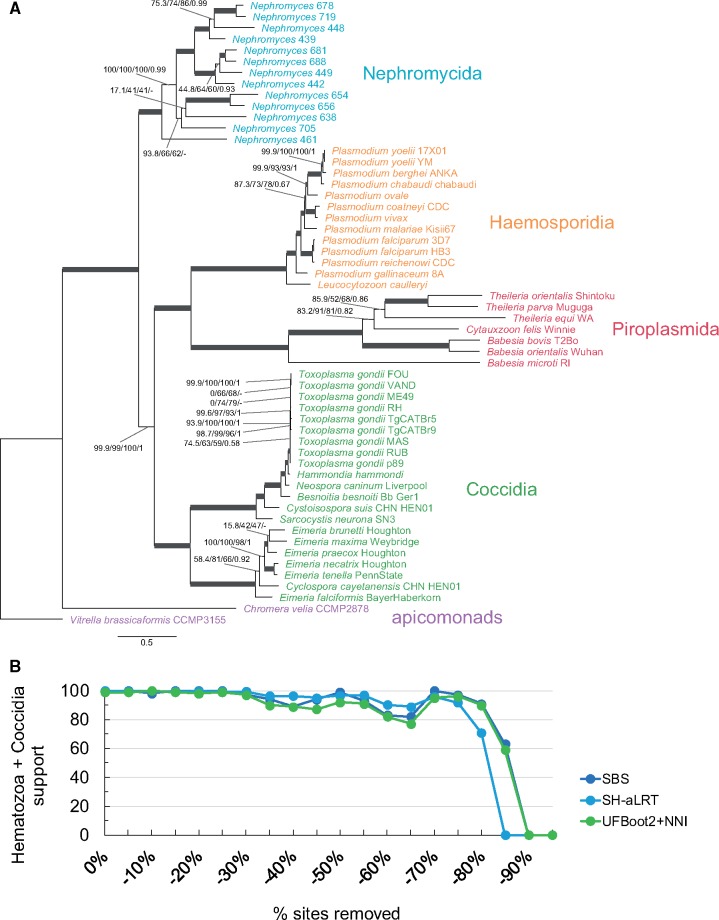
A most interesting exception within the parasitic Apicomplexa is Nephromyces, an extracellular, probably mutualistic, endosymbiont found living inside molgulid ascidian tunicates (i.e., sea squirts). Even though Nephromyces is now known to be an apicomplexan, many other questions about its nature remain unanswered. To gain further insights into the biology and evolutionary history of this unusual apicomplexan, we aimed to 1) find the precise phylogenetic position of Nephromyces within the Apicomplexa, 2) search for the apicoplast genome of Nephromyces, and 3) infer the major metabolic pathways in the apicoplast of Nephromyces. To do this, we sequenced a metagenome and a metatranscriptome from the molgulid renal sac, the specialized habitat where Nephromyces thrives. Our phylogenetic analyses of conserved nucleus-encoded genes robustly suggest that Nephromyces is a novel lineage sister to the Hematozoa, which comprises both the Haemosporidia (e.g., Plasmodium) and the Piroplasmida (e.g., Babesia and Theileria). Furthermore, a survey of the renal sac metagenome revealed 13 small contigs that closely resemble the genomes of the nonphotosynthetic reduced plastids, or apicoplasts, of other apicomplexans. We show that these apicoplast genomes correspond to a diverse set of most closely related but genetically divergent Nephromyces lineages that co-inhabit a single tunicate host. In addition, the apicoplast of Nephromyces appears to have retained all biosynthetic pathways inferred to have been ancestral to parasitic apicomplexans. Our results shed light on the evolutionary history of the only probably mutualistic apicomplexan known, Nephromyces, and provide context for a better understanding of its life style and intricate symbiosis.
寄生的顶复门生物中,有一种非常有趣的例外,即 Nephromyces。它是一种生活在海鞘被囊动物(即海鞘)内部的细胞外共生体,可能是互利共生的。尽管现在已经知道 Nephromyces 是顶复门生物,但关于其性质的许多其他问题仍然没有答案。为了更深入地了解这种不寻常的顶复门生物的生物学和进化历史,我们的目标是:1)确定 Nephromyces 在顶复门中的精确系统发育位置,2)寻找 Nephromyces 的质体基因组,3)推断 Nephromyces 质体中的主要代谢途径。为此,我们对来自海鞘肾脏囊的宏基因组和宏转录组进行了测序,该囊是 Nephromyces 茁壮成长的特殊栖息地。我们对保守核编码基因的系统发育分析强烈表明,Nephromyces 是 Hematozoa 的一个新谱系,Hematozoa 包括 Haemosporidia(如 Plasmodium)和 Piroplasmida(如 Babesia 和 Theileria)。此外,对肾脏囊宏基因组的调查发现了 13 个与其他顶复门生物的非光合还原质体或质体基因组非常相似的小片段。我们表明,这些质体基因组与一组多样化的最密切相关但遗传上有差异的 Nephromyces 谱系相对应,这些谱系共同栖息在单个被囊动物宿主中。此外,Nephromyces 的质体似乎保留了所有推断为寄生顶复门生物祖先的生物合成途径。我们的研究结果揭示了唯一已知的可能互利共生的顶复门生物 Nephromyces 的进化历史,并为更好地了解其生活方式和复杂的共生关系提供了背景。