Australian Centre for Health Services Innovation, Institute of Health and Biomedical Innovation, School of Public Health and Social Work, Faculty of Health, Queensland University of Technology, Brisbane, Queensland, Australia.
Centre for Economic Impacts of Genomic Medicine, Macquarie University, Sydney, New South Wales, Australia.
PLoS One. 2019 Jul 22;14(7):e0220209. doi: 10.1371/journal.pone.0220209. eCollection 2019.
To estimate the productivity impacts of a policy intervention on the prevention of premature mortality due to obesity.
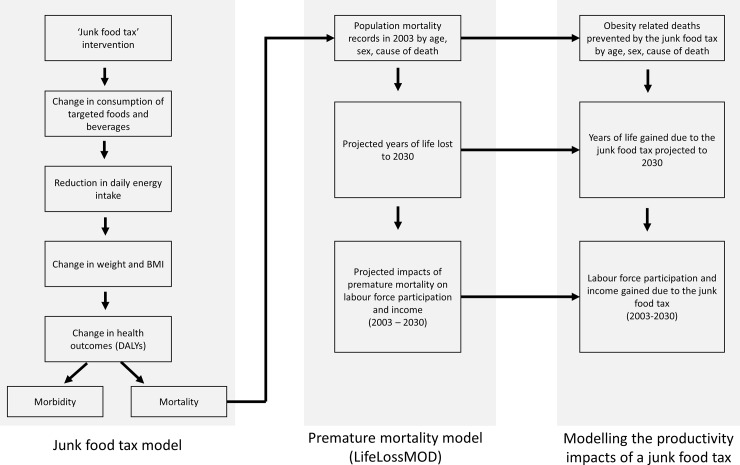
A simulation model of the Australian population over the period from 2003 to 2030 was developed to estimate productivity gains associated with premature deaths averted due to an obesity prevention intervention that applied a 10% tax on unhealthy foods. Outcome measures were the total working years gained, and the present value of lifetime income (PVLI) gained. Impacts were modelled over the period from 2003 to 2030. Costs are reported in 2018 Australian dollars and a 3% discount rate was applied to all future benefits.
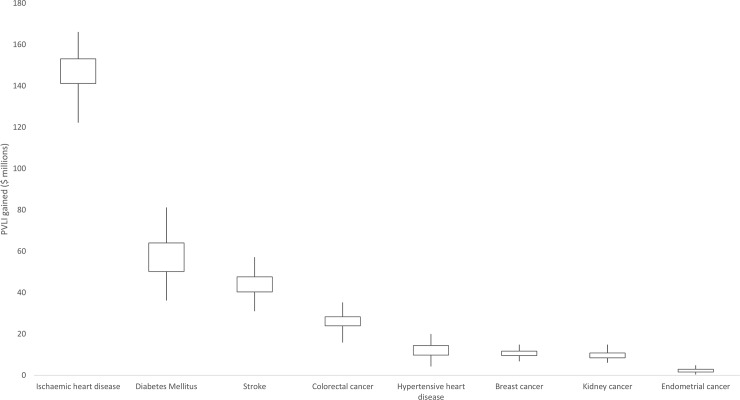
Premature deaths averted due to a junk food tax accounted for over 8,000 additional working years and a $307 million increase in PVLI. Deaths averted in men between the ages of 40 to 59, and deaths averted from ischaemic heart disease, were responsible for the largest gains.
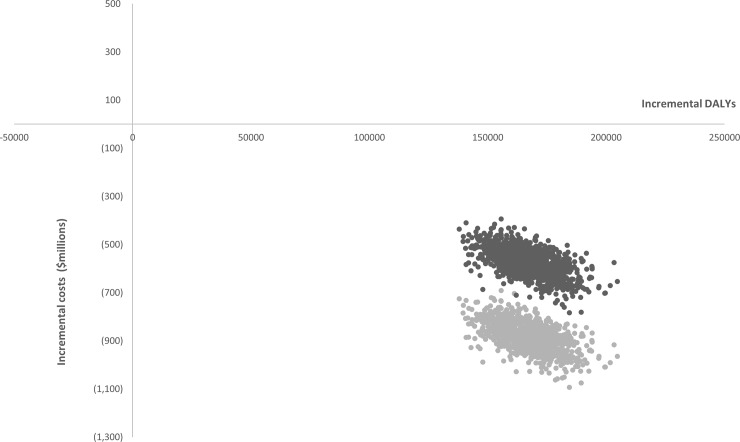
The productivity gains associated with a junk food tax are substantial, accounting for almost twice the value of the estimated savings to the health care system. The results we have presented provide evidence that the adoption of a societal perspective, when compared to a health sector perspective, provides a more comprehensive estimate of the cost-effectiveness of a junk food tax.
评估一项政策干预对预防肥胖导致过早死亡的生产力影响。
开发了一个针对澳大利亚人口的模拟模型,以估计由于预防肥胖的干预措施而避免过早死亡所带来的生产力收益,该干预措施对不健康食品征收 10%的税。结果衡量标准为避免的过早死亡人数、获得的总工作年限以及获得的终生收入的现值 (PVLI)。影响模型是在 2003 年至 2030 年期间进行的。成本以 2018 年澳元报告,并对所有未来收益应用 3%的贴现率。
由于垃圾食品税而避免的过早死亡人数增加了超过 8000 个工作年,并使终生收入的现值增加了 3.07 亿澳元。40 至 59 岁男性的死亡人数减少,以及缺血性心脏病的死亡人数减少,是收益最大的原因。
垃圾食品税带来的生产力收益很大,几乎是估计节省给医疗保健系统的价值的两倍。我们提出的结果表明,与卫生部门的观点相比,从社会角度出发可以更全面地评估垃圾食品税的成本效益。