Center for Theoretical Biological Physics, Rice University, Houston, TX, USA.
Department of Chemistry, Rice University, Houston, TX, USA.
Integr Biol (Camb). 2019 Jun 1;11(6):251-263. doi: 10.1093/intbio/zyz021.
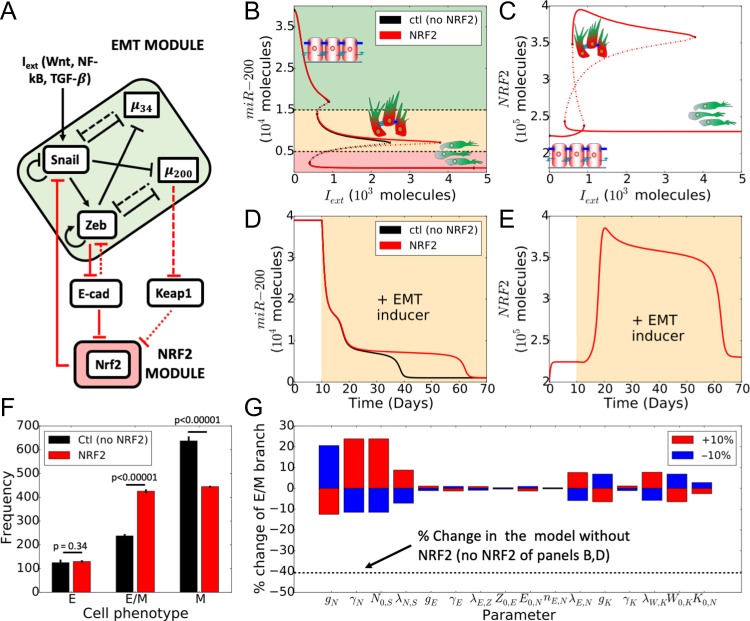
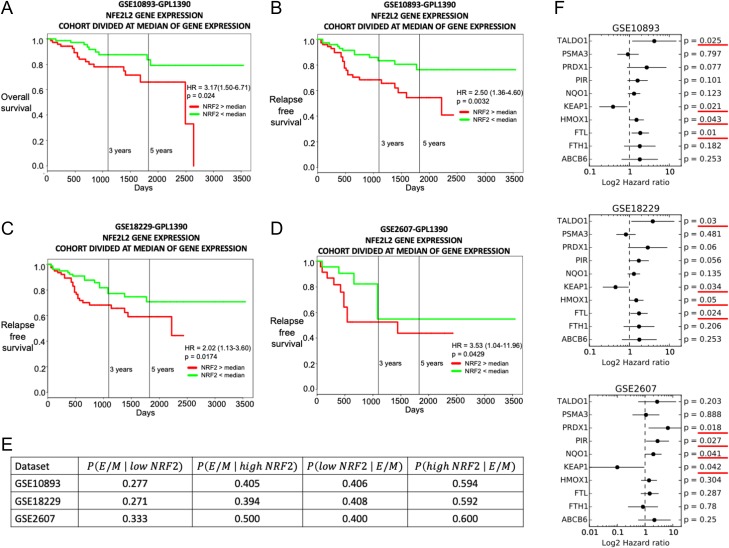
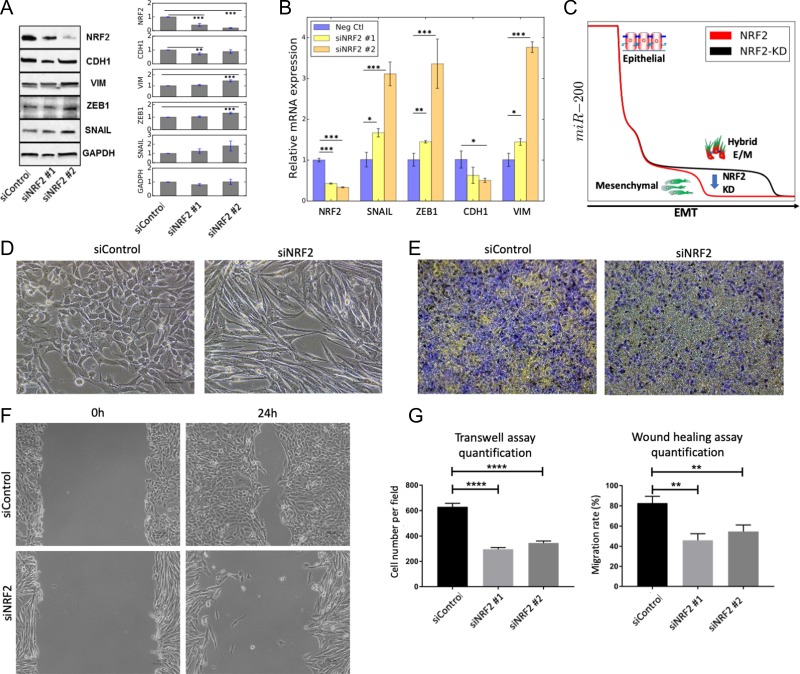
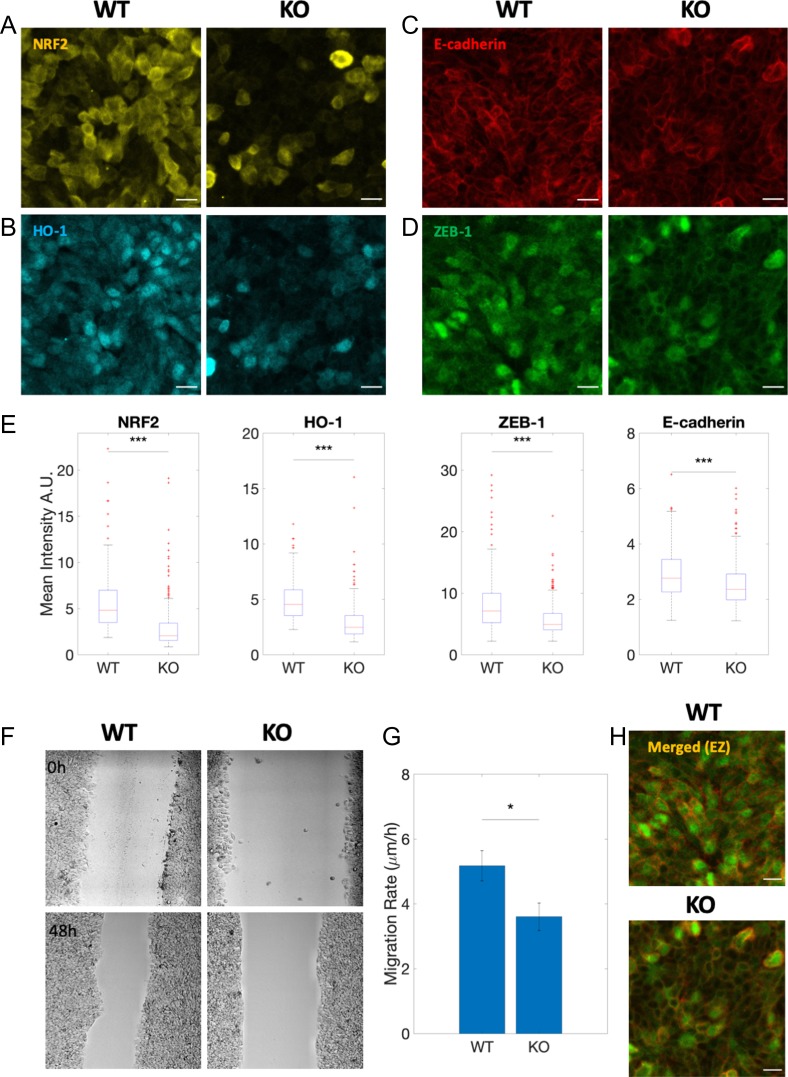
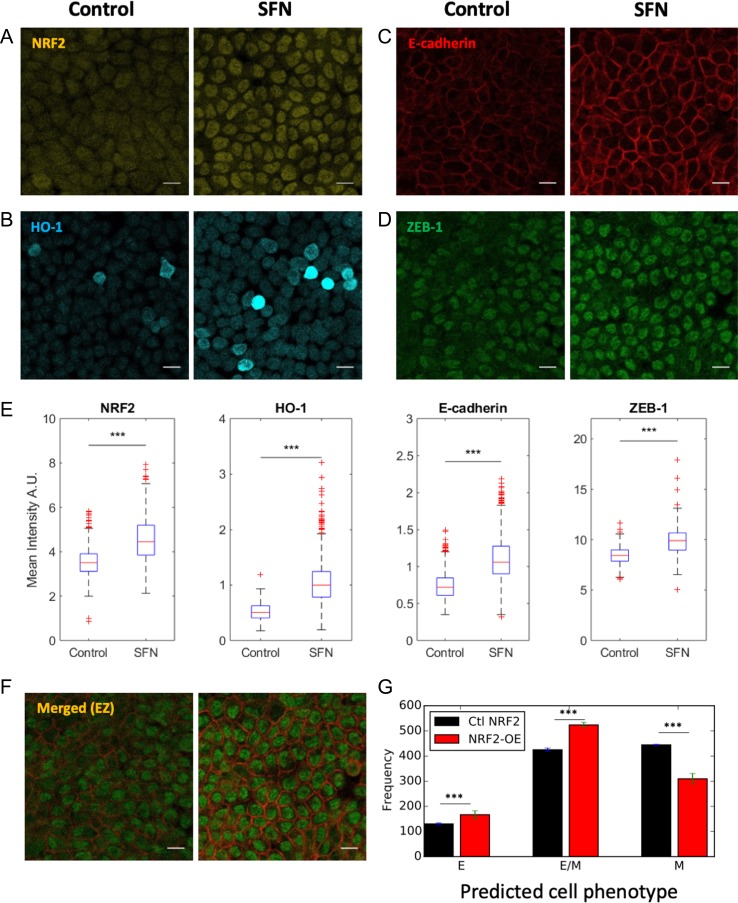
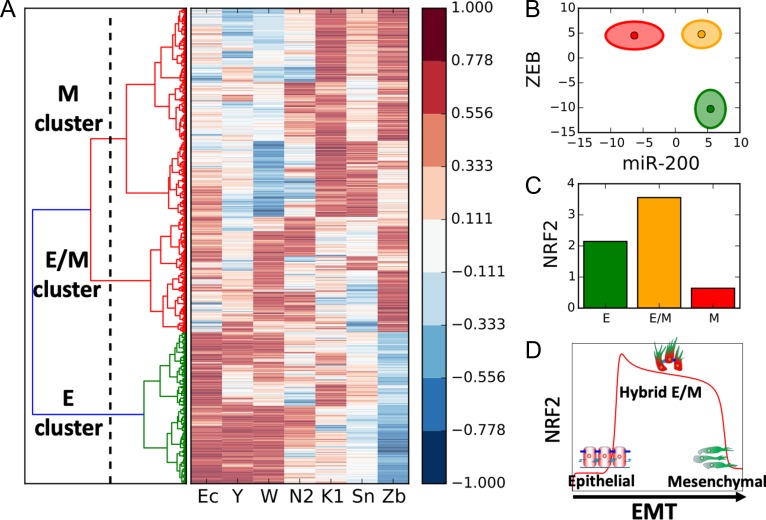
The epithelial-mesenchymal transition (EMT) is a key process implicated in cancer metastasis and therapy resistance. Recent studies have emphasized that cells can undergo partial EMT to attain a hybrid epithelial/mesenchymal (E/M) phenotype - a cornerstone of tumour aggressiveness and poor prognosis. These cells can have enhanced tumour-initiation potential as compared to purely epithelial or mesenchymal ones and can integrate the properties of cell-cell adhesion and motility that facilitates collective cell migration leading to clusters of circulating tumour cells (CTCs) - the prevalent mode of metastasis. Thus, identifying the molecular players that can enable cells to maintain a hybrid E/M phenotype is crucial to curb the metastatic load. Using an integrated computational-experimental approach, we show that the transcription factor NRF2 can prevent a complete EMT and instead stabilize a hybrid E/M phenotype. Knockdown of NRF2 in hybrid E/M non-small cell lung cancer cells H1975 and bladder cancer cells RT4 destabilized a hybrid E/M phenotype and compromised the ability to collectively migrate to close a wound in vitro. Notably, while NRF2 knockout simultaneously downregulated E-cadherin and ZEB-1, overexpression of NRF2 enriched for a hybrid E/M phenotype by simultaneously upregulating both E-cadherin and ZEB-1 in individual RT4 cells. Further, we predict that NRF2 is maximally expressed in hybrid E/M phenotype(s) and demonstrate that this biphasic dynamic arises from the interconnections among NRF2 and the EMT regulatory circuit. Finally, clinical records from multiple datasets suggest a correlation between a hybrid E/M phenotype, high levels of NRF2 and its targets and poor survival, further strengthening the emerging notion that hybrid E/M phenotype(s) may occupy the 'metastatic sweet spot'.
上皮-间质转化 (EMT) 是癌症转移和治疗耐药性的关键过程。最近的研究强调,细胞可以经历部分 EMT 以获得混合上皮/间质 (E/M) 表型 - 这是肿瘤侵袭性和预后不良的基石。与纯上皮或间质细胞相比,这些细胞具有增强的肿瘤起始潜力,并且可以整合细胞-细胞粘附和运动的特性,从而促进细胞集体迁移,导致循环肿瘤细胞 (CTC) 簇的形成 - 这是转移的主要模式。因此,确定能够使细胞维持混合 E/M 表型的分子参与者对于遏制转移负荷至关重要。通过综合计算实验方法,我们表明转录因子 NRF2 可以防止完全 EMT 并稳定混合 E/M 表型。在混合 E/M 非小细胞肺癌细胞 H1975 和膀胱癌细胞 RT4 中敲低 NRF2 会破坏混合 E/M 表型并损害集体迁移以在体外封闭伤口的能力。值得注意的是,虽然 NRF2 敲除同时下调了 E-钙粘蛋白和 ZEB-1,但 NRF2 的过表达通过同时上调单个 RT4 细胞中的 E-钙粘蛋白和 ZEB-1 丰富了混合 E/M 表型。此外,我们预测 NRF2 在混合 E/M 表型中表达最高,并证明这种双相动态源自 NRF2 和 EMT 调节回路之间的相互连接。最后,来自多个数据集的临床记录表明混合 E/M 表型、NRF2 及其靶标水平与不良生存之间存在相关性,进一步加强了混合 E/M 表型可能占据“转移的甜蜜点”的新兴观点。