Department of Medical and Clinical Psychology, Uniformed Services University of the Health Sciences (USUHS), 4301 Jones Bridge Road, Bethesda, MD 20814, USA.
Section on Growth and Obesity, Division of Intramural Research, Eunice Kennedy Shriver National Institute of Child Health and Human Development (NICHD), National Institutes of Health (NIH), DHHS, 10 Center Drive, Bethesda, MD 20892-1103, USA.
Nutrients. 2019 Jul 20;11(7):1658. doi: 10.3390/nu11071658.
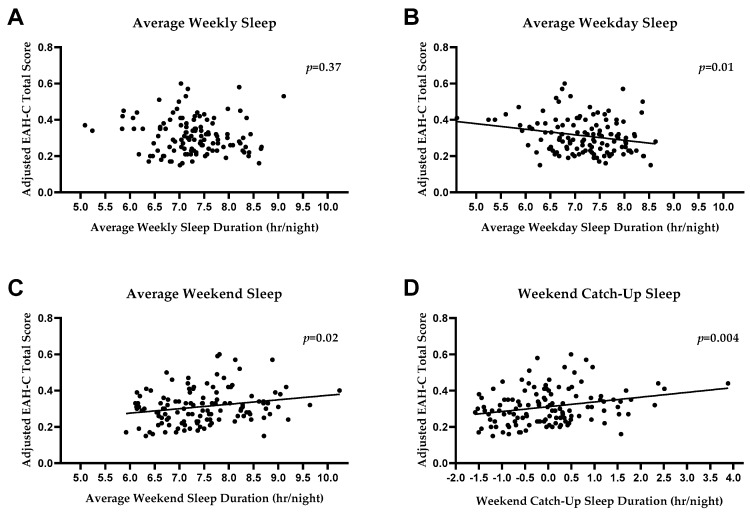
Insufficient average sleep duration has been inconsistently associated with poor diet and obesity risks in youth. Inconsistencies in findings across studies may be due to a general failure to examine associations in weekday versus weekend sleep. We hypothesized that greater variations in weekday and weekend sleep duration would be associated with more disinhibited eating behaviors, which, in turn, might be involved in the relationship between sleep and weight. We, therefore, examined, among healthy, non-treatment seeking youth, the associations of average weekly, weekend, and weekday sleep duration with eating in the absence of hunger (EAH), a disinhibited eating behavior associated with disordered eating and obesity. Sleep was assessed via actigraphy for 14 days. Participants completed a self-report measure of EAH. Adiposity was measured by dual-energy X-ray absorptiometry. Linear regressions were used to test the associations of sleep duration with EAH and the associations of sleep duration and EAH, with fat mass. Among 123 participants (8-17 years, 52.0% female, and 30.9% with overweight), there was no significant association between average weekly sleep and EAH. Further, there was no significant association among average weekly sleep duration or EAH and fat mass. However, average weekday sleep was negatively associated, and average weekend sleep was positively associated, with EAH (s < 0.02). Weekend "catch-up" sleep (the difference between weekend and weekday sleep) was positively associated with EAH ( < 0.01). Findings indicate that shorter weekday sleep and greater weekend "catch-up" sleep are associated with EAH, which may place youth at risk for the development of excess weight gain over time.
睡眠时间不足与年轻人不良饮食和肥胖风险之间的关联并不一致。研究结果的不一致可能是由于普遍未能检查工作日与周末睡眠的关联。我们假设工作日和周末睡眠时间的变化与更多的饮食抑制行为有关,而这种行为反过来可能与睡眠和体重之间的关系有关。因此,我们在健康的、未接受治疗的年轻人中,检查了平均每周、周末和工作日睡眠时间与无饥饿进食行为(EAH)的关联,EAH 是一种与饮食失调和肥胖有关的饮食抑制行为。通过活动记录仪评估睡眠 14 天。参与者完成了无饥饿进食行为的自我报告测量。体脂通过双能 X 射线吸收法测量。线性回归用于测试睡眠持续时间与 EAH 的关联,以及睡眠持续时间和 EAH 与脂肪量的关联。在 123 名参与者(8-17 岁,52.0%为女性,30.9%超重)中,平均每周睡眠时间与 EAH 之间没有显著关联。此外,平均每周睡眠时间或 EAH 与脂肪量之间也没有显著关联。然而,平均工作日睡眠与 EAH 呈负相关,平均周末睡眠与 EAH 呈正相关(s < 0.02)。周末“补觉”(周末和工作日睡眠之间的差异)与 EAH 呈正相关(< 0.01)。研究结果表明,工作日睡眠时间较短和周末“补觉”较多与 EAH 有关,这可能使年轻人随着时间的推移面临体重过度增加的风险。