Hypertension Unit, Department of Medicine-DIMED, University Hospital, 35128 Padova, Italy.
Int J Mol Sci. 2019 Jul 21;20(14):3567. doi: 10.3390/ijms20143567.
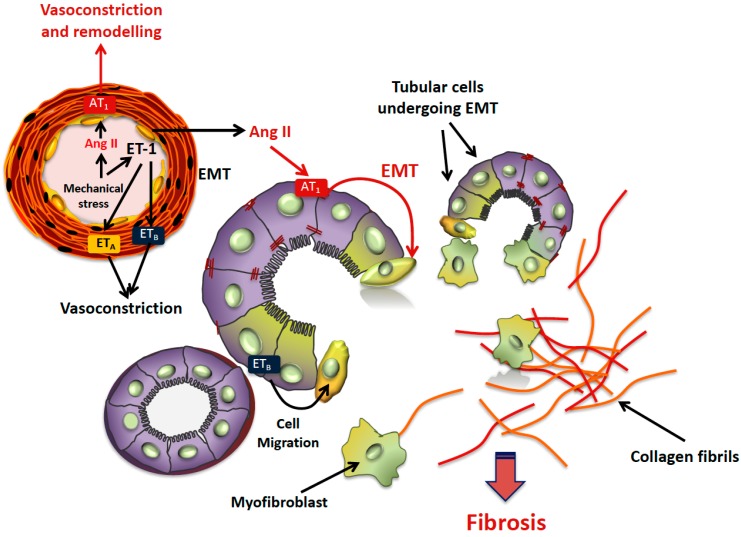
Accumulating evidence indicates that epithelial-to-mesenchymal transition (EMT), originally described as a key process for organ development and metastasis budding in cancer, plays a key role in the development of renal fibrosis in several diseases, including hypertensive nephroangiosclerosis. We herein reviewed the concept of EMT and its role in renal diseases, with particular focus on hypertensive kidney disease, the second leading cause of end-stage renal disease after diabetes mellitus. After discussing the pathophysiology of hypertensive nephropathy, the 'classic' view of hypertensive nephrosclerosis entailing hyalinization, and sclerosis of interlobular and afferent arterioles, we examined the changes occurring in the glomerulus and tubulo-interstitium and the studies that investigated the role of EMT and its molecular mechanisms in hypertensive kidney disease. Finally, we examined the reasons why some studies failed to provide solid evidence for renal EMT in hypertension.
越来越多的证据表明,上皮-间充质转化(EMT)最初被描述为器官发育和癌症转移芽形成的关键过程,在几种疾病(包括高血压性肾血管硬化症)的肾纤维化发展中发挥关键作用。我们在此回顾了 EMT 的概念及其在肾脏疾病中的作用,特别关注高血压性肾脏病,这是继糖尿病之后导致终末期肾病的第二大主要原因。在讨论了高血压肾病的病理生理学、涉及小动脉玻璃样变和硬化的“经典”高血压性肾血管硬化症之后,我们研究了发生在肾小球和肾小管间质中的变化,并研究了 EMT 及其在高血压性肾脏病中的分子机制的作用。最后,我们研究了为什么一些研究未能为高血压中的肾脏 EMT 提供确凿证据的原因。