National Institute of Education, Nanyang Technological University, Singapore 637616, Singapore.
Department of Health and Physical Education, The Education University of Hong Kong, Hong Kong, China.
Int J Environ Res Public Health. 2019 Jul 21;16(14):2599. doi: 10.3390/ijerph16142599.
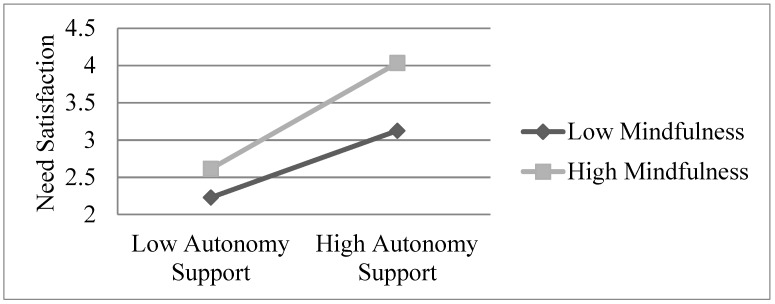
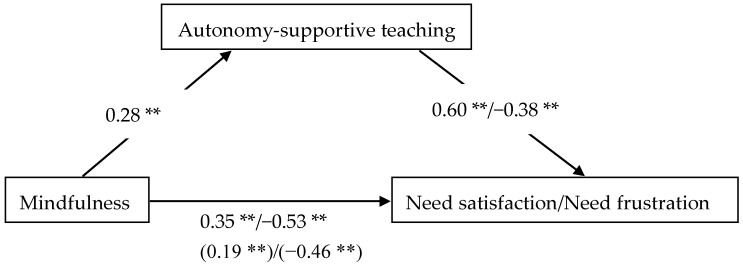
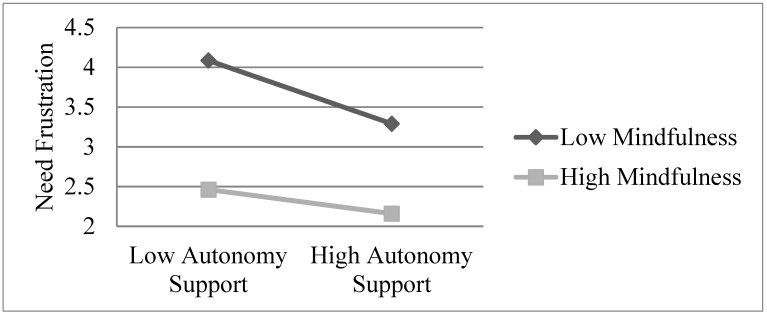
Grounded in self-determination theory, the purpose of this study was to investigate the relationships between autonomy-supportive teaching, mindfulness, and basic psychological need satisfaction/frustration. Secondary school students ( = 390, age = 15) responded to a survey form measuring psychological constructs pertaining to the research purpose. A series of multiple regression analysis showed that autonomy-supportive teaching and mindfulness positively predicted need satisfaction and negatively predicted need frustration. In addition, the associations between autonomy-supportive teaching and need satisfaction/frustration were moderated by mindfulness. Students higher in mindfulness were more likely to feel need satisfaction and less likely to experience need frustration, even in a low autonomy-supportive teaching environment. These results speak to the relevance of creating autonomy-supportive teaching environments and highlight mindfulness as a potential pathway to basic psychological need satisfaction in educational settings.
本研究以自我决定理论为基础,旨在探讨自主支持教学、正念与基本心理需求满足/受挫之间的关系。中学生(n=390,年龄=15)对一份调查问卷做出了回应,该问卷测量了与研究目的相关的心理结构。一系列多元回归分析表明,自主支持教学和正念正向预测需求满足,负向预测需求受挫。此外,自主支持教学与需求满足/受挫之间的关联受到正念的调节。正念水平较高的学生更有可能感到需求满足,而不太可能体验到需求受挫,即使在自主支持教学环境较低的情况下也是如此。这些结果表明了营造自主支持教学环境的重要性,并强调了正念是教育环境中基本心理需求满足的一个潜在途径。