Wan Jing, Hao Yang, Shi Yang, Song Yue-Xian, Yan Hui-Juan, Zheng Jian, Wen Rui, Wan Li-Jun
Key Laboratory of Molecular Nanostructure and Nanotechnology, Beijing National Laboratory for Molecular Sciences, CAS Research/Education Center for Excellence in Molecular Sciences, Institute of Chemistry, Chinese Academy of Sciences, 100190, Beijing, China.
University of Chinese Academy of Sciences, 100049, Beijing, China.
Nat Commun. 2019 Jul 22;10(1):3265. doi: 10.1038/s41467-019-11197-7.
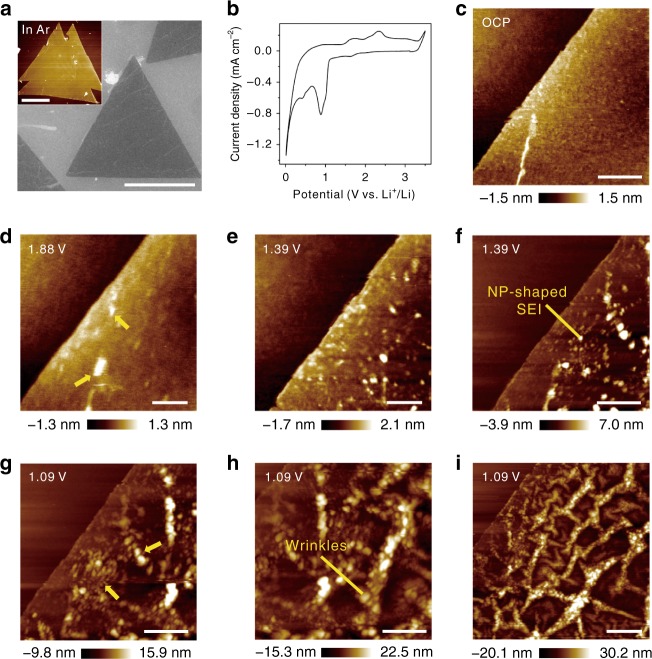
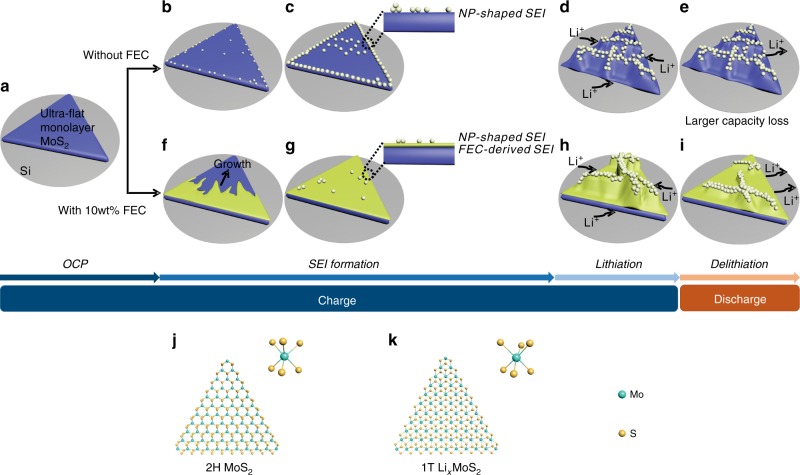
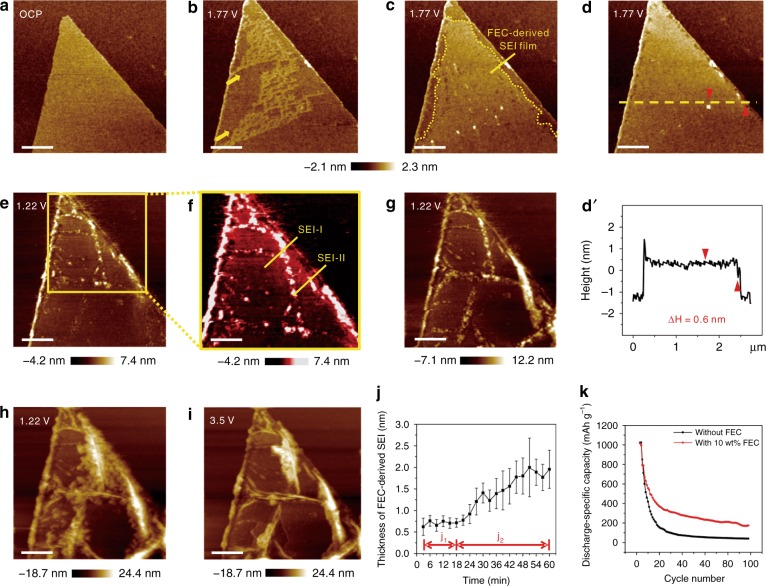
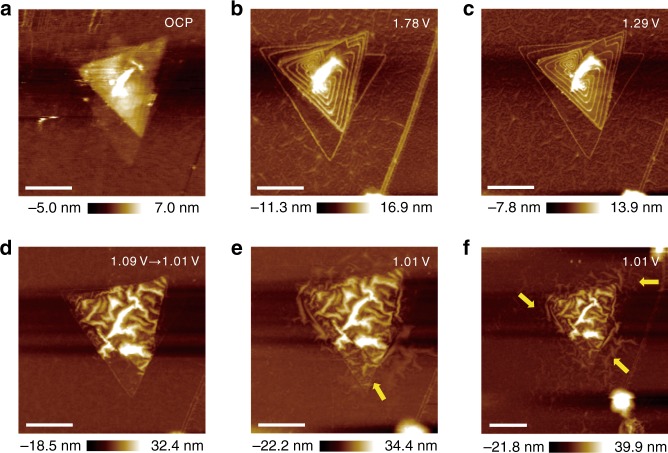
Molybdenum disulfide is considered one of the most promising anodes for lithium-ion batteries due to its high specific capacity; however, it suffers from an unstable solid electrolyte interphase. Understanding its structural evolution and reaction mechanism upon charging/discharging is crucial for further improvements in battery performance. Herein, the interfacial processes of solid electrolyte interphase film formation and lithiation/delithiation on ultra-flat monolayer molybdenum disulfide are monitored by in situ atomic force microscopy. The live formation of ultra-thin and dense films can be induced by the use of fluoroethylene carbonate as an additive to effectively protect the anode electrodes. The evolution of the fluoroethylene carbonate-derived solid electrolyte interphase film upon cycling is quantitatively analysed. Furthermore, the formation of wrinkle-structure networks upon lithiation process is distinguished in detailed steps, and accordingly, structure-reactivity correlations are proposed. These quantitative results provide an in-depth understanding of the interfacial mechanism in molybdenum disulfide-based lithium-ion batteries.
二硫化钼因其高比容量被认为是锂离子电池最有前景的负极材料之一;然而,它存在固体电解质界面不稳定的问题。了解其在充电/放电过程中的结构演变和反应机制对于进一步提高电池性能至关重要。在此,通过原位原子力显微镜监测了超平坦单层二硫化钼上固体电解质界面膜形成以及锂化/脱锂的界面过程。使用氟代碳酸乙烯酯作为添加剂可诱导超薄致密膜的实时形成,从而有效保护负极电极。对氟代碳酸乙烯酯衍生的固体电解质界面膜在循环过程中的演变进行了定量分析。此外,详细区分了锂化过程中皱纹结构网络的形成步骤,并据此提出了结构-反应性相关性。这些定量结果为基于二硫化钼的锂离子电池界面机制提供了深入理解。