Zhang Zhenyu, Smith Keenan, Jervis Rhodri, Shearing Paul R, Miller Thomas S, Brett Daniel J L
Electrochemical Innovation Lab, Department of Chemical Engineering, University College London, Torrington Place, WC1E 7JE London, U.K.
The Faraday Institution, Quad One, Becquerel Avenue, Harwell Campus, OX11 ORA Didcot, U.K.
ACS Appl Mater Interfaces. 2020 Aug 5;12(31):35132-35141. doi: 10.1021/acsami.0c11190. Epub 2020 Jul 27.
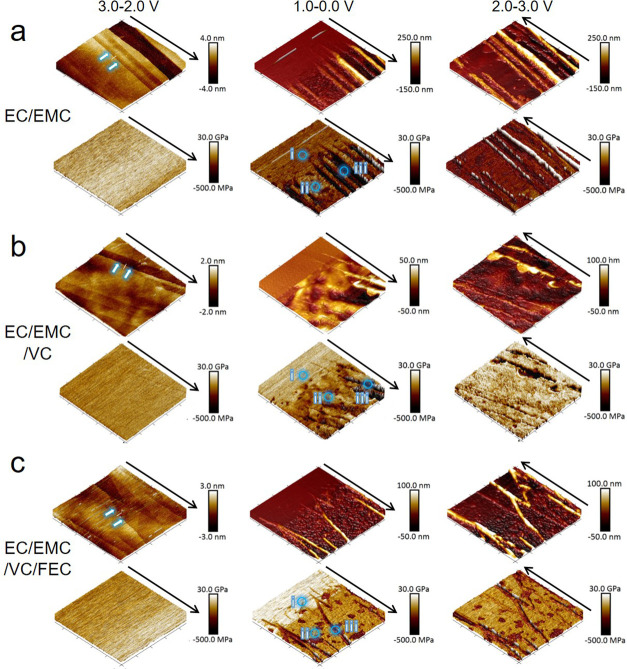
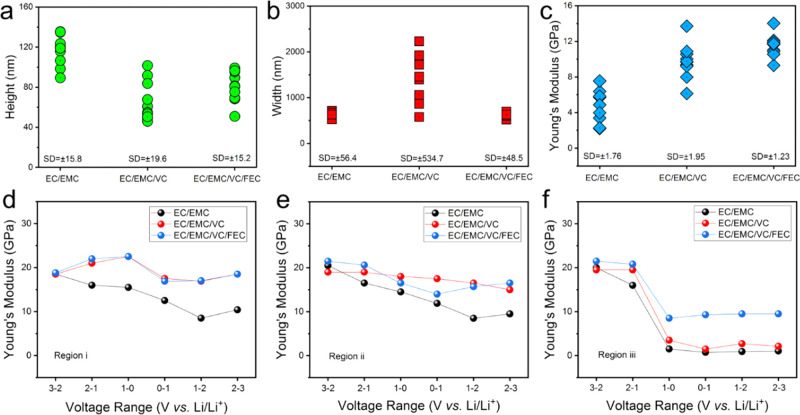
Understanding and ultimately controlling the properties of the solid-electrolyte interphase (SEI) layer at the graphite anode/liquid electrolyte boundary are of great significance for maximizing the performance and lifetime of lithium-ion batteries (LIBs). However, comprehensive in situ monitoring of SEI formation and evolution, alongside measurement of the corresponding mechanical properties, is challenging due to the limitations of the characterization techniques commonly used. This work provides a new insight into SEI formation during the first lithiation and delithiation of graphite battery anodes using operando electrochemical atomic force microscopy (EC-AFM). Highly oriented pyrolytic graphite (HOPG) is investigated first as a model system, exhibiting unique morphological and nanomechanical behavior dependent on the various electrolytes and commercially relevant additives used. Then, to validate these findings with respect to real-world battery electrodes, operando EC-AFM of individual graphite particles like those in commercial systems are studied. Vinylene carbonate (VC) and fluoroethylene carbonate (FEC) are shown to be effective additives to enhance SEI layer stability in 1 M LiPF/ethylene carbonate/ethyl methyl carbonate (EC/EMC) electrolytes, attributed to their role in improving its structure, density, and mechanical strength. This work therefore presents an unambiguous picture of SEI formation in a real battery environment, contributes a comprehensive insight into SEI formation of electrode materials, and provides a visible understanding of the influence of electrolyte additives on SEI formation.
了解并最终控制石墨阳极/液体电解质界面处的固体电解质界面(SEI)层的性质,对于最大化锂离子电池(LIB)的性能和寿命具有重要意义。然而,由于常用表征技术的局限性,对SEI的形成和演变进行全面的原位监测以及对相应机械性能的测量具有挑战性。这项工作利用原位电化学原子力显微镜(EC-AFM),对石墨电池阳极首次锂化和脱锂过程中的SEI形成提供了新的见解。首先研究了高度取向热解石墨(HOPG)作为模型系统,其表现出独特的形态和纳米力学行为,这取决于所使用的各种电解质和商业相关添加剂。然后,为了在实际电池电极方面验证这些发现,对商业系统中单个石墨颗粒进行了原位EC-AFM研究。碳酸亚乙烯酯(VC)和碳酸氟乙烯酯(FEC)被证明是有效的添加剂,可增强1 M LiPF/碳酸乙烯酯/碳酸甲乙酯(EC/EMC)电解质中SEI层的稳定性,这归因于它们在改善其结构、密度和机械强度方面的作用。因此,这项工作展示了真实电池环境中SEI形成的清晰图景,对电极材料的SEI形成提供了全面的见解,并对电解质添加剂对SEI形成的影响提供了直观的认识。