Department of Physics and Astronomy, University of Bologna, Bologna, Italy.
Department of Biomedical and Neuromotor Sciences - Physiology, University of Bologna, Bologna, Italy.
Sci Rep. 2019 Jul 22;9(1):10598. doi: 10.1038/s41598-019-46967-2.
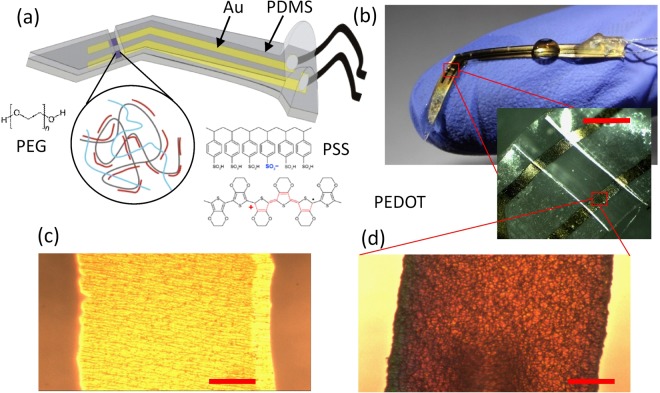
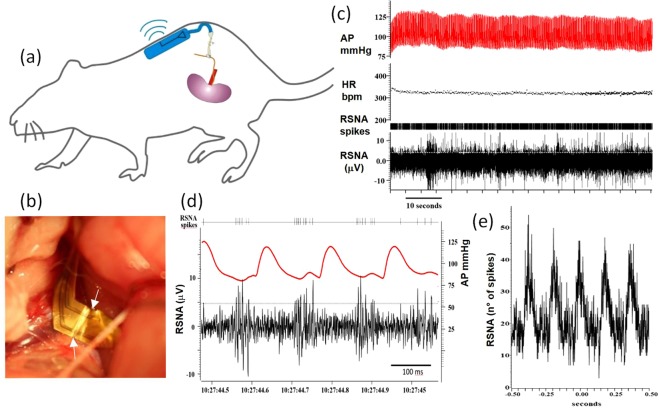
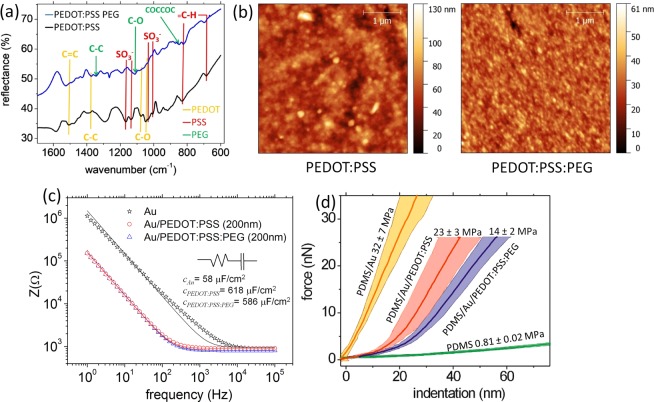
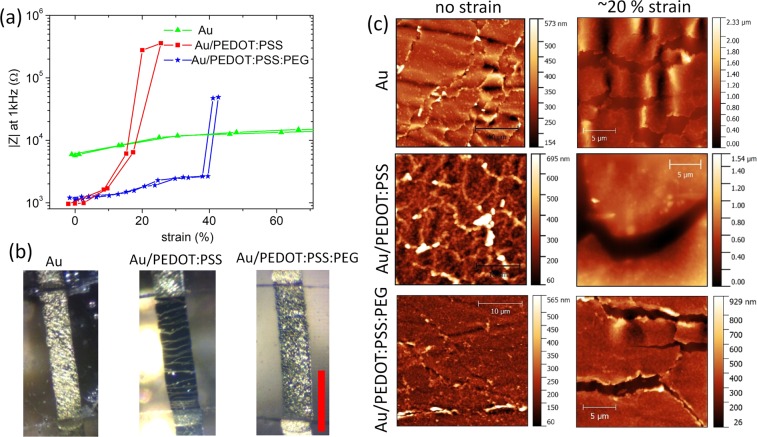
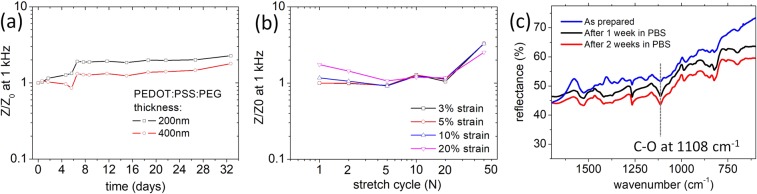
Monitoring of bioelectric signals in peripheral sympathetic nerves of small animal models is crucial to gain understanding of how the autonomic nervous system controls specific body functions related to disease states. Advances in minimally-invasive electrodes for such recordings in chronic conditions rely on electrode materials that show low-impedance ionic/electronic interfaces and elastic mechanical properties compliant with the soft and fragile nerve strands. Here we report a highly stretchable low-impedance electrode realized by microcracked gold films as metallic conductors covered with stretchable conducting polymer composite to facilitate ion-to-electron exchange. The conducting polymer composite based on poly(3,4-ethylenedioxythiophene) polystyrene sulfonate (PEDOT:PSS) obtains its adhesive, low-impedance properties by controlling thickness, plasticizer content and deposition conditions. Atomic Force Microscopy measurements under strain show that the optimized conducting polymer coating is compliant with the micro-crack mechanics of the underlying Au-layer, necessary to absorb the tensile deformation when the electrodes are stretched. We demonstrate functionality of the stretchable electrodes by performing high quality recordings of renal sympathetic nerve activity under chronic conditions in rats.
监测小动物模型周围交感神经的生物电信号对于了解自主神经系统如何控制与疾病状态相关的特定身体功能至关重要。在慢性疾病中进行此类记录的微创电极的进展依赖于显示低阻抗离子/电子界面和弹性机械性能的电极材料,这些性能与柔软和脆弱的神经束相兼容。在这里,我们报告了一种高度可拉伸的低阻抗电极,该电极由微裂纹金膜作为金属导体实现,并用可拉伸的导电聚合物复合材料覆盖,以促进离子到电子的交换。基于聚(3,4-亚乙基二氧噻吩)聚苯乙烯磺酸盐(PEDOT:PSS)的导电聚合物复合材料通过控制厚度、增塑剂含量和沉积条件获得其粘合性和低阻抗特性。应变下的原子力显微镜测量表明,优化后的导电聚合物涂层与底层 Au 层的微裂纹力学相兼容,这对于吸收电极拉伸时的拉伸变形是必要的。我们通过在大鼠慢性条件下进行高质量的肾交感神经活动记录来证明可拉伸电极的功能。