Alshaalan Anas Alshaalan, Alharbi Mohammed K, Alattas Khaled A
College of Medicine, King Saud bin Abdulaziz University for Health Sciences, Riyadh, Kingdom of Saudi Arabia.
Anaesthesia Department, King Abdulaziz Medical City, Riyadh, Kingdom of Saudi Arabia.
Saudi J Anaesth. 2019 Jul-Sep;13(3):191-196. doi: 10.4103/sja.SJA_792_18.
The aim of this study was to analyze the thinking processes of anesthesia physicians at in Riyadh, Jeddah, and Dammam cities in Saudi Arabia.
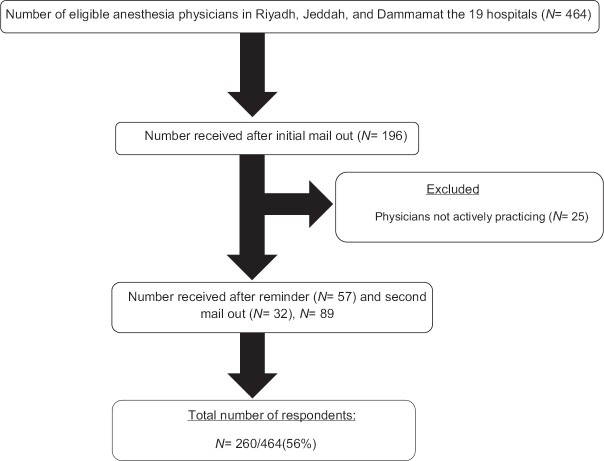
This cross-sectional study was undertaken in the cities of Riyadh, Jeddah, and Dammam in Saudi Arabia. Using a previously published psychometric tool (the Rational and Experiential Inventory, REI-40), the survey was sent through email and social networks to anesthesia physicians working in the targeted hospitals. An initial survey was sent out, followed by a reminder and a second survey to nonrespondents. Analysis included descriptive statistics and Student's -tests.
Most of the participants (69.2%) were males. At the time of the study, 35% of participants were consultants; 9.6% were associate consultants; 19.2% were registrars, fellows, or staff physicians; and 35.8% were senior residents. Anesthesia physicians' mean "rational" score was 3.22 [standard deviation (SD) =0.49)] and their mean "experiential" score was 3.01 (SD = 0.31). According to Pearson's correlation, the difference of 0.21 between these two scores was not statistically significant ( = 0.35). Male anesthesia physicians tended more toward faster, logical thinking. Consultant anesthesia physicians had faster rational thinking than nonconsultant physicians ( = 0.01). Anesthesia physicians with more than 10 years in practice had faster rational thinking than physicians who had worked for fewer than 10 years ( = 0.001).
This study evaluated anesthesia physicians' general decision-making approaches. Despite the fact that both rational and experiential techniques are used in clinical decision-making, male consultants and physicians with more than 10 years' experience and certified non-Saudi board anesthesiologists prefer rational decision-making style.
本研究旨在分析沙特阿拉伯利雅得、吉达和达曼市麻醉医师的思维过程。
本横断面研究在沙特阿拉伯的利雅得、吉达和达曼市开展。使用先前发表的心理测量工具(理性与经验量表,REI - 40),通过电子邮件和社交网络向目标医院的麻醉医师发送调查问卷。先发送初始调查问卷,之后向未回复者发送提醒和第二次调查问卷。分析包括描述性统计和学生t检验。
大多数参与者(69.2%)为男性。在研究时,35%的参与者为顾问医师;9.6%为副顾问医师;19.2%为住院医师、研究员或主治医师;35.8%为高级住院医师。麻醉医师的平均“理性”得分为3.22[标准差(SD)=0.49],平均“经验”得分为3.01(SD = 0.31)。根据皮尔逊相关性分析,这两个分数之间0.21的差异无统计学意义(P = 0.35)。男性麻醉医师更倾向于快速、逻辑性的思维。顾问麻醉医师比非顾问医师的理性思维更快(P = 0.01)。从业超过10年的麻醉医师比从业少于10年的医师理性思维更快(P = 0.001)。
本研究评估了麻醉医师的一般决策方法。尽管在临床决策中同时使用了理性和经验技术,但男性顾问医师、从业超过10年的医师以及获得非沙特委员会认证的麻醉医师更喜欢理性决策风格。