Zhu Tingfei, Xue Jiang, Montuclard Astrid, Jiang Yuxing, Weng Wenqi, Chen Shulin
Department of Psychology and Behavioral Sciences, Zhejiang University, Hangzhou, China.
Department of Human Ecology, University of California, Davis, Davis, CA, United States.
Front Psychol. 2019 Jul 3;10:1549. doi: 10.3389/fpsyg.2019.01549. eCollection 2019.
Based on eastern philosophy, mindfulness is becoming popular for human being's mental health and well-being in western countries. In this study, we proposed to explore the effectiveness and potential pathway of mindfulness-based training (MBT) on Chinese Non-clinical higher education students' cognition and emotion.
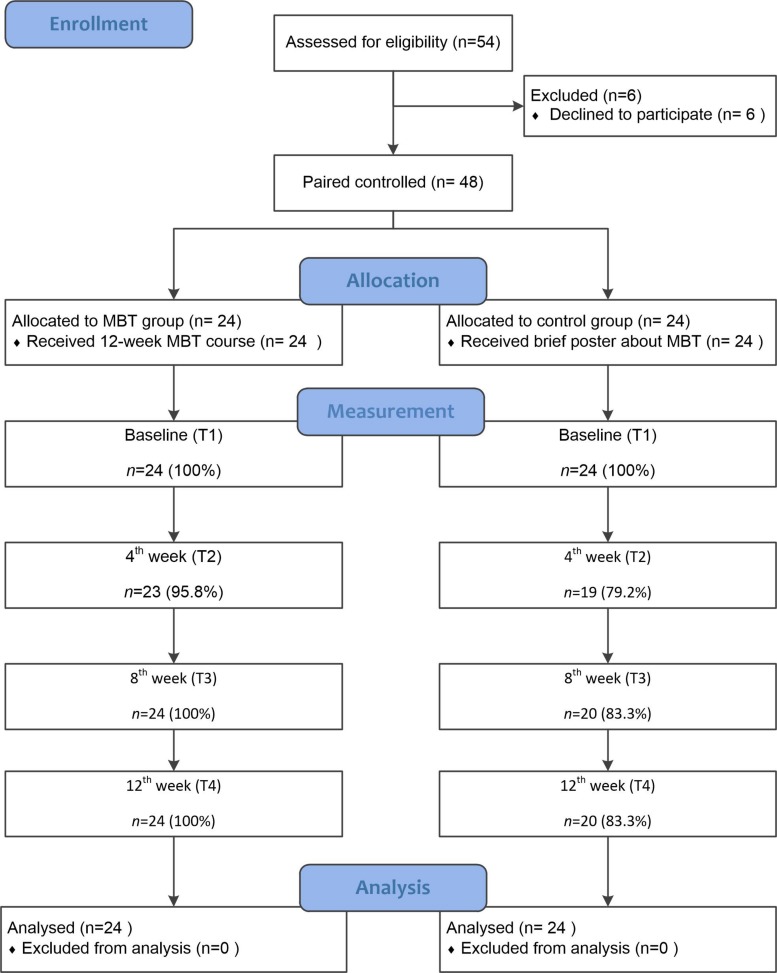
A paired control design was used. 48 higher education students (24 in MBT group, 24 in control group) were recruited in the study. The MBT group engaged in a 12-week MBT. A package of measurements, including sustained attention tasks (The Continuous Performance Test, CPT), executive function task (Stroop) for cognitive functions, the self-reported mindfulness levels (The Mindful Attention Awareness Scale, MAAS) and emotion (The Profile of Mood States, POMS), were apply for all participants at baseline and every 4 weeks during next 12 weeks.
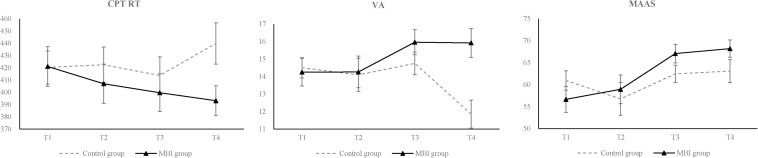
There were no differences in baseline demographic variables between two groups. Over the 12-week training, participants assigned to MBT group had a significantly greater reduction in CPT reaction time (Cohen's d 0.72), significantly greater improvement in positive emotion (Vigor-Activity, VA) (Cohen's d 1.08) and in MAAS (Cohen's d 0.49) than those assigned to control group. And, MAAS at 4th week could significantly predict the CPT RT and VA at 8th week in the MBT group. VA at 4th week could significantly predict the CPT RT at 8th week ( = 4.88, 2.21, 0.034, = 0.35).
This study shows the efficiency of 12-week MBT on Chinese Non-clinical students' cognition and emotion. Mindfulness training may impact cognition and emotion through the improvement in mindfulness level, and may impact cognition through the improvement in positive emotion.
基于东方哲学,正念在西方国家正日益流行,用于促进人类的心理健康和幸福。在本研究中,我们旨在探讨基于正念的训练(MBT)对中国非临床高等教育学生认知和情绪的有效性及潜在途径。
采用配对对照设计。本研究招募了48名高等教育学生(MBT组24名,对照组24名)。MBT组参加了为期12周的MBT训练。对所有参与者在基线时以及接下来的12周内每4周进行一系列测量,包括持续注意力任务(连续性能测试,CPT)、认知功能的执行功能任务(斯特鲁普测试)、自我报告的正念水平(正念注意觉知量表,MAAS)和情绪(情绪状态剖面图,POMS)。
两组在基线人口统计学变量上无差异。在为期12周的训练中,与对照组相比,分配到MBT组的参与者在CPT反应时间上有显著更大幅度的降低(科恩d值为0.72),在积极情绪(活力-活动,VA)(科恩d值为1.08)和MAAS(科恩d值为0.49)上有显著更大幅度的改善。并且,MBT组第4周的MAAS能够显著预测第8周的CPT反应时间和VA。第4周的VA能够显著预测第8周的CPT反应时间(=4.88,2.21,0.034,=0.35)。
本研究表明为期12周的MBT对中国非临床学生的认知和情绪有效。正念训练可能通过提高正念水平影响认知和情绪,并且可能通过改善积极情绪影响认知。