Pindus Dominika M, Drollette Eric S, Raine Lauren B, Kao Shih-Chun, Khan Naiman, Westfall Daniel R, Hamill Morgan, Shorin Rebecca, Calobrisi Emily, John Dinesh, Kramer Arthur F, Hillman Charles H
Department of Kinesiology and Community Health, University of Illinois at Urbana-Champaign, Urbana, IL 61801, USA.
School of Health and Human Sciences, University of North Carolina Greensboro, Greensboro, NC 6170, USA.
J Sport Health Sci. 2019 Jul;8(4):301-314. doi: 10.1016/j.jshs.2019.02.003. Epub 2019 Feb 15.
Structured vigorous physical activity (VPA) can improve cognitive control in children, but studies relating daily physical activity (PA) to cognitive control have yielded conflicting findings. While objectively measured daily PA summarizes all occurrences of PA within a registered period, a minimum duration of continuous PA is required for registration of a PA bout. Because brief bouts of high-intensity PA can account for a large proportion of children's daily activity-related energy expenditure, this study assessed whether daily and bouted VPA were selectively related to cognitive control in preadolescents relative to other PA intensities.
A total of 75 children between the ages of 8 and 10 years (49% girls) wore an ActiGraph wGT3X+ on the hip for 7 days. The acceleration signal from the vertical axis was summarized over 1 s, 5 s, and 15 s epochs. Daily and bouted moderate PA, moderate-to-vigorous PA, and VPA were measured. PA bouts were expressed as the frequency and time spent in 2 different continuous PA bouts, one lasting ≥10 s and the other lasting ≥30 s at a given intensity. Inhibitory control was assessed using behavioral responses to a modified flanker task (mean reaction time (RT) and accuracy). Attentional resource allocation and cognitive processing speed were measured using the amplitude and latency of the P3 component of event-related brain potentials, respectively. Associations between PA, behavioral indices of inhibitory control, P3 amplitude, and latency were assessed using hierarchical regression models.
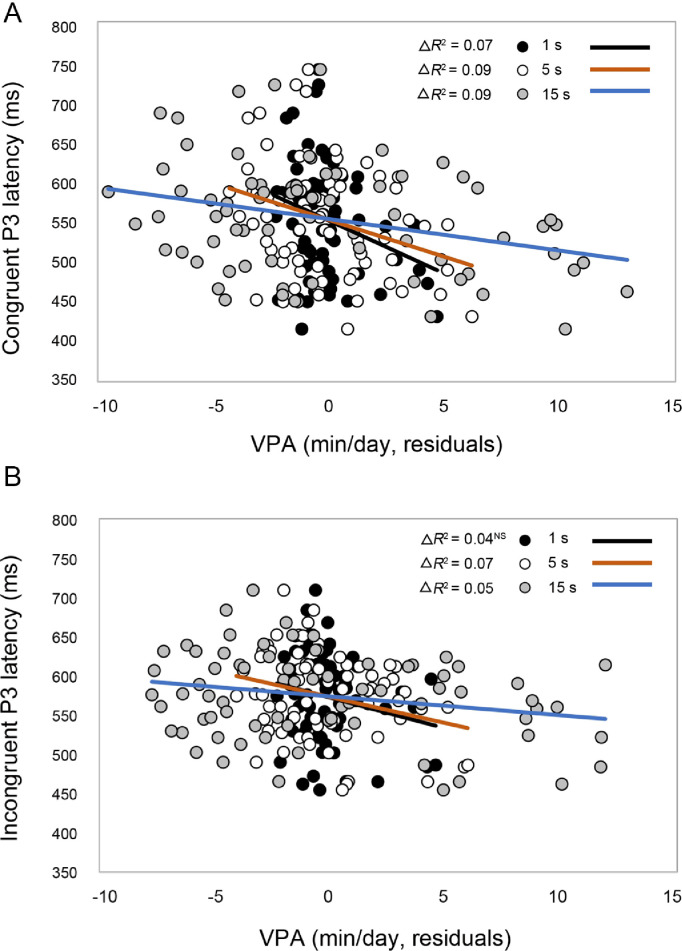
Daily VPA was not related to RT or accuracy on either congruent or incongruent trials. In contrast, more time spent in VPA bouts lasting ≥30 s predicted shorter P3 latency across epochs and flanker congruencies (all -0.24, all 004). The associations between shorter P3 latency and the time spent in moderate-to-vigorous PA bouts lasting ≥30 s were less consistent and largely limited to congruent trials (congruent: (-0.31, -0.34)). No significant associations were observed upon correction for false discovery rate.
The pattern of uncorrected associations aligns with the dose-response literature and suggests that brief VPA bouts may yield the greatest benefits to cognitive processing speed in preadolescents. Future studies using measures of brain structure and function are needed to understand the mechanisms linking bouted VPA to neurocognitive function during childhood.
结构化的剧烈身体活动(VPA)可以改善儿童的认知控制,但关于日常身体活动(PA)与认知控制之间关系的研究结果相互矛盾。虽然客观测量的日常PA总结了登记期间内PA的所有发生情况,但登记一次PA发作需要连续PA的最短持续时间。由于短时间的高强度PA可占儿童日常活动相关能量消耗的很大一部分,因此本研究评估了相对于其他PA强度,日常和发作性VPA是否与青春期前儿童的认知控制存在选择性关联。
共有75名8至10岁的儿童(49%为女孩)在臀部佩戴ActiGraph wGT3X+ 7天。垂直轴的加速度信号在1秒、5秒和15秒的时间段内进行汇总。测量日常和发作性的中等强度PA、中等至剧烈强度PA和VPA。PA发作表示为在2种不同的连续PA发作中花费的频率和时间,一种在给定强度下持续≥10秒,另一种持续≥30秒。使用对改良侧翼任务的行为反应(平均反应时间(RT)和准确性)评估抑制控制。分别使用事件相关脑电位P3成分的振幅和潜伏期测量注意力资源分配和认知处理速度。使用分层回归模型评估PA、抑制控制的行为指标、P3振幅和潜伏期之间的关联。
日常VPA与一致性或不一致性试验中的RT或准确性均无关。相比之下,在持续≥30秒的VPA发作中花费更多时间预示着在各个时间段和侧翼一致性情况下P3潜伏期更短(所有p < -0.24,所有p < 0.04)。较短的P3潜伏期与持续≥30秒的中等至剧烈强度PA发作中花费的时间之间的关联不太一致,并且在很大程度上限于一致性试验(一致性:p < (-0.31, -0.34))。在对错误发现率进行校正后未观察到显著关联。
未校正关联的模式与剂量反应文献一致,表明短时间的VPA发作可能对青春期前儿童的认知处理速度产生最大益处。未来需要使用脑结构和功能测量方法的研究来了解儿童期发作性VPA与神经认知功能之间联系的机制。