• 文献检索
  • 文档翻译
  • 深度研究
  • 学术资讯
  • Suppr Zotero 插件Zotero 插件
  • 邀请有礼
  • 套餐&价格
  • 历史记录
应用&插件
Suppr Zotero 插件Zotero 插件浏览器插件Mac 客户端Windows 客户端微信小程序
定价
高级版会员购买积分包购买API积分包
服务
文献检索文档翻译深度研究API 文档MCP 服务
关于我们
关于 Suppr公司介绍联系我们用户协议隐私条款
关注我们

Suppr 超能文献

核心技术专利:CN118964589B侵权必究
粤ICP备2023148730 号-1Suppr @ 2026

文献检索

告别复杂PubMed语法,用中文像聊天一样搜索,搜遍4000万医学文献。AI智能推荐,让科研检索更轻松。

立即免费搜索

文件翻译

保留排版,准确专业,支持PDF/Word/PPT等文件格式,支持 12+语言互译。

免费翻译文档

深度研究

AI帮你快速写综述,25分钟生成高质量综述,智能提取关键信息,辅助科研写作。

立即免费体验

美国青少年驾驶员使用大麻的情况:报告使用情况的路边调查与四氢大麻酚(THC)液体测试的比较。

Marijuana use in U.S. teen drivers: a comparison of a road-side survey of reported use and fluid tests for tetrahydrocannabinol (THC).

作者信息

Pressley Joyce C, Arora Arushi, Sarmah Raina

机构信息

1Columbia University Mailman School of Public Health Departments of Epidemiology and Health Policy and Management, 722 West 168th St., New York, NY 10032 USA.

Health Policy and Management, New York, NY USA.

出版信息

Inj Epidemiol. 2019 May 29;6(Suppl 1):25. doi: 10.1186/s40621-019-0204-0. eCollection 2019.

DOI:10.1186/s40621-019-0204-0
PMID:31333991
原文链接:https://pmc.ncbi.nlm.nih.gov/articles/PMC6616460/
Abstract

BACKGROUND

Although the growth of state-level legalization of marijuana is aimed at increasing availability for adults and the chronically ill, one fear is that this trend may also increase accessibility in younger populations. The objectives of this study are to evaluate marijuana use in teen driver study participants and to compare their survey self-reported use with oral fluid and blood tests for psychoactive metabolites of tetrahydrocannabinol (THC).

METHODS

The National Roadside Survey (NRS) of 2013-2014 was used to examine marijuana use in drivers aged 16-19 years. Of 11,100 drivers surveyed at 300 U.S. locations in 24 states, 718 were 16-19 years, and 666 (92.8%) provided oral fluid and/or blood. We examined weighted and unweighted data, but present unweighted findings. Kappa statistics, Chi square, and multivariable logistic regressions were used to assess agreement, associations and independent predictors of outcomes.

RESULTS

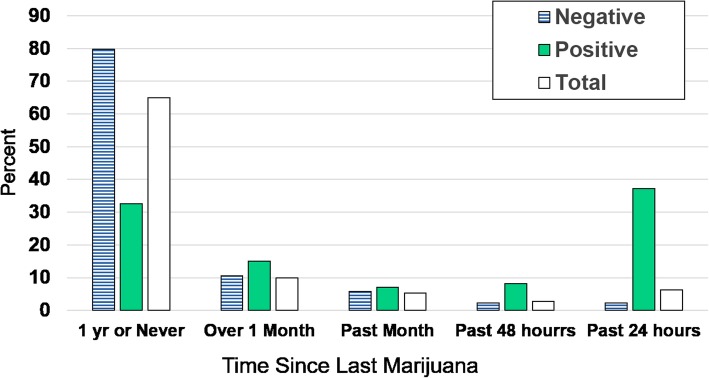
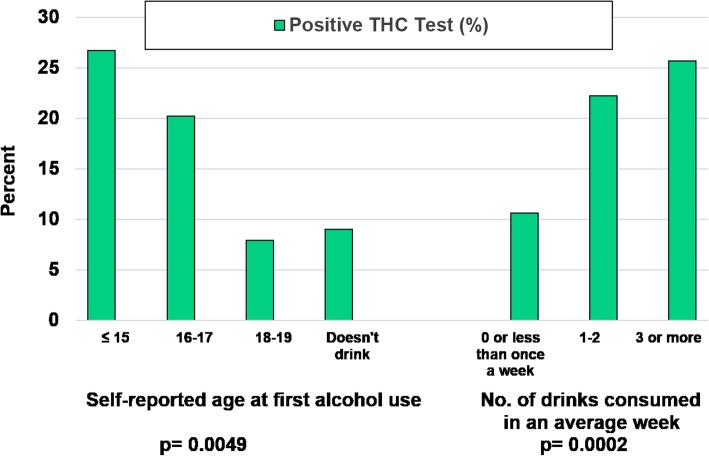
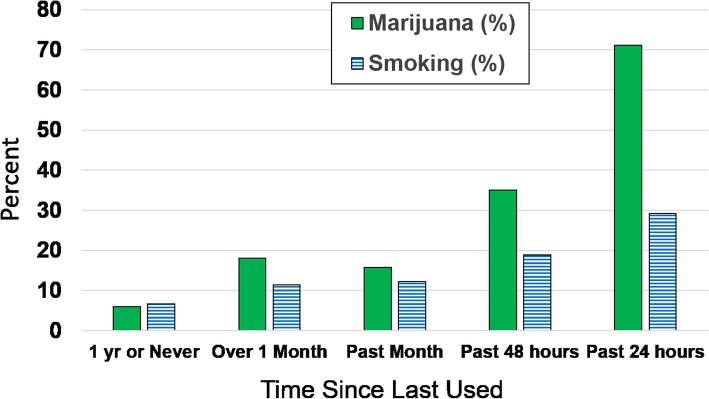
More than one-quarter (203/718) of teen drivers reported either using marijuana in the last year or were THC positive. Overall incidence of a THC positive fluid test was 13.7%. In addition to 175 (27.3%) teen drivers who reported use in the last year, 28 (4.4%) who denied using in the past year, tested positive for THC. Of 45 teen drivers reporting use in the last 24 h, more than two-thirds (71.1%) were THC positive. Disagreement between the oral and blood test for 305 teen drivers who had both tests was 17 (5.6%), with a Kappa of 0.78 (95% CI 0.69-0.88). Of THC-positive drivers, nearly 20% started drinking alcohol by age 14 and more than 70% by age 16. Age, gender- and income-adjusted independent predictors of a positive THC test included survey completion during the school year (OR 3.2, 95% CI 1.6-6.2), survey-reported marijuana use in last year (OR 5.3, 95% CI 3.0-9.2), current smoker (OR 2.1, 95% CI 1.1-3.7), and alcohol consumption before age 16 (OR 2.3, 95% CI 1.1-3.7).

CONCLUSIONS

Although specific THC thresholds for safe driving have not been established, taken in the context of teen crash statistics, THC documented impairments and rapidly relaxing marijuana laws, these findings suggest the need for increased vigilance and stepped-up surveillance in teen drivers.

摘要

背景

尽管州级大麻合法化的发展旨在使成年人和慢性病患者更容易获取大麻,但人们担心这一趋势可能也会增加年轻人群体获取大麻的机会。本研究的目的是评估青少年驾驶员研究参与者中大麻的使用情况,并将他们在调查中自我报告的使用情况与针对四氢大麻酚(THC)精神活性代谢物的唾液和血液检测结果进行比较。

方法

使用2013 - 2014年的全国路边调查(NRS)来研究16 - 19岁驾驶员中大麻的使用情况。在24个州的300个美国地点对11100名驾驶员进行了调查,其中718名年龄在16 - 19岁,666名(92.8%)提供了唾液和/或血液样本。我们检查了加权和未加权数据,但呈现的是未加权结果。使用卡方统计、卡方检验和多变量逻辑回归来评估一致性、关联性和结果的独立预测因素。

结果

超过四分之一(203/718)的青少年驾驶员报告在过去一年中使用过大麻或THC检测呈阳性。THC唾液检测呈阳性的总体发生率为13.7%。除了175名(27.3%)报告在过去一年中使用过大麻的青少年驾驶员外,28名(4.4%)否认在过去一年中使用过大麻的驾驶员THC检测呈阳性。在45名报告在过去24小时内使用过大麻的青少年驾驶员中,超过三分之二(71.1%)的人THC检测呈阳性。对305名同时进行了唾液和血液检测的青少年驾驶员来说,唾液和血液检测结果的不一致率为17例(5.6%),卡方值为0.78(95%可信区间0.69 - 0.88)。在THC检测呈阳性的驾驶员中,近20%在14岁前开始饮酒,超过70%在16岁前开始饮酒。经年龄、性别和收入调整后,THC检测呈阳性的独立预测因素包括在学年期间完成调查(比值比3.2,95%可信区间1.6 - 6.2)、调查中报告在过去一年中使用过大麻(比值比5.3,95%可信区间3.0 - 9.2)、当前吸烟者(比值比2.1,95%可信区间1.1 - 3.7)以及在16岁前饮酒(比值比2.3,95%可信区间1.1 - 3.7)。

结论

尽管尚未确定安全驾驶的具体THC阈值,但结合青少年车祸统计数据、记录在案的THC损害以及迅速放宽的大麻法律来看,这些发现表明有必要提高对青少年驾驶员的警惕并加强监测。
https://cdn.ncbi.nlm.nih.gov/pmc/blobs/52e5/6616460/df5b714cfd79/40621_2019_204_Fig3_HTML.jpg
https://cdn.ncbi.nlm.nih.gov/pmc/blobs/52e5/6616460/4f71bb4f53a7/40621_2019_204_Fig1_HTML.jpg
https://cdn.ncbi.nlm.nih.gov/pmc/blobs/52e5/6616460/5e301f482672/40621_2019_204_Fig2_HTML.jpg
https://cdn.ncbi.nlm.nih.gov/pmc/blobs/52e5/6616460/df5b714cfd79/40621_2019_204_Fig3_HTML.jpg
https://cdn.ncbi.nlm.nih.gov/pmc/blobs/52e5/6616460/4f71bb4f53a7/40621_2019_204_Fig1_HTML.jpg
https://cdn.ncbi.nlm.nih.gov/pmc/blobs/52e5/6616460/5e301f482672/40621_2019_204_Fig2_HTML.jpg
https://cdn.ncbi.nlm.nih.gov/pmc/blobs/52e5/6616460/df5b714cfd79/40621_2019_204_Fig3_HTML.jpg

相似文献

1
Marijuana use in U.S. teen drivers: a comparison of a road-side survey of reported use and fluid tests for tetrahydrocannabinol (THC).美国青少年驾驶员使用大麻的情况:报告使用情况的路边调查与四氢大麻酚(THC)液体测试的比较。
Inj Epidemiol. 2019 May 29;6(Suppl 1):25. doi: 10.1186/s40621-019-0204-0. eCollection 2019.
2
Marijuana use and driving in Washington State: Risk perceptions and behaviors before and after implementation of retail sales.华盛顿州的大麻使用与驾车:零售销售实施前后的风险认知与行为
Traffic Inj Prev. 2019;20(1):23-29. doi: 10.1080/15389588.2018.1530769. Epub 2019 Mar 1.
3
Validity of oral fluid test for Delta-9-tetrahydrocannabinol in drivers using the 2013 National Roadside Survey Data.使用2013年全国路边调查数据评估驾驶员口腔液检测Δ-9-四氢大麻酚的有效性。
Inj Epidemiol. 2018 Feb 19;5(1):3. doi: 10.1186/s40621-018-0134-2.
4
Alcohol and marijuana use among young injured drivers in Arizona, 2008-2014.2008 - 2014年亚利桑那州年轻受伤驾驶员的酒精和大麻使用情况
Traffic Inj Prev. 2019;20(1):9-14. doi: 10.1080/15389588.2018.1527032. Epub 2019 Jan 25.
5
Comparison of teen and adult driver crash scenarios in a nationally representative sample of serious crashes.在全国具有代表性的严重撞车事故样本中,青少年与成年驾驶员撞车场景的比较。
Accid Anal Prev. 2014 Nov;72:302-8. doi: 10.1016/j.aap.2014.07.016. Epub 2014 Aug 5.
6
Cannabis use as a risk factor for causing motor vehicle crashes: a prospective study.大麻使用作为导致机动车事故的风险因素:一项前瞻性研究。
Addiction. 2019 Sep;114(9):1616-1626. doi: 10.1111/add.14663. Epub 2019 Jul 3.
7
Comparison between self-report of cannabis use and toxicological detection of THC/THCCOOH in blood and THC in oral fluid in drivers in a roadside survey.在路边调查中,比较驾驶员自我报告的大麻使用情况与血液中 THC/THCCOOH 和尿液中 THC 的毒物学检测结果。
Drug Test Anal. 2014 Jan-Feb;6(1-2):137-42. doi: 10.1002/dta.1517. Epub 2013 Aug 13.
8
Advanced driver assistance systems for teen drivers: A national survey of teen and parent perceptions.针对青少年驾驶员的先进驾驶辅助系统:一项关于青少年及家长认知的全国性调查。
Traffic Inj Prev. 2018;19(sup2):S84-S90. doi: 10.1080/15389588.2018.1494383. Epub 2018 Oct 18.
9
Cannabis Legalization and Detection of Tetrahydrocannabinol in Injured Drivers.大麻合法化与事故驾车者体内四氢大麻酚的检测。
N Engl J Med. 2022 Jan 13;386(2):148-156. doi: 10.1056/NEJMsa2109371.
10
The impact of marijuana decriminalization on California drivers.大麻合法化对加利福尼亚州驾驶员的影响。
Drug Alcohol Depend. 2015 May 1;150:135-40. doi: 10.1016/j.drugalcdep.2015.02.024. Epub 2015 Mar 1.

本文引用的文献

1
Cannabis and its effects on driving skills.大麻及其对驾驶技能的影响。
Forensic Sci Int. 2016 Nov;268:92-102. doi: 10.1016/j.forsciint.2016.09.007. Epub 2016 Sep 16.
2
National Highway Traffic Safety Administration (NHTSA) Notes. Results of the 2013-2014 National Roadside Survey of Alcohol and Drug Use by Drivers.美国国家公路交通安全管理局(NHTSA)注释。2013 - 2014年驾驶员酒精和药物使用情况全国路边调查结果。
Ann Emerg Med. 2015 Dec;66(6):669.
3
Cannabis effects on driving lateral control with and without alcohol.大麻对有或无酒精情况下驾驶横向控制的影响。
Drug Alcohol Depend. 2015 Sep 1;154:25-37. doi: 10.1016/j.drugalcdep.2015.06.015. Epub 2015 Jun 23.
4
Nonsmoker Exposure to Secondhand Cannabis Smoke. III. Oral Fluid and Blood Drug Concentrations and Corresponding Subjective Effects.非吸烟者接触二手大麻烟雾。III. 口腔液和血液中的药物浓度及相应的主观效应。
J Anal Toxicol. 2015 Sep;39(7):497-509. doi: 10.1093/jat/bkv070. Epub 2015 Jul 2.
5
Concordance of self-reported drug use and saliva drug tests in a sample of emergency department patients.急诊科患者样本中自我报告的药物使用情况与唾液药物检测结果的一致性。
J Subst Use. 2014 Mar 1;19(1-2):147-151. doi: 10.3109/14659891.2012.760010.
6
Current knowledge on cannabinoids in oral fluid.关于口腔液中大麻素的现有知识。
Drug Test Anal. 2014 Jan-Feb;6(1-2):88-111. doi: 10.1002/dta.1514. Epub 2013 Aug 25.
7
Comparison between self-report of cannabis use and toxicological detection of THC/THCCOOH in blood and THC in oral fluid in drivers in a roadside survey.在路边调查中,比较驾驶员自我报告的大麻使用情况与血液中 THC/THCCOOH 和尿液中 THC 的毒物学检测结果。
Drug Test Anal. 2014 Jan-Feb;6(1-2):137-42. doi: 10.1002/dta.1517. Epub 2013 Aug 13.
8
Changes in cannabis use among young people: impact on mental health.年轻人中大麻使用情况的变化:对心理健康的影响。
Curr Opin Psychiatry. 2013 Jul;26(4):325-9. doi: 10.1097/YCO.0b013e328361eae5.
9
Cannabis effects on driving skills.大麻对驾驶技能的影响。
Clin Chem. 2013 Mar;59(3):478-92. doi: 10.1373/clinchem.2012.194381. Epub 2012 Dec 7.
10
Persistent cannabis users show neuropsychological decline from childhood to midlife.持续吸食大麻的人从儿童期到中年会出现神经认知能力下降。
Proc Natl Acad Sci U S A. 2012 Oct 2;109(40):E2657-64. doi: 10.1073/pnas.1206820109. Epub 2012 Aug 27.