Jin Huiyan, Williams Sharifa Z, Chihuri Stanford T, Li Guohua, Chen Qixuan
Department of Biostatistics, Columbia University Mailman School of Public Health, 722 West 168th Street, New York, NY, 10032, USA.
Department of Anesthesiology, Columbia University College of Physicians and Surgeons, 622 West 168th Street, New York, NY, 10032, USA.
Inj Epidemiol. 2018 Feb 19;5(1):3. doi: 10.1186/s40621-018-0134-2.
Driving under the influence of marijuana is a serious traffic safety concern in the United States. Delta 9-tetrahydrocannabinol (THC) is the main active compound in marijuana. Although blood THC testing is a more accurate measure of THC-induced impairment, measuring THC in oral fluid is a less intrusive and less costly method of testing.
We examined whether the oral fluid THC test can be used as a valid alternative to the blood THC test using a sensitivity and specificity analysis and a logistic regression, and estimate the quantitative relationship between oral fluid THC concentration and blood THC concentration using a correlation analysis and a linear regression on the log-transformed THC concentrations. We used data from 4596 drivers who participated in the 2013 National Roadside Survey of Alcohol and Drug Use by Drivers and for whom THC testing results from both oral fluid and whole blood samples were available.
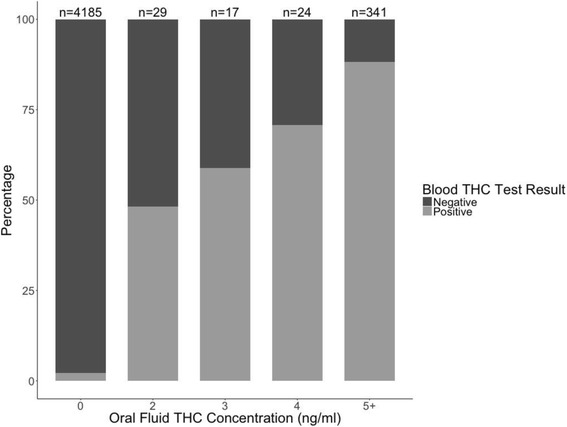
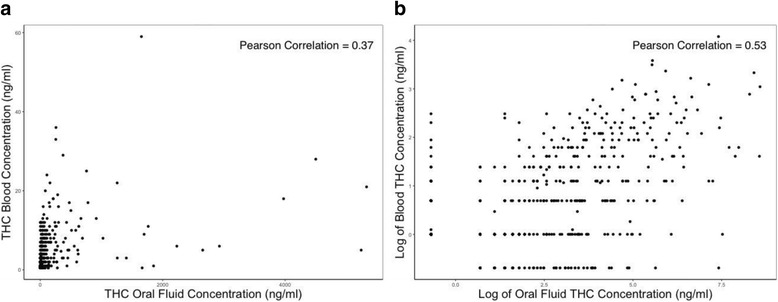
Overall, 8.9% and 9.4% of the participants tested positive for THC in oral fluid and whole blood samples, respectively. Using blood test as the reference criterion, oral fluid test for THC positivity showed a sensitivity of 79.4% (95% CI: 75.2%, 83.1%) and a specificity of 98.3% (95% CI: 97.9%, 98.7%). The log-transformed oral fluid THC concentration accounted for about 29% of the variation in the log-transformed blood THC concentration. That is, there is still 71% of the variation in the log-transformed blood THC concentration unexplained by the log-transformed oral fluid THC concentration. Back-transforming to the original scale, we estimated that each 10% increase in the oral fluid THC concentration was associated with a 2.4% (95% CI: 2.1%, 2.8%) increase in the blood THC concentration.
The oral fluid test is a highly valid method for detecting the presence of THC in the blood but cannot be used to accurately measure the blood THC concentration.
在美国,吸食大麻后驾车是一个严重的交通安全问题。δ9-四氢大麻酚(THC)是大麻中的主要活性成分。虽然血液中THC检测是衡量THC所致损害的更准确方法,但检测口腔液中的THC是一种侵入性较小且成本较低的检测方法。
我们通过敏感性和特异性分析以及逻辑回归,研究口腔液THC检测是否可作为血液THC检测的有效替代方法,并使用相关性分析和对数转换后THC浓度的线性回归,估计口腔液THC浓度与血液THC浓度之间的定量关系。我们使用了4596名驾驶员的数据,这些驾驶员参与了2013年全国驾驶员酒精和药物使用路边调查,并且有口腔液和全血样本的THC检测结果。
总体而言,分别有8.9%和9.4%的参与者口腔液和全血样本中THC检测呈阳性。以血液检测为参考标准,口腔液检测THC阳性的敏感性为79.4%(95%置信区间:75.2%,83.1%),特异性为98.3%(95%置信区间:97.9%,98.7%)。对数转换后的口腔液THC浓度约占对数转换后血液THC浓度变异的29%。也就是说,对数转换后血液THC浓度仍有71%的变异无法用对数转换后的口腔液THC浓度解释。转换回原始尺度后,我们估计口腔液THC浓度每增加10%,血液THC浓度会增加2.4%(95%置信区间:2.1%,2.8%)。
口腔液检测是检测血液中THC存在的一种高度有效的方法,但不能用于准确测量血液中THC的浓度。