Yang Fan, Guo Wenlai, Wang Qian, Zhu Zhe, Guan Congying, Zhao Shishun, Yuan Baoming
Center for Applied Statistical Research and College of Mathematics, Jilin University.
Hand & Foot Surgery and Reparative & Reconstruction Surgery Center.
Medicine (Baltimore). 2019 Jul;98(29):e16338. doi: 10.1097/MD.0000000000016338.
To systematically review the efficacy of surgical versus nonsurgical treatment for acute patellar dislocation.
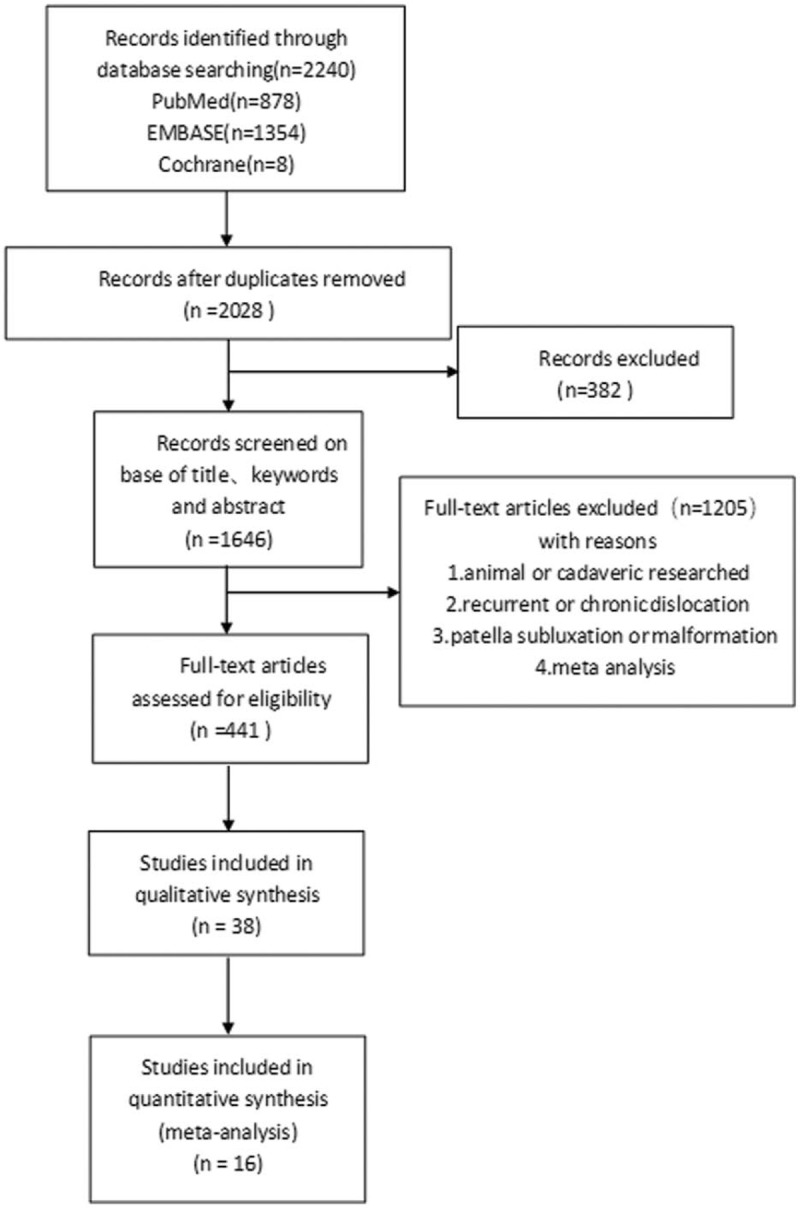
PubMed, Cochrane, and Embase were searched up to February 12, 2019. After removing duplicates, preliminary screening, and reading the full texts, we finally selected 16 articles, including 11 randomized controlled trials and 5 cohort studies. The quality of the enrolled studies was evaluated by Jadad score or Newcastle-Ottawa scale. Meta-analyses were performed using odds ratio (OR) and standardized mean difference (SMD) as effect variables. The clinical parameters assessed included mean Kujala score, rate of redislocation, incidence of patellar subluxation, patient satisfaction, and visual analog scale (VAS) for pain. Evidence levels were determined using GRADE profile.
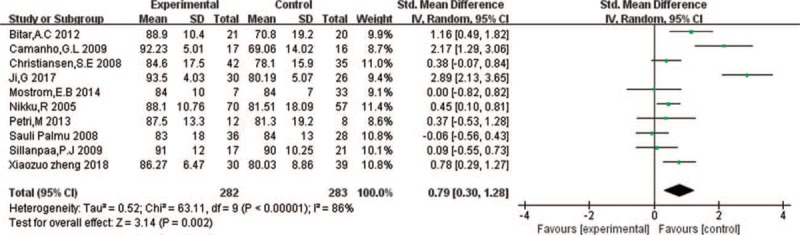
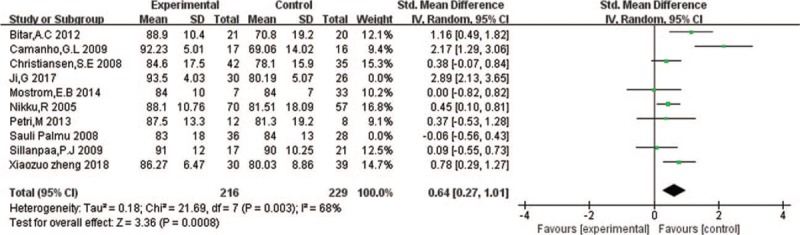
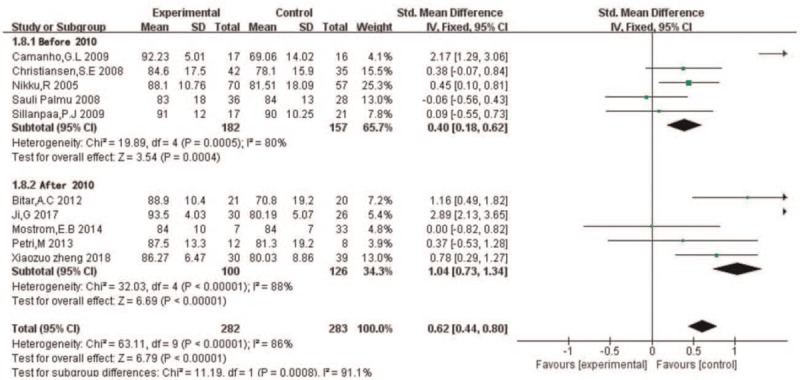
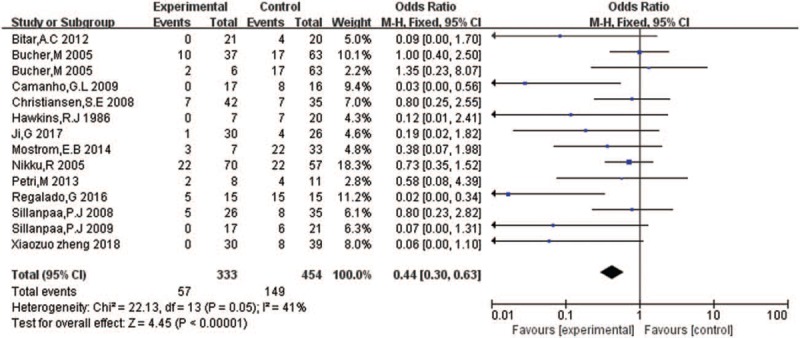
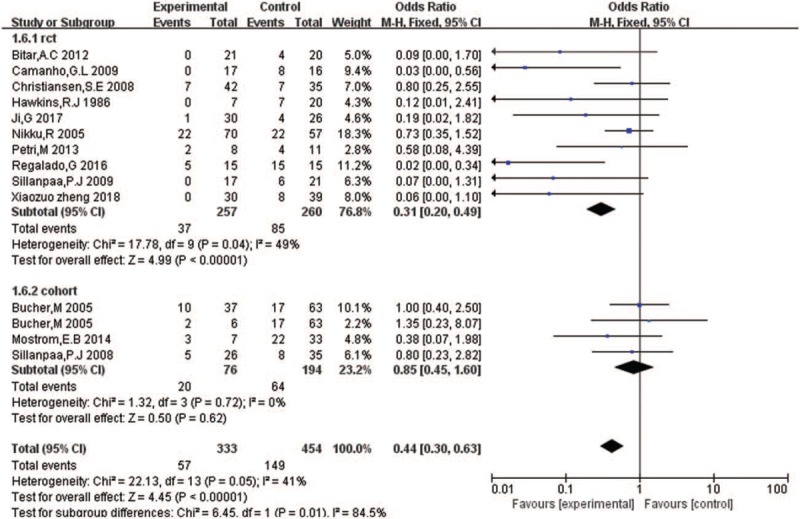
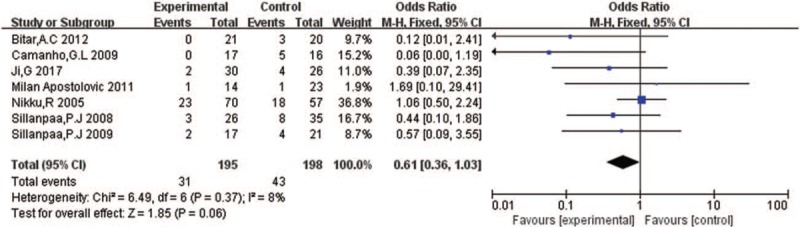
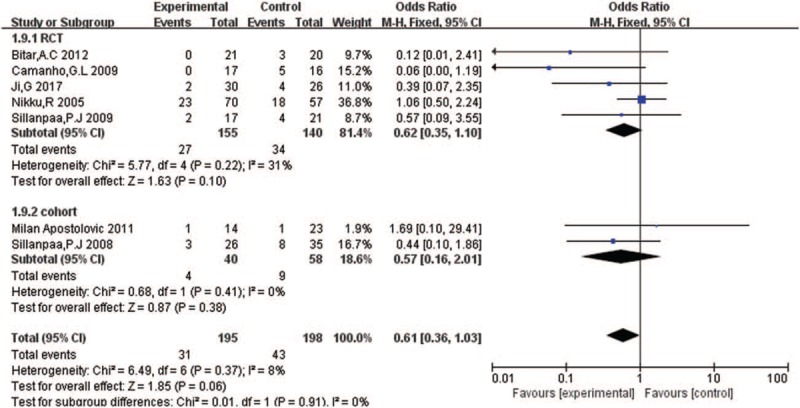
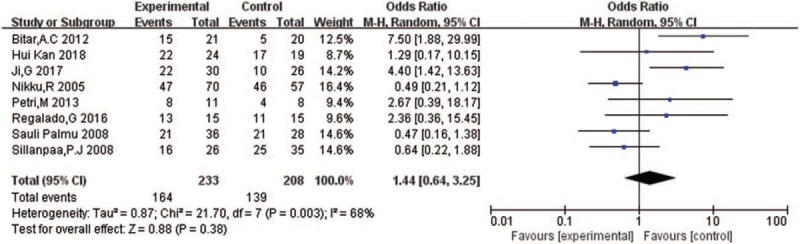
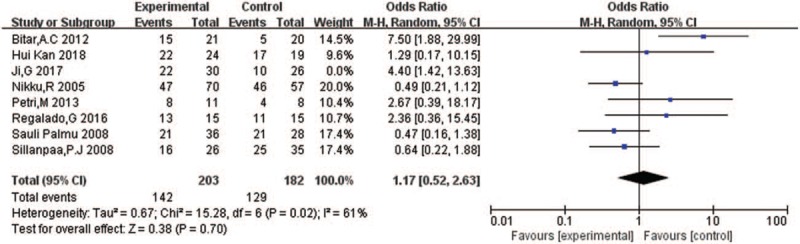
The 16 included studies involved 918 cases, 418 in the surgical group and 500 in the nonsurgical group. The results of the meta-analysis showed higher mean Kujala score (SMD = 0.79, 95% confidence interval [CI] [0.3, 1.28], P = .002) and lower rate of redislocation (OR = 0.44, 95% CI [0.3, 0.63], P < .00001) in the surgical group than the nonsurgical group, but showed insignificant differences in the incidence of patellar subluxation (OR = 0.61, 95% CI [0.36, 1.03], P = .06), satisfaction of patients (OR = 1.44, 95% CI [0.64, 3.25], P = .38), and VAS (SMD = 0.84, 95% CI [-0.36, 9.03], P = .84).
For patients with primary acute patellar dislocation, surgical treatment produces a higher mean Kujala score and a lower rate of redislocation than nonsurgical treatment.
系统评价手术治疗与非手术治疗急性髌骨脱位的疗效。
检索截至2019年2月12日的PubMed、Cochrane和Embase数据库。在去除重复文献、初步筛选及阅读全文后,最终纳入16篇文章,包括11项随机对照试验和5项队列研究。采用Jadad评分或纽卡斯尔-渥太华量表评估纳入研究的质量。使用比值比(OR)和标准化均数差(SMD)作为效应变量进行Meta分析。评估的临床参数包括平均Kujala评分、再脱位率、髌骨半脱位发生率、患者满意度以及疼痛视觉模拟量表(VAS)评分。采用GRADE概况确定证据等级。
16项纳入研究共涉及918例患者,手术组418例,非手术组500例。Meta分析结果显示,手术组的平均Kujala评分高于非手术组(SMD = 0.79,95%置信区间[CI][0.3, 1.28],P = 0.002),再脱位率低于非手术组(OR = 0.44,95% CI[0.3, 0.63],P < 0.00001),但在髌骨半脱位发生率(OR = 0.61,95% CI[0.36, 1.03],P = 0.06)、患者满意度(OR = 1.44,95% CI[0.64, 3.25],P = 0.38)和VAS评分(SMD = 0.84,95% CI[-0.36, 9.03],P = 0.84)方面差异无统计学意义。
对于原发性急性髌骨脱位患者,手术治疗比非手术治疗的平均Kujala评分更高,再脱位率更低。