Wu Kuan-Jou, Li Shu-Hao, Yeh Kuang-Ting, Chen Ing-Ho, Lee Ru-Ping, Yu Tzai-Chiu, Peng Cheng-Huan, Liu Kuan-Lin, Yao Ting-Kuo, Wang Jen-Hung, Wu Wen-Tien
School of Medicine, Tzu Chi University.
Department of Orthopedics, Hualien Tzu Chi Hospital, Buddhist Tzu Chi Medical Foundation.
Medicine (Baltimore). 2019 Jul;98(29):e16559. doi: 10.1097/MD.0000000000016559.
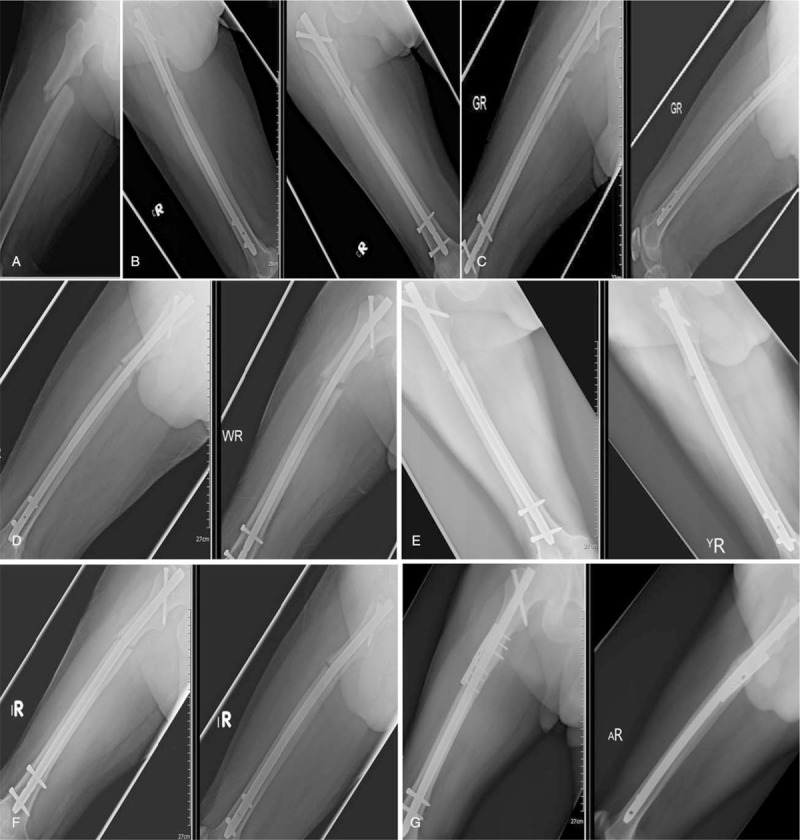
Although the optimal treatment for femur shaft fracture is intramedullary nailing fixation, nonunion still occurs. We determined the oligotrophic nonunion rate among femur fractures managed operatively and identified risk factors for reoperation. This was a retrospective clinical study. The data of the patients between 40 and 70 years old with diaphyseal femur fracture who have received reamed and interlocked intramedullary nailing fixation in our hospital from February 2014 to April 2018 were collected. They were followed at regular intervals for at least 1 year after the operation. The primary outcome was nonunion of the fracture site that required reoperation in accordance with the radiographic union scale for tibial shaft fracture (RUST), which is a reasonable score system for lower limb diaphyseal fracture. Three of them were hypertrophic nonunion (1.9%) and the other 13 cases were oligotrophic nonunion (8.6%) at postoperative 12 months follow-up. All of the postoperative plain films showed adequate reduction quality. The three hypertrophic nonunion cases were all obese male with fracture site comminution. Fracture at the proximal third junction, hypertension (HTN) and diabetes mellitus (DM) was significantly associated with oligotrophic nonunion of the fracture site from logistic regression analysis. The mean RUST score 3 months after the operation was not significantly different between the union group and nonunion group but was significantly lower 6 months after the operation in the nonunion group. In conclusion, intramedullary nailing of the femur shaft fractures was associated with a low risk of nonunion at the 1-year follow-up in the middle age group. Those with comorbidity such as obese, HTN, and DM, with fracture site at the proximal third junction or comminution should be followed up closely and rehabilitation with cause aggressively. Radiographic scale as the RUST score at postoperative 6 months could be used to predict this complication.
尽管股骨干骨折的最佳治疗方法是髓内钉固定,但骨不连仍会发生。我们确定了手术治疗的股骨骨折中骨营养不足性骨不连的发生率,并确定了再次手术的危险因素。这是一项回顾性临床研究。收集了2014年2月至2018年4月在我院接受扩髓带锁髓内钉固定的40至70岁股骨干骨折患者的数据。术后定期随访至少1年。主要结局是根据胫骨干骨折影像学愈合量表(RUST)判定需要再次手术的骨折部位骨不连,这是一种适用于下肢骨干骨折的合理评分系统。术后12个月随访时,其中3例为肥大性骨不连(1.9%),另外13例为骨营养不足性骨不连(8.6%)。所有术后平片显示复位质量良好。3例肥大性骨不连病例均为肥胖男性,骨折部位粉碎。经逻辑回归分析,近端三分之一交界处骨折、高血压(HTN)和糖尿病(DM)与骨折部位骨营养不足性骨不连显著相关。术后3个月联合组和骨不连组的平均RUST评分无显著差异,但术后6个月骨不连组的平均RUST评分显著更低。总之,在中年组中,股骨干骨折髓内钉固定在1年随访时骨不连风险较低。对于合并肥胖、HTN和DM等疾病、骨折部位在近端三分之一交界处或粉碎的患者,应密切随访并积极进行有针对性的康复治疗。术后6个月的RUST评分等影像学量表可用于预测这种并发症。